
Generative AI can draft an email, create an image, summarize a report or suggest computer code in seconds. That fluency can make the system appear to understand a subject exactly as a person does. In reality, it is a prediction system trained to produce new patterns from patterns found in data.
Understanding the basic mechanism matters because the same qualities that make generative AI useful also create its most important limits. A model can be creative without being accurate, confident without having evidence, and helpful without knowing whether its answer is safe for a particular situation.
Quick answer: Generative AI is software that learns statistical patterns from large collections of examples and uses those patterns to create new text, images, audio, video or code. Most modern systems convert an instruction into small units, predict or generate the next useful units, and repeat the process. Their output can be impressive, but it is not automatically factual, original, private or unbiased.
Generative AI at a glance
| Part | What happens | What the user sees |
|---|---|---|
| Training | The model adjusts many internal parameters while learning patterns from examples | No direct interaction |
| Prompt | An instruction and any supplied context are converted into machine-readable units | A question, request, image or file |
| Generation | The model repeatedly predicts a suitable next unit or transforms noise into a structured result | Text, images, audio, video or code |
| Evaluation | People or automated systems test quality, safety and usefulness | Warnings, revisions or a final answer |
The NIST Generative AI Profile treats these systems as a distinct risk-management challenge because they can produce convincing synthetic content at scale. That does not make every use dangerous. It means the result should be judged according to what it will be used for.
How is generative AI different from older software?
Traditional software follows rules written by programmers. A calculator uses explicit mathematical operations. A database returns stored records that match a query. A generative model is different: developers design the learning process, but the model discovers an enormous web of statistical relationships during training.
Predictive AI is not new. Spam filters, speech recognition and recommendation systems have long estimated categories or probabilities. The newer generative systems are designed to construct rich outputs rather than only classify an input. They can combine learned structures in ways that were not stored as one finished item.
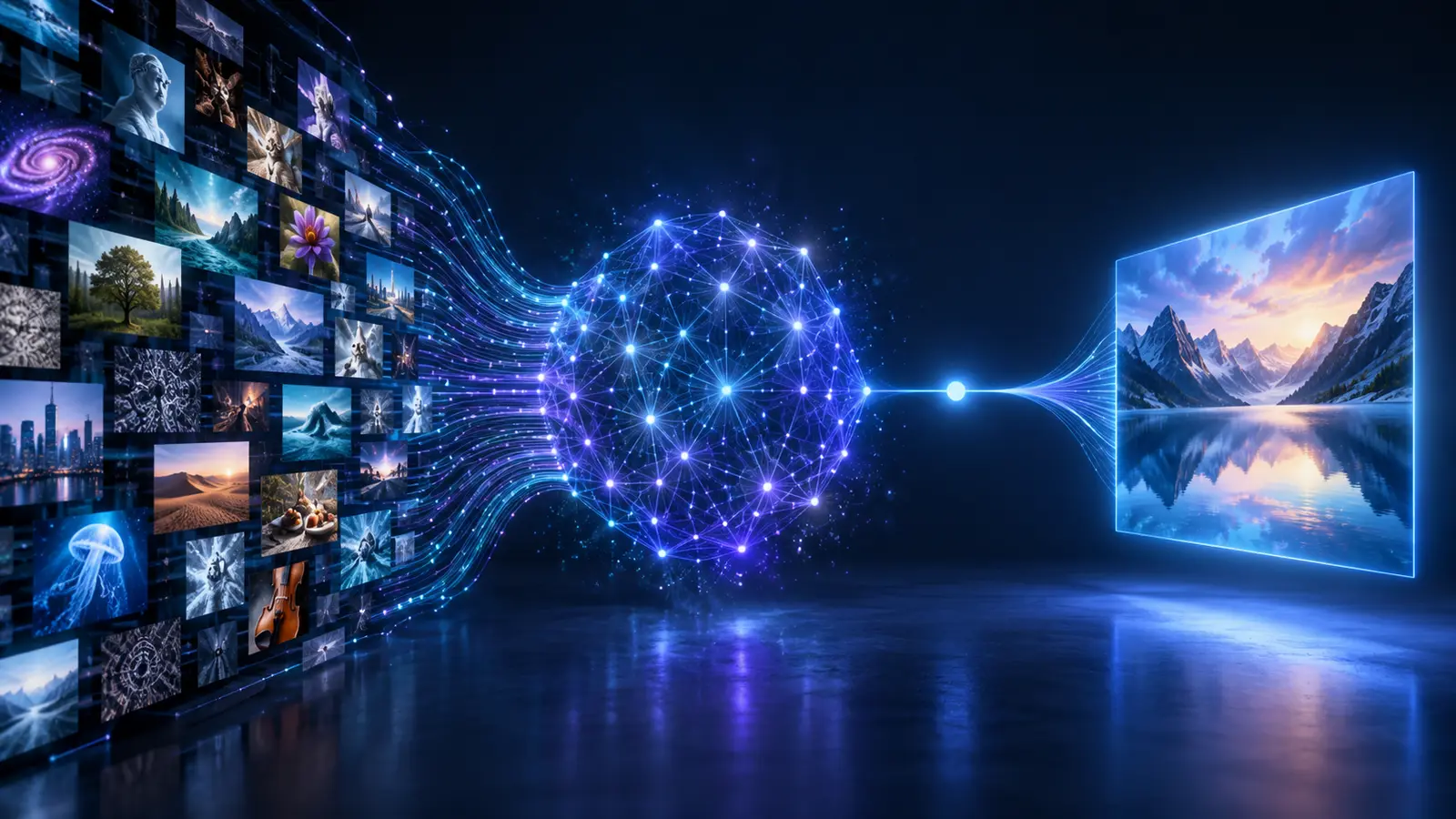
This is why “copying from a database” is an incomplete description. A language model normally generates a response token by token. An image model may begin with noise and repeatedly refine it toward a pattern that matches the prompt. However, learned material can still be reproduced or closely imitated, so questions about training data, copyright and attribution remain important.
How a language model learns patterns
During training, text is divided into tokens. A token may be a whole word, part of a word, punctuation or another small unit. The model sees sequences and learns to predict missing or next tokens. Each error causes tiny adjustments to numerical parameters inside a neural network. Repeating this process across a vast collection of examples gradually creates a model of relationships among words, concepts, styles and structures.
The influential Transformer paper introduced an attention-based architecture that lets a model weigh relationships among different parts of a sequence. Modern systems extend that idea with much larger models, more data, refined training objectives, human feedback and additional safety techniques.
Training does not produce a neat library in which every sentence has an address. It produces parameter values that influence future predictions. The model can generalize from patterns, but it does not guarantee a faithful memory of sources. Asking it to provide a citation may lead to a real reference, an irrelevant one or a plausible-looking invention.
What happens after you enter a prompt?
- The system prepares the input. It combines the user’s instruction with system rules, conversation history and any allowed files or tools.
- The input becomes tokens or another numerical representation. The model processes relationships among those units.
- The model calculates probabilities. For text, it estimates which token could come next. Settings can make selection more conservative or more varied.
- Generation repeats. Each selected token becomes part of the context for the next prediction.
- Additional systems may intervene. Safety filters, retrieval tools, calculators or search systems can check or enrich the answer.
The response is therefore created during the interaction. The model is not looking up a prewritten answer in most ordinary cases. It is also not proving every statement before displaying it. Fluent generation and factual verification are separate processes.
Why can the same prompt produce different answers?
Many possible continuations can be reasonable. A system may sample among them rather than always selecting the single highest-probability option. Small differences in wording, hidden instructions, model version, conversation history or random selection can change the result.
Variation is valuable for brainstorming and creative work. It is less desirable when an exact answer is required. In those cases, use a calculator, database or authoritative source, and ask the model to show its assumptions. Repeating a prompt is not the same as independently verifying the answer because each response may rely on the same mistaken pattern.
How image generators work
Many image systems use diffusion. During training, the system learns how images change as noise is added and how to reverse that process. At generation time it begins with a field of noise and progressively shapes it into an image that corresponds to the prompt. Text and images are represented in related numerical spaces so the model can connect phrases such as “soft morning light” with visual features.
This is a simplified description; different products combine architectures and editing methods. The important point is that the image is synthesized rather than retrieved as one complete photograph. That still does not guarantee novelty. A generated picture may reflect stereotypes in training data, imitate familiar artistic conventions or create misleading realism.
What are multimodal and retrieval-augmented systems?
A multimodal model can process more than one type of information, such as text, images and audio. It may describe a photograph, answer questions about a chart or produce an image from text. The model does not necessarily perceive the world as a person does; it maps patterns across different representations.
Retrieval-augmented generation adds a search step. The system retrieves documents from a chosen collection and supplies relevant passages to the model before it answers. This can improve currency and traceability, especially when the collection is controlled. It does not eliminate errors: retrieval can miss a document, select a weak passage or be interpreted incorrectly.
Tool use goes further. A model can send a calculation to a calculator, query a database or search the web. The answer may then be better grounded, but users should still distinguish what the source says from what the model inferred.
Why does generative AI sometimes invent facts?
A language model is optimized to produce a likely and useful continuation, not to maintain an internal ledger in which every sentence is marked true or false. When information is missing, ambiguous or uncommon, the system may fill the gap with a pattern that sounds right. This behavior is often called a hallucination.
False details can include dates, quotations, court cases, medical claims, product specifications and references. Confidence in the wording is not evidence. The risk rises when the prompt demands an answer even if the model lacks reliable information.
NIST’s AI Risk Management Framework emphasizes measuring and managing risks in context. A harmless invented detail in a fictional story is different from an invented dosage, legal deadline or financial figure.
How to use generative AI responsibly
- Use it for the right job. Drafting, outlining and transforming supplied material are often lower-risk than asking for unknown facts.
- Provide context. State the audience, purpose, limits and preferred format.
- Protect sensitive information. Do not paste confidential records, passwords, private identifiers or unpublished business data unless the service is approved for that use.
- Ask for uncertainty. Request assumptions, missing information and points that need checking.
- Verify important claims. Open the original source and confirm that it supports the statement.
- Keep a person accountable. A human should make consequential decisions and review work released under an organization’s name.
UNESCO’s guidance for education and research stresses a human-centred approach, data privacy and age-appropriate use. The OECD’s AI Principles similarly focus on human rights, transparency, robustness and accountability.
Privacy, copyright and bias
Privacy
A prompt can be transmitted to a service and may be stored according to its settings and policy. Removing a person’s name may not fully anonymize a detailed record. Before using workplace, medical, school or customer information, check the organization’s rules and the provider’s current data controls.
Copyright and attribution
Laws and court decisions vary by country and continue to develop. A model’s output should not be assumed to be copyright-free, exclusively yours or safe to publish. The U.S. Copyright Office AI initiative illustrates the ongoing work around digital replicas, copyrightability and training.
Bias
Training examples reflect unequal representation and human prejudice. Evaluation and safeguards can reduce some problems but not remove every one. Check whether a result generalizes from one culture, treats a group as a stereotype or excludes people whose experiences were less visible in the data.
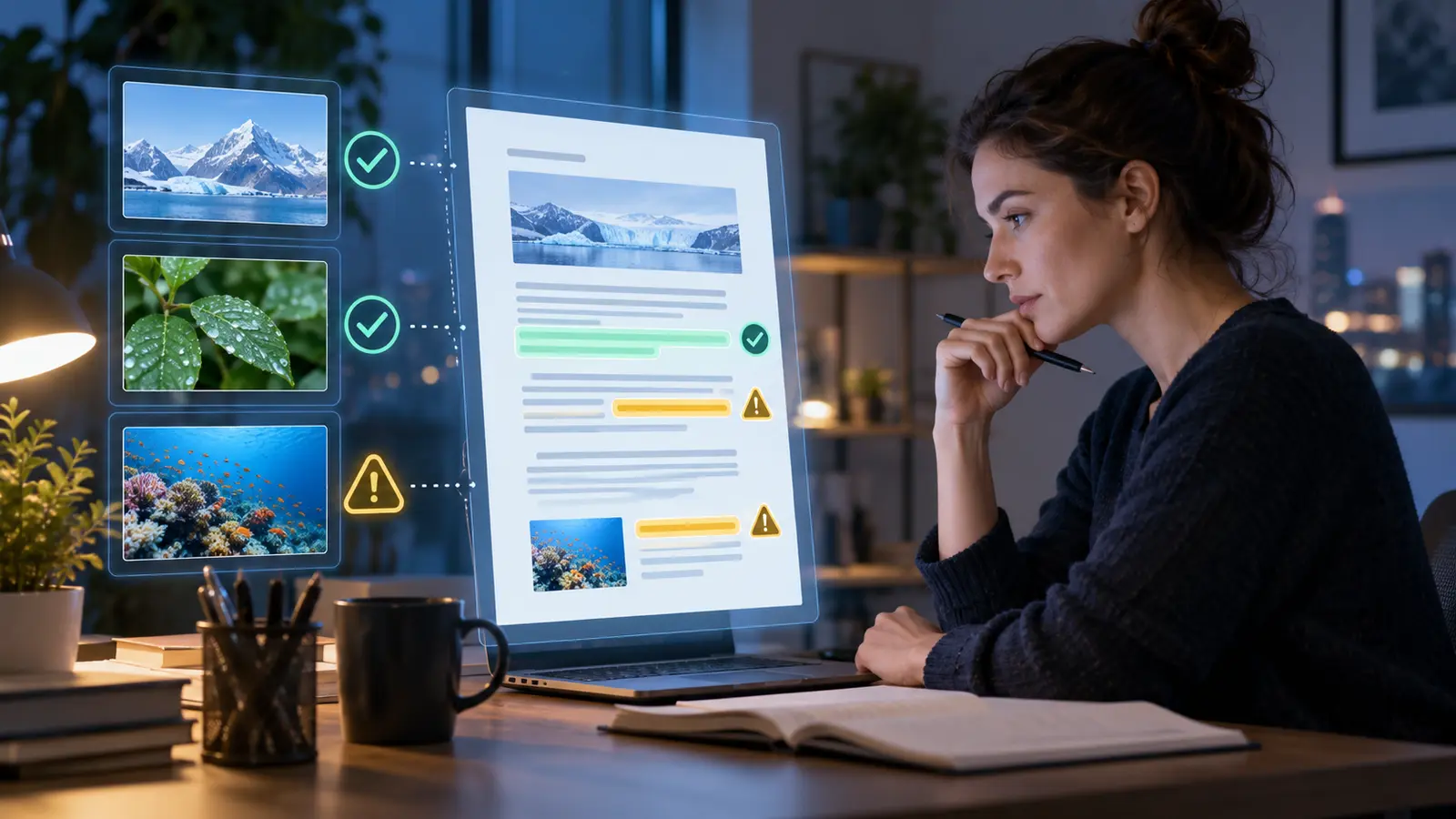
How to check an AI-generated answer
- Separate factual claims from suggestions and creative language.
- Identify which facts would cause harm if wrong.
- Find the original document, official database or recognized expert source.
- Check dates, because rules and product details change.
- Recalculate quantities independently.
- Confirm that quotations appear in the named source.
- Rewrite the result in your own voice and disclose AI assistance when required.
For images, inspect hands, reflections, shadows, signs and background details, but do not rely on visual oddities alone. High-quality synthetic media can look natural, while genuine images can look strange after compression. Provenance, original publication context and corroborating evidence are stronger checks.
What generative AI is good at—and what it is not
| Often useful | Needs strong checking | Poor basis for automation alone |
|---|---|---|
| Brainstorming, outlines, summaries of supplied text | Research synthesis, technical explanations, translation | Medical diagnosis or treatment |
| Drafting routine messages and variations | Current events, legal or tax information | Hiring, lending or policing decisions |
| Explaining code and suggesting tests | Production code and security advice | Any decision requiring personal accountability |
The European Union’s AI Act overview shows how regulators are applying different obligations according to risk. Even outside the EU, the basic lesson is useful: the higher the stakes, the stronger the evidence, oversight and documentation should be.
Frequently asked questions
Does generative AI understand what it writes?
It represents complex relationships and can perform tasks that look like understanding. Whether that counts as human-like understanding is a philosophical and scientific question. Practically, it should not be treated as conscious, truthful or accountable.
Is generative AI the same as a search engine?
No. A search engine retrieves and ranks existing pages. A generative model constructs a response. Some products combine both, so check whether the answer cites retrieved sources.
Can AI-generated content be detected reliably?
Not in every case. Detection tools can produce false positives and false negatives, especially after editing or translation. Process records and provenance are more dependable than a single detector score.
Does a model learn from every conversation immediately?
Usually not in the sense of changing its core model after each chat. Providers may use conversations for product improvement depending on service, account and settings. Read the current policy rather than assuming.
Will better prompts prevent hallucinations?
Clear prompts can reduce ambiguity and encourage caution, but they cannot guarantee truth. Verification remains necessary.
Final summary
Generative AI learns patterns from examples and uses them to create new content. Its speed and flexibility make it valuable for drafts, explanations and creative exploration. Its statistical nature also means that fluency is not proof, citations can be wrong, and sensitive information requires care.
The most productive approach is neither blind trust nor blanket rejection. Give the system a defined role, keep private data out, verify consequential claims and make a person responsible for the final decision. SOAKJAM’s practical guide to media literacy provides a repeatable process for checking generated claims and sources. Used that way, generative AI becomes a capable assistant rather than an unquestioned authority.
Transparency
Sources & references
- NIST — Artificial Intelligence Risk Management Framework
- NIST — Generative Artificial Intelligence Profile (NIST AI 600-1)
- Vaswani et al. — Attention Is All You Need
- UNESCO — Guidance for Generative AI in Education and Research
- OECD — OECD AI Principles
- U.S. Copyright Office — Copyright and Artificial Intelligence
- European Commission — AI Act overview
- ISO — Artificial intelligence management systems overview
Editorially reviewed
Editorial information
SOAKJAM articles are designed for clarity, useful context and transparent sourcing. Important facts should be checked against the linked primary sources.
Found an error, outdated detail or a useful source we should consider?