
How do batteries store and release energy? A battery stores chemical potential energy and releases it as electrical energy when a circuit is connected.
Rechargeable batteries reverse much of that process during charging. An external power source drives electrons and ions back toward a higher-energy arrangement. The details differ among lithium-ion, lead-acid, nickel-metal hydride and other chemistries, but the same broad structure appears again and again.
Quick answer: A battery cell has two electrodes separated by an electrolyte. Chemical reactions move ions inside the cell and electrons through the external circuit. That electron flow powers a device. Charging a rechargeable cell uses outside energy to drive the reactions in the opposite direction. A battery pack combines cells with electrical connections, sensors and protective controls.
Battery parts at a glance
| Part | What it does |
|---|---|
| Anode | Electrode where oxidation releases electrons during discharge |
| Cathode | Electrode where reduction accepts electrons during discharge |
| Electrolyte | Conducts ions between electrodes |
| Separator | Keeps electrodes from touching while allowing ion movement |
| External circuit | Path through which electrons power a load |
| Battery-management system | Monitors and protects many rechargeable packs |
How Do Batteries Store and Release Energy?
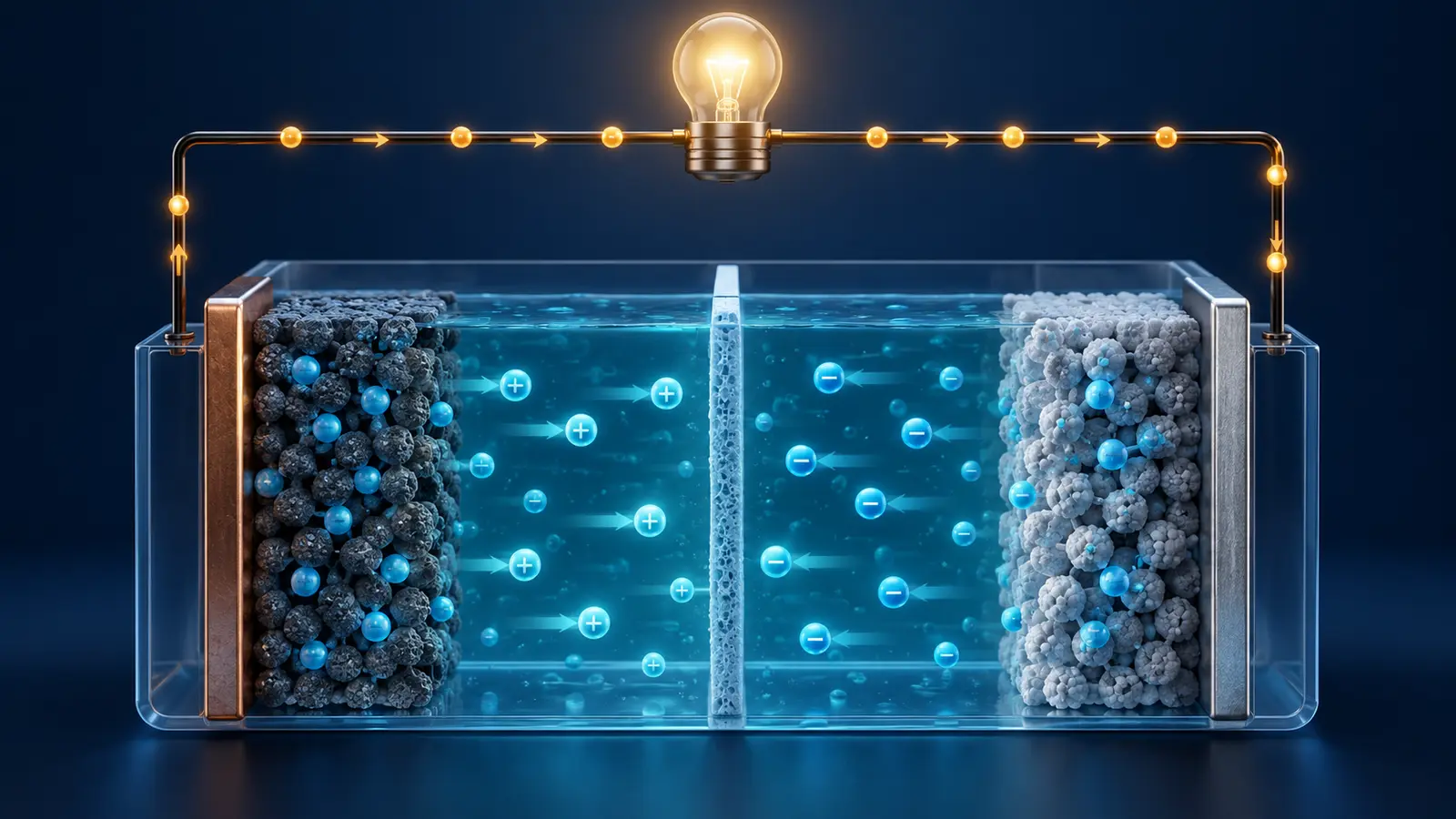
Atoms can lose or gain electrons through chemical reactions. During discharge, oxidation at one electrode releases electrons. Reduction at the other electrode accepts them. The electrolyte allows charged ions to move internally so charge does not build up and stop the reaction.
The separator is electrically insulating. If the electrodes touched directly, electrons could take a short path inside the cell, releasing energy as heat rather than doing useful work. The separator must therefore be thin enough for ion transport yet strong and stable enough to prevent internal contact.
The U.S. Department of Energy’s lithium-ion battery explainer describes lithium ions moving through the electrolyte while electrons travel through the external circuit. The precise electrode materials determine voltage, capacity, lifetime, cost and safety behavior.
To understand how batteries store and release energy, it helps to follow the movement of electrons and ions separately.
Why electrons take the long way around
The electrolyte conducts ions but not free electrons efficiently. Electrons therefore move through the connected wire and device. As they pass through the load, their energy can become light, motion, sound, computation or heat.
Voltage describes electric potential difference—the push available per unit charge. Current describes the rate of charge flow. Power is voltage multiplied by current. A battery’s stored energy is commonly expressed in watt-hours: a one-watt load operating ideally for one hour uses one watt-hour.
Real batteries have internal resistance. Some energy becomes heat, terminal voltage changes with load and temperature, and usable capacity depends on discharge rate and cutoff settings. A label is therefore not a promise that every device can extract every stated watt-hour.
What charging reverses
A charger supplies a controlled voltage and current. It pushes electrons toward the electrode from which they left and drives ions through the electrolyte, rebuilding the higher-energy chemical arrangement. The battery now contains more chemical potential energy.
The process is not perfectly reversible. Side reactions, structural changes and heat gradually reduce capacity or increase resistance. Fast charging can be convenient but creates more demanding thermal and electrochemical conditions. Good systems adjust current according to temperature, voltage and state of charge.
Cell, module and pack
A cell is the basic electrochemical unit. Cells can be connected in series to raise voltage and in parallel to increase current capability and capacity. A module groups several cells, and a pack combines modules, structure, cooling, fuses, contactors and electronics.
A battery-management system estimates state of charge, measures temperatures and voltages, balances cells and disconnects the pack when conditions become unsafe. Estimation is difficult because charge cannot be observed directly; software combines electrical measurements with a model of the cell.
How common battery types differ
| Chemistry | Common uses | General characteristics |
|---|---|---|
| Alkaline | Remote controls, toys, clocks | Widely available primary cell; normally not rechargeable |
| Lead-acid | Vehicle starting, backup power | Low cost, high surge current, heavy |
| Nickel-metal hydride | Rechargeable household cells, hybrid vehicles | Robust, rechargeable, lower energy density than many lithium-ion designs |
| Lithium-ion | Phones, laptops, tools, EVs, grid storage | High energy density; many sub-chemistries and strict control needs |
| Sodium-ion | Emerging stationary and mobility uses | Uses abundant sodium; performance and commercialization continue to develop |
“Lithium-ion” is a family, not one recipe. Lithium iron phosphate, nickel manganese cobalt and other cathodes trade energy density, power, cost, life and material needs differently. Avoid declaring one chemistry universally best without defining the job.
Capacity, energy and power
Ampere-hours describe electric charge capacity at a stated voltage. Watt-hours describe energy and are more useful when comparing batteries with different voltages. A nominal 12-volt, 10-ampere-hour battery contains roughly 120 watt-hours in a simple estimate, but actual usable energy depends on voltage curve, discharge conditions and protection limits.
Energy density measures how much energy fits in a mass or volume. Power density measures how quickly energy can be delivered. A cell optimized for long runtime may not deliver the highest burst current, while a power cell may sacrifice capacity.
Why batteries degrade
- Calendar aging: chemical changes occur even when the battery is unused.
- Cycle aging: charging and discharging gradually change electrodes and interfaces.
- High temperature: often accelerates unwanted reactions.
- Very high or low charge: long periods at extremes can stress some chemistries.
- Fast charging and high current: can add heat and reaction gradients.
- Deep discharge: can damage cells when protective limits are ignored.
Device software may stop at displayed zero before the cell is chemically empty and may reserve capacity near displayed 100 percent. These buffers protect the battery. Follow manufacturer guidance rather than trying to bypass charging controls.
Battery safety
Stored energy can be released quickly if a cell is crushed, punctured, overheated, improperly charged or internally damaged. In a lithium-ion cell, severe failure can trigger self-heating called thermal runaway. Heat may spread to neighboring cells if a pack lacks effective barriers and cooling.
Use the correct charger, keep vents clear, stop using swollen or damaged devices and do not carry loose cells where metal objects can bridge their terminals. The U.S. Department of Transportation publishes travel rules for batteries; airlines and countries may add requirements.
If a device is smoking, hissing, unusually hot or emitting an odor, move away and call local emergency services. Do not handle a failing large pack without training. Fire-response advice varies with size, location and chemistry.
Batteries and renewable electricity
Solar and wind production changes with weather and time. Batteries can store electricity when supply is abundant and return it later. They respond quickly, which can help balance short-term changes and support grid frequency.
Storage is not a source of energy; charging loses some energy and the battery has a finite duration. Long periods with little wind or sun may require transmission, flexible demand, other storage or generation. See SOAKJAM’s guides to solar panels and the power grid for the wider system.
The International Energy Agency’s Batteries and Secure Energy Transitions examines the rapid growth of storage in transport and power systems and the need for resilient supply chains.
Materials, second life and recycling
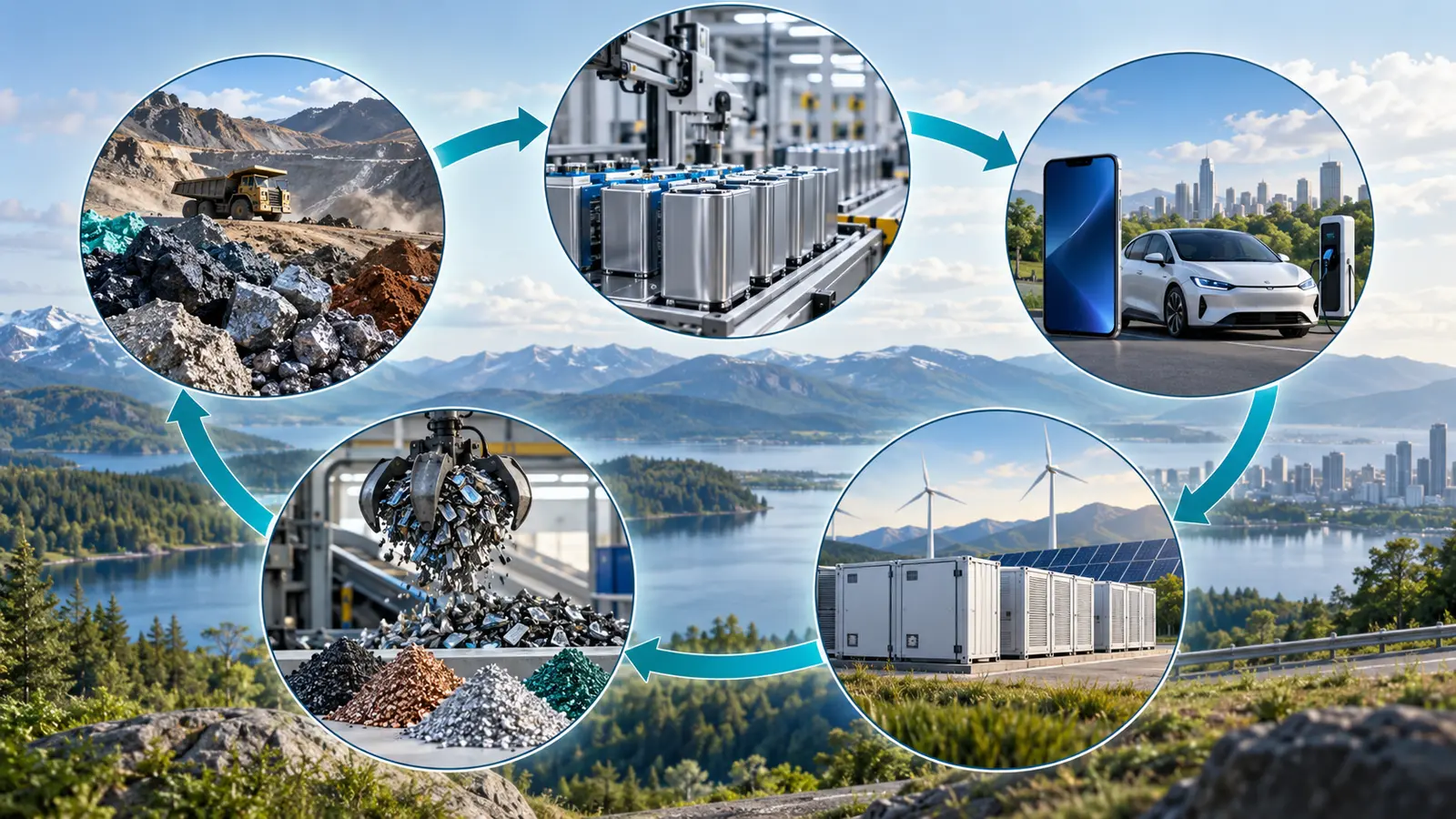
Battery production uses mined and processed materials, energy, water and manufacturing infrastructure. Impacts depend on chemistry and source. Improving traceability, material efficiency and working conditions matters alongside performance.
An electric-vehicle pack that no longer meets driving requirements may retain enough capacity for less demanding stationary use, but testing, safety certification and economics determine whether second life is sensible. Reuse delays recycling; it does not remove the need for it.
Recycling can recover metals and reduce demand for newly mined material. Collection is essential because discarded batteries can start fires in waste facilities. The U.S. Environmental Protection Agency advises consumers to use appropriate lithium-ion battery collection, not household trash or curbside recycling bins unless the local program explicitly accepts them.
How to make a rechargeable battery last
- Avoid leaving devices in hot cars or direct sun.
- Use certified chargers and intact cables with the correct specifications.
- Enable optimized or adaptive charging when available.
- For long storage, follow the manufacturer’s recommended partial charge and temperature.
- Do not puncture, bend or compress a battery.
- Replace swollen packs through a qualified service channel.
Rechargeable batteries demonstrate how batteries store and release energy through reactions that can be reversed many times.
Advice for one chemistry should not be blindly applied to another. A lead-acid backup battery, lithium-ion phone and lithium iron phosphate storage system have different charging controls.
Frequently asked questions
Does a battery store electrons?
A charged battery stores energy in a chemical arrangement and charge separation. Electrons move through the circuit during use; describing them as liquid stored in a tank is misleading.
Why does a cold battery seem weaker?
Low temperature slows reactions and increases resistance, reducing available power and capacity. Performance often recovers when the cell warms safely.
Why does a battery get warm while charging?
Internal resistance and electrochemical processes produce heat. Mild warmth can be normal; unusual heat, swelling or odor is a warning.
Can every battery be recharged?
No. Primary cells are not designed for reversal and may leak or fail if charged. Recharge only cells and packs explicitly designed for it.
What is a battery cycle?
One equivalent full cycle is cumulative discharge totaling 100 percent of capacity, not necessarily one plug-in event. Two 50-percent discharges can equal roughly one cycle.
Final summary
A battery converts chemical potential energy into electrical energy by moving ions internally and electrons through an external circuit. Charging a rechargeable cell drives much of that process backward. Voltage, capacity, power, temperature and control systems determine how the stored energy can be used.
Modern batteries make portable electronics, electric transport and renewable-energy storage possible. Their value comes with responsibilities: use the right charger, protect cells from heat and damage, and return spent batteries through an approved collection system.
Transparency
Sources & references
- U.S. Department of Energy — How lithium-ion batteries work
- Argonne National Laboratory — Battery science
- IEA — Batteries and Secure Energy Transitions
- U.S. EPA — Used lithium-ion batteries
- PHMSA — Traveling safely with batteries
- NREL — Battery storage
- U.S. DOE — Energy Storage Safety Strategic Plan
- European Commission JRC — Raw materials and batteries
Editorially reviewed
Editorial information
SOAKJAM articles are designed for clarity, useful context and transparent sourcing. Important facts should be checked against the linked primary sources.
Found an error, outdated detail or a useful source we should consider?