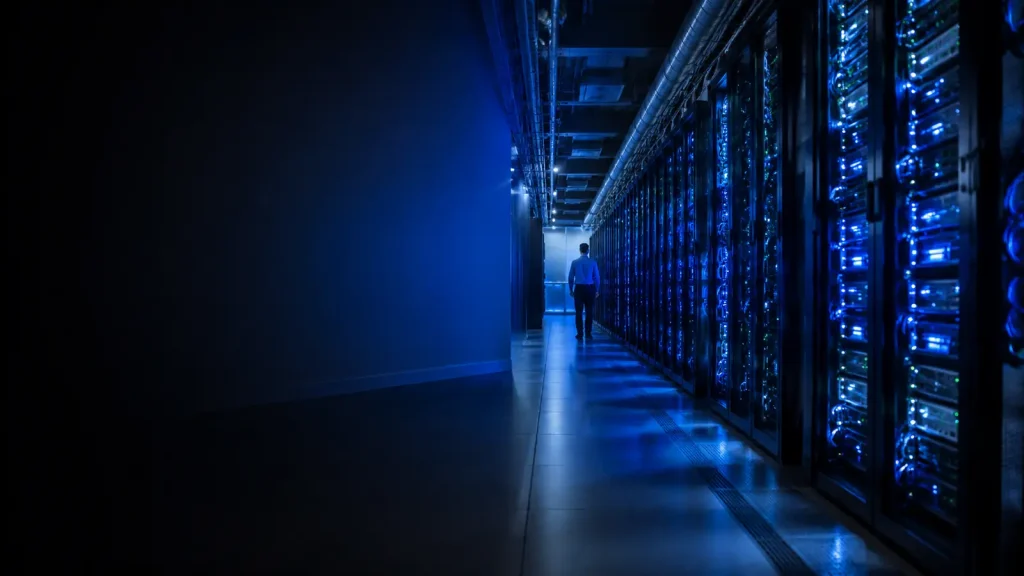

AI electricity and water use has become a serious infrastructure question as generative tools move from occasional experiments into search, office software, coding, images, video and automated agents. An answer may appear instantly on a phone, but the work often happens inside a distant data centre filled with specialised chips. Those chips draw electricity, release heat and depend on cooling systems. Some cooling systems consume water directly, while electricity production can create a much larger indirect water footprint.
The numbers are growing, but viral claims about the footprint of one prompt are often too certain. A short text request, a long reasoning task and an AI-generated video do not require the same amount of computation. Hardware, model design, data-centre efficiency, climate, cooling and the local power grid also change the result. This guide explains where the resources go, what reliable 2026 estimates show and which improvements can reduce demand.
Quick answer: AI uses electricity mainly for processors, memory, data movement and cooling. Water may be consumed on site to remove heat, at power plants that generate electricity, and during chip manufacturing. The International Energy Agency expects total global data-centre electricity consumption—not AI alone—to rise from about 485 terawatt-hours in 2025 to around 950 TWh in 2030. Better chips and software can lower the resources needed for each task, but total AI electricity and water use can still rise when demand grows faster than efficiency improves.
Where does AI electricity and water use happen?
A generative-AI service usually runs in a data centre rather than entirely on the user’s device. When someone submits a prompt, the request travels through internet networks to servers that load a model, perform calculations and return the result. Our guide to how generative AI works explains the model process; the physical side begins with racks of computing equipment.
Electricity reaches the facility through substations, transformers, switchgear and backup systems. It powers accelerators such as graphics processing units, conventional processors, memory, storage and high-speed networking. Almost all of that electrical energy eventually becomes heat. Fans, pumps, chillers, cooling towers or liquid loops must move the heat away so the equipment stays within safe temperatures.
Water can enter the chain in three places. First, evaporative cooling may consume water at the data centre. Second, power stations may consume water while producing the facility’s electricity. Third, semiconductor factories use highly purified water when making chips. A study that counts only on-site cooling will therefore produce a different result from one that includes electricity and hardware manufacturing.
Why AI calculations require so much electricity
Modern AI models contain large collections of numerical parameters. Running them involves repeated matrix operations: many multiplications and additions performed in parallel. Accelerators are efficient at this work, but a server may contain several power-hungry chips and large banks of high-bandwidth memory. Moving data between processors and memory also uses energy, as do the switches that connect thousands of devices into one computing system.
AI raises data-centre power density as well as total demand. The IEA reported in 2026 that the power density of AI servers increased elevenfold between 2020 and 2025 and could rise another fourfold by 2027. A single advanced rack could then have peak demand comparable with 65 households. That comparison describes power at one moment, not annual household electricity, but it shows why ordinary air cooling can become difficult.
A data centre also loses some energy while converting and distributing electricity. Uninterruptible power supplies keep equipment stable during disturbances, and backup systems provide resilience. Lighting and security use relatively little, while cooling can be significant. Engineers summarize facility overhead with power usage effectiveness, or PUE:
PUE = total facility electricity ÷ IT-equipment electricity
A PUE of 1.20 means that every unit used by servers is accompanied by 0.20 units for cooling, power conversion and other facility systems. Lower is generally better, but PUE says nothing about the carbon intensity of electricity, the usefulness of the computation or the amount of water consumed.

Training and inference are different workloads
Training adjusts a model’s parameters by processing examples repeatedly. A frontier training run can occupy a large cluster for weeks or months. Inference is the work performed after training, when the model answers a question, classifies an image or generates content. One inference can be much smaller than a training run, but a widely used service may handle millions of requests.
| Stage | Main activity | What changes resource demand |
|---|---|---|
| Model training | Learning parameters from large datasets | Model size, training method, chip count, run time and failed experiments |
| Fine-tuning | Adapting an existing model to a narrower task | Dataset size, method, model size and number of repeated runs |
| Inference | Producing answers, images, audio or video | Users, input and output length, media type, model choice and batching |
| Supporting systems | Storing data, searching indexes and moving results | Storage, networking, redundancy and retention |
It is misleading to say training always dominates. For a new, rarely used model, training may be the largest component. For a popular service that runs continuously, cumulative inference can become larger. Berkeley Lab’s 2024 U.S. model estimated that inference accounted for nearly 60% of AI-server energy in 2023, but projected training could reach roughly half by 2028 as more powerful accelerators were allocated to it. The balance is not universal and will change with technology and demand.
How large is the electricity demand in 2026?
The best global figures usually cover all data centres because AI workloads share facilities with cloud storage, websites, business systems, streaming and other services. They should not be reported as “AI electricity” without that qualification.
The IEA’s 2026 analysis estimates that data centres used about 485 TWh worldwide in 2025. Its central projection reaches about 950 TWh in 2030—around 3% of global electricity demand. Electricity consumption in AI-focused facilities is projected to triple over that period, faster than data-centre demand as a whole. The outlook is uncertain because chip supply, grid connections, financing, model efficiency and adoption can all change.
For AI electricity and water use, installed capacity and actual consumption are also different. A proposed facility’s maximum power connection does not reveal how fully its servers will run, and an announcement does not guarantee construction. Measured consumption, realistic utilization and transparent forecasts are more useful than adding every proposed project at its headline capacity.
National effects can be much larger than the global percentage. A June 2026 Berkeley Lab update estimates a U.S. reference case of 649 TWh in 2030, equal to about 11.8% of national electricity. Its combined uncertainty scenarios range from 521 to 843 TWh, or roughly 9.5% to 15.3%. These are scenarios, not a guarantee.
The global and U.S. estimates cannot be added or compared as though they used the same boundary. They cover different geographies, years and modelling assumptions. Their shared message is that data-centre demand is growing quickly enough to affect grid planning. Our article on how electricity reaches homes explains why new generation alone is not enough; substations, transformers and transmission also need capacity.
Why AI uses water even when no water touches the chips
Servers generate concentrated heat. In a liquid-cooled rack, coolant may circulate through sealed pipes and cold plates without being consumed. That closed loop then transfers heat to another system. If a cooling tower rejects the heat by evaporating water, some water leaves as vapour and must be replaced. Air-cooled or dry-cooling systems can reduce direct consumption, but may require more electricity or perform less efficiently during hot weather.
Power generation creates an indirect footprint. Many thermal power plants use water for cooling; reservoirs can also lose water through evaporation. The result depends strongly on the electricity mix and location. Solar photovoltaic panels and wind turbines generally have low operational water consumption, while individual thermal plants vary by technology and cooling method.
Berkeley Lab estimated that U.S. data centres consumed about 66 billion litres directly in 2023 and were associated with nearly 800 billion litres of indirect water consumption through electricity. Those totals cover U.S. data centres, not AI alone, and the indirect estimate assumes regional grid mixes where facility-level supply details were unavailable. They illustrate why AI electricity and water use must be studied as a connected system rather than only at the building fence.
Water withdrawal and water consumption are not identical
Withdrawal means taking water from a river, lake, aquifer or utility. Much of it may be treated and returned. Consumption is the portion not immediately returned to the same local water cycle, commonly because it evaporates. Reports may use one measure, the other or both. They may also combine freshwater with reclaimed or non-potable water.
Timing and place matter as much as an annual total. Consuming water in a cool, water-abundant region during a wet season is different from using the same volume in a drought-stressed basin during peak summer demand. A company can reduce its global average while still creating pressure near one facility. Good disclosure therefore identifies the site, source, season and local water risk instead of presenting only a company-wide total.
Why there is no universal footprint for one AI prompt
People understandably want a simple answer such as “one query uses this much electricity” or “every prompt consumes one bottle of water.” No fixed number is valid for every service. Per-request AI electricity and water use can change by orders of magnitude because several variables move at once:
- Model: a small specialized model can require far less computation than a frontier general-purpose model.
- Output: ten words of text, a high-resolution image and a minute of video are different workloads.
- Serving method: batching several requests, caching repeated results and keeping chips highly utilized can reduce energy per task.
- Hardware: accelerator generation, memory, precision and cooling affect efficiency.
- Place and time: weather, cooling mode, grid generation and water stress vary by hour and region.
- Accounting boundary: a calculation may include only server electricity or also networks, cooling, power generation, training and manufacturing.
A 2025 Berkeley Lab review found workload-level water estimates differing by more than 10,000 times across the combinations it studied. The authors identified server efficiency, the grid’s water intensity, utilization, cooling type, facility efficiency and climate among the important drivers. That range is a warning against repeating a single per-prompt figure without its assumptions.
Electricity demand is not the same as carbon emissions
Two data centres can use the same electricity and have very different emissions. The result depends on which generators supply the grid at that time, whether clean power is genuinely additional and how backup generation operates. Annual renewable-energy contracts can support new projects, but an annual match does not necessarily mean the facility runs on carbon-free electricity every hour.
AI can also help energy systems forecast demand, find faults and optimise operations. Those benefits do not erase the resources used by AI, and energy use alone does not prove a net environmental loss. A fair assessment compares a specific application’s value and avoided impacts with its full cost. For background, see our practical guide to reducing a carbon footprint honestly.

What can reduce AI electricity and water use?
Use less computation for the same result
Efficient accelerators, lower-precision calculations, model compression, sparsity and improved algorithms can reduce work per output. Providers can route simple requests to smaller models, batch compatible jobs, cache reusable results and switch off idle equipment. Software and hardware should be measured together; a more efficient chip delivers little benefit if demand or idle power rises faster.
Design cooling for the place
There is no universal best cooling system. Direct liquid cooling can remove dense heat effectively. Evaporative systems may save electricity but consume water. Dry systems reduce direct water use but can need more fan or chiller power, especially in heat. Reclaimed water can protect drinking supplies when treatment, pipelines and ecological impacts are managed. Operators should optimize carbon, water, reliability and local scarcity together.
Build clean, flexible electricity supply
Low-carbon generation, storage, transmission and demand flexibility can reduce emissions and grid stress. Some computation can shift to hours with abundant clean power, although real-time services and critical workloads cannot always wait. Siting should consider available grid and water capacity before construction rather than treating local infrastructure as unlimited.
Report comparable numbers
Public reporting should separate total data-centre demand from AI-specific estimates, direct from indirect water, and withdrawal from consumption. It should state the year, geography and accounting boundary. Standardized facility metrics are useful, but PUE or a global water target alone cannot describe the complete impact.
What can an ordinary AI user do?
The largest decisions belong to model developers, data-centre operators, utilities and regulators. Individual choices are smaller, but avoiding pointless computation still helps. Use a tool suited to the task, give enough context to reduce repeated attempts, reuse a satisfactory result and avoid generating many high-resolution images or videos that will immediately be discarded.
Do not turn this into guilt over every useful query. Online video, cloud storage and many ordinary digital services also use shared infrastructure. A better goal is informed use and stronger transparency. Users should be able to compare services, while communities should receive credible information about new facilities’ electricity, water, jobs, noise, backup generation and infrastructure costs.
The future of AI electricity and water use will be shaped less by one person’s occasional question than by billions of repeated requests, model design, corporate investment and public infrastructure choices. Individual restraint is useful, but it cannot replace efficiency standards, responsible siting, grid planning and clear disclosure.
Frequently asked questions
Does every AI question use water?
Not necessarily at the data-centre site. A facility using dry cooling may consume very little water directly. Its electricity could still carry an indirect water footprint, and chip manufacturing uses water upstream. The answer depends on the accounting boundary.
Does a longer prompt always use more energy?
Longer inputs usually require more computation, but model choice and the generated output can matter more. Producing a long answer, image or video generally requires more work than a short text response. Providers rarely publish enough operational detail for users to calculate an exact footprint.
Is training or everyday use the bigger problem?
It depends on the model. Training is concentrated and can be enormous, while inference repeats for every user request. A popular service may eventually use more energy serving people than it used in its original training run.
Will more efficient chips solve the problem?
They are essential but not sufficient. Efficiency lowers energy per calculation, yet total consumption can rise if larger models, richer outputs and more users expand faster. This is sometimes called a rebound effect.
Are data centres expected to use 3% of global electricity?
The IEA’s central projection is around 3% in 2030 for all data centres, not AI alone. It is a forecast based on assumptions and will change with technology, construction bottlenecks, adoption and energy policy.
Bottom line: AI electricity and water use is real and growing, but it cannot be reduced to one universal number per prompt. The footprint begins with computation, expands through cooling and electricity supply, and varies sharply by system and location. Efficiency, cleaner power, water-aware design and transparent reporting can lower the impact—but only if they grow faster than demand.
Transparency
Sources & references
- International Energy Agency — Key Questions on Energy and AI, 2026
- Lawrence Berkeley National Laboratory — United States Data Center Energy Usage Report: 2025 Update
- Lawrence Berkeley National Laboratory — The Water Use of Data Center Workloads
- Lawrence Berkeley National Laboratory — 2024 United States Data Center Energy Usage Report
Editorially reviewed
Editorial information
SOAKJAM articles are designed for clarity, useful context and transparent sourcing. Important facts should be checked against the linked primary sources.
Found an error, outdated detail or a useful source we should consider?