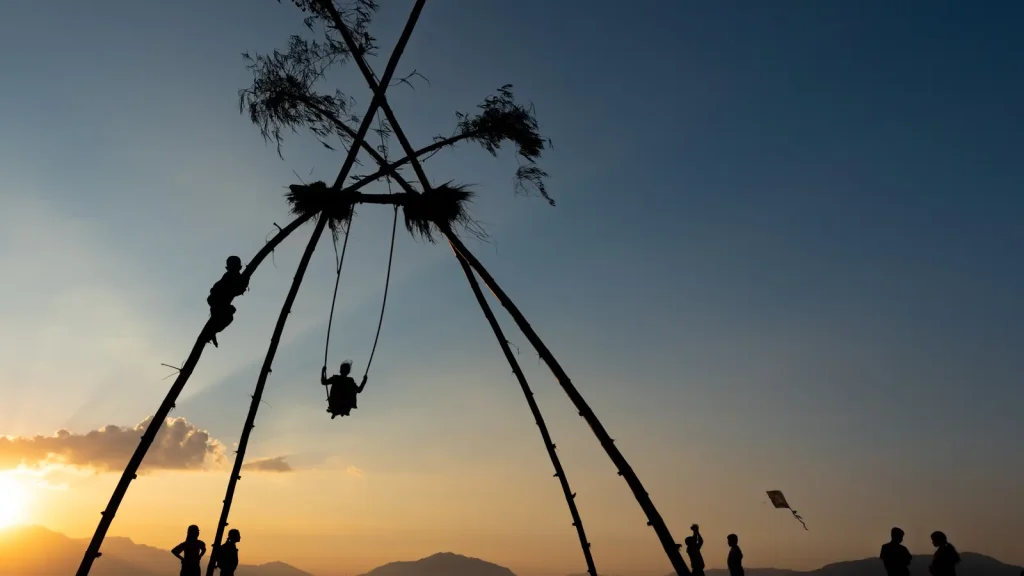

During Teej, temple courtyards and neighbourhood gathering places in Nepal fill with movement and colour. Women arrive in red saris, green beads and gold-toned jewellery; groups sing, dance and wait to offer prayers. Yet the Teej festival in Nepal is more than its most photographed scenes. It is also a reunion with maternal family, a Hindu observance associated with Shiva and Parvati, and a rare traditional space in which women’s songs have carried private feelings into public life.
There is no single Teej experience shared by every Nepali woman. Practice varies by region, community, generation, health and belief. Some women fast strictly; others modify the fast or do not fast. For some, worship is central; for others, the family visit, meal or music matters most.
Quick answer: The Teej festival in Nepal is a Hindu festival observed especially by women, usually in the late monsoon season. Its best-known elements are the Dar feast, fasting and prayer, visits to Shiva temples, red dress, singing and dancing, and the Rishi Panchami observance. It honours a popular tradition about Parvati’s devotion to Shiva, while also creating space for family reunion, friendship and social expression.
What is the Teej festival in Nepal?
“Teej” can refer to related monsoon festivals across South Asia, so context matters. In Nepal, the name commonly refers to Haritalika Teej, associated with Hindu women and worship of Shiva and Parvati. It is especially visible at Pashupatinath in Kathmandu, but families and communities observe it across Nepal and abroad.
The festival brings several layers together. It is religious, because devotees pray, fast and visit temples. It is social, because married daughters have traditionally returned to their maita—their parental or natal home—to reconnect. It is expressive, because Teej songs can be playful, devotional, sorrowful or critical. Recorded music, social media, work schedules and diaspora life now shape it too.
The Nepal Tourism Board’s description of Haritalika Teej highlights the Dar feast, fasting, red and green dress, songs, dancing and worship at Pashupatinath. Those features are widely recognizable, but they should be treated as a framework rather than a rulebook for every household.
Teej at a glance
| Question | Short answer |
|---|---|
| What kind of festival is Teej? | A Hindu religious and cultural festival associated with Shiva, Parvati, women’s gatherings and family reunion |
| When is it observed? | In the Nepali month of Bhadra, usually in August or September on the Gregorian calendar |
| Who observes it? | Especially Hindu women, both married and unmarried, although participation and meaning vary |
| What is Dar? | A generous pre-fast meal shared with family and friends on Dar Khane Din |
| Why do people wear red? | Red is commonly associated with marriage, vitality, auspiciousness and celebration in many Nepali Hindu settings |
| Are Teej practices identical everywhere? | No. Food, fasting, songs, dress and ritual details differ among families, places and generations |
When is the Teej festival in Nepal?
Haritalika Teej falls on the third lunar day of the bright fortnight of Bhadra. That usually places it in August or September, but its Gregorian date changes from year to year. The date is determined within a traditional lunar framework rather than fixed to one day on the Gregorian calendar.
This moving date is normal for many Nepali festivals. Nepal also uses Bikram Sambat for civil life, while religious observances may depend on lunar tithi calculations. Readers unfamiliar with the country’s parallel systems can see SOAKJAM’s guide to why Nepal’s calendar is about 57 years ahead. For attendance or travel, the safest approach is to confirm the current date through an official Nepali calendar rather than assuming last year’s date will repeat.
The story of Parvati and Shiva
A popular religious account connects Haritalika Teej with Parvati’s determination to marry Shiva. In common retellings, Parvati’s father intended another marriage for her, but a friend took her away to a forest. There she performed austerities and prayed until Shiva accepted her devotion. Versions differ in detail, as living religious stories often do.
For many devotees, the story represents steadfastness, spiritual discipline and a woman’s resolve. Married women may pray for the health and well-being of their husbands and families, while unmarried women may pray for a good partner or a fulfilling future. Others understand the observance more broadly as devotion to Shiva and Parvati or as a moment for reflection and renewal.
Reducing Teej to “women fasting for husbands” therefore misses much of its lived meaning. Faith, family, friendship, choice and cultural belonging can all be present in different proportions.
How the festival unfolds
Teej is often described as a three-day festival. In practice, the connected observances can extend across several calendar days, and some accounts count the sequence differently. Ganesh Chaturthi falls between the main Teej fast and Rishi Panchami in many calendars, so a household may speak of three principal Teej observances while the full sequence spans four days.
| Stage | Common emphasis | Important nuance |
|---|---|---|
| Dar Khane Din | Family visit, generous meal, singing and preparation | The foods and timing differ by household; modern Dar gatherings may happen more than once |
| Haritalika Teej | Fasting, Shiva-Parvati worship, temple visits, songs and dance | Not everyone keeps the same kind of fast, and participation should be voluntary |
| Ganesh Chaturthi | Worship of Ganesh | It is a distinct observance but falls within the wider sequence on the calendar |
| Rishi Panchami | Bathing, purification rites and worship associated with the seven sages | Ideas about ritual purity are interpreted, questioned or adapted differently today |
Dar Khane Din: food, rest and reunion
The day before the principal fast is known as Dar Khane Din—the day for eating Dar. In its most familiar form, women gather at the parental home or another family house for a rich meal. The table may include rice, vegetable and meat dishes, pickles, sweets, fruit and dairy foods, but there is no single required menu. Families serve what is meaningful, available and suitable for them.
Dar is practical because it comes before a fasting day, but the meal’s social meaning is just as important. Historically, a married daughter might have had limited opportunities to leave her marital household. An invitation from her maternal family offered time with parents, sisters and friends, as well as a setting in which women could talk and sing together. Today, transport, jobs and family patterns have changed, yet the emotional pull of returning to maita remains powerful for many.
Urban celebrations have expanded the idea of Dar. Workplaces, community groups and friends may organize meals before the festival. Some enjoy that wider sociability; others criticize expensive venues, competitive fashion or prolonged feasting. Both reactions show a living tradition negotiating display, convenience and older ideas of homecoming.
Fasting and worship on Haritalika Teej
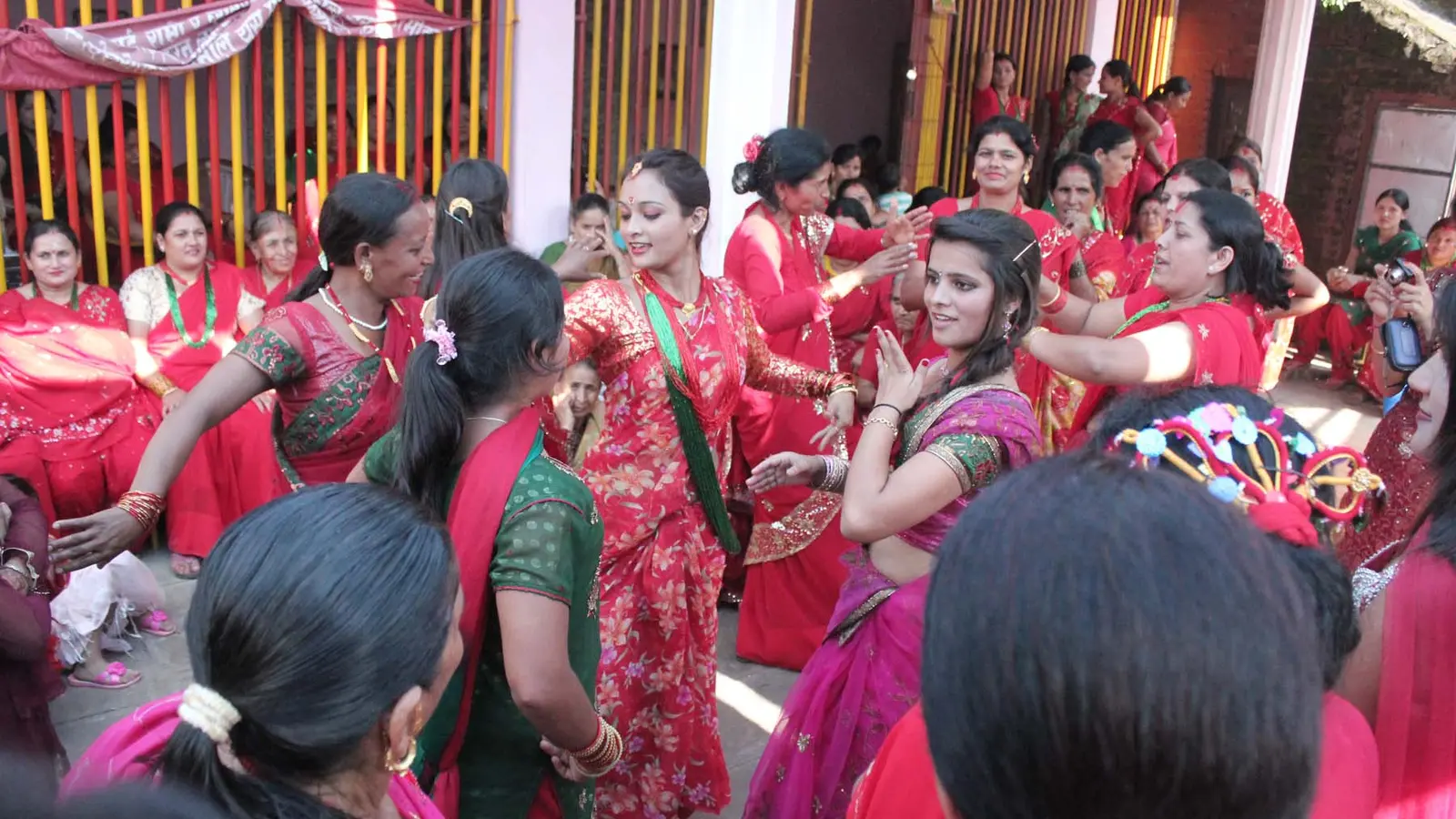
On the principal day, worshippers may bathe early, dress for the occasion, visit a Shiva temple and join prayers, singing and dance. Some undertake a nirjala fast without food or water. Others drink water, eat fruit or participate without fasting. Health and individual conviction matter. A strict fast is one form of devotion, not a test of every woman’s faith.
At home or in a temple, devotees may offer flowers, fruit, incense and lamps to Shiva and Parvati. Groups often continue singing and dancing even while waiting in long temple lines. The combination can look paradoxical to an outsider—physical restraint alongside energetic celebration—but within Teej, devotion and joy are not opposites.
Rishi Panchami and changing ideas of purity
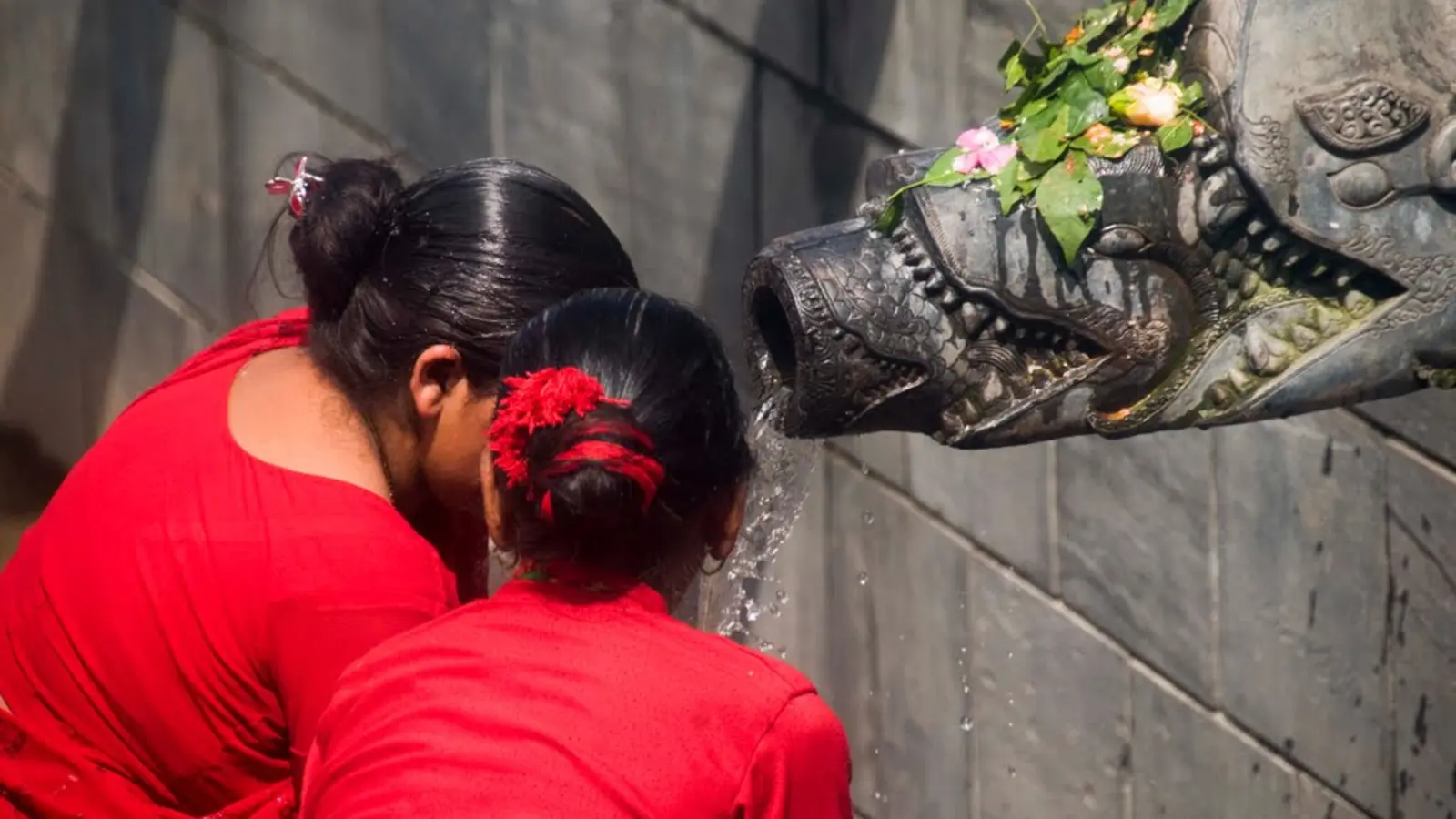
Rishi Panchami concludes the best-known ritual cycle. Traditional practice may include bathing, cleaning the teeth with datiwan twigs, worshipping the Saptarishi or seven sages, and eating a simple ritual meal. Some explanations connect the day with atonement for breaches of older rules concerning menstruation and household purity.
That aspect deserves careful language. Menstruation is a normal bodily process, not a moral fault. Contemporary Nepalis do not all understand or observe Rishi Panchami in the same way: some follow inherited ritual instructions, some reinterpret the day as personal cleansing or renewal, and some reject the stigma contained in older purity rules. Describing the tradition accurately does not require presenting every historical belief as a modern medical or ethical fact.
Why red, green and gold are so visible
Red dominates many public images of Teej. In Nepali Hindu contexts it can signal auspiciousness, vitality, marriage and celebration. Married women may wear red saris, glass bangles, pote bead necklaces, tilhari pendants and vermilion. Green, often seen in bangles or clothing, adds another vivid colour associated in popular practice with life and well-being. Gold jewellery or gold-coloured ornaments complete many festive outfits.
These are recognizable symbols, not compulsory uniforms. An unmarried participant may also choose red; a married woman may prefer another colour; and some people dress simply for comfort, affordability or taste. Meaning does not depend on the price of a sari or the weight of jewellery.
Pashupatinath and the public face of Teej
Pashupatinath in Kathmandu is the festival’s most prominent pilgrimage site. Large numbers of worshippers queue to enter the temple complex, while singing and dancing take place in surrounding areas. The red-clad crowds have made Pashupatinath the visual shorthand for Teej in news and travel photography.
Yet Teej is not confined to one famous temple. Worship occurs at Shiva shrines and community spaces throughout Nepal, while many families celebrate primarily at home. Local observance can be quieter, smaller and no less meaningful. Access rules also matter at Pashupatinath: the main temple’s inner premises are restricted to Hindus, although visitors can view parts of the wider heritage area from permitted locations.
Teej songs: celebration, memory and social voice
Teej songs are among the festival’s most distinctive cultural forms. A group may sing while dancing in a circle, with verses answered or repeated by others. The music creates enjoyment, but the words have often done more demanding work. Songs can remember the maternal home, express the pain of separation, describe difficult relationships, tease relatives, question inequality or comment on events beyond the household.
That history complicates the idea that women in earlier generations were simply silent. The influential study The Songs of Tij: A Genre of Critical Commentary for Women in Nepal treats the genre as a vehicle through which women could comment on gender relations and social conditions. Later scholarship has examined the contrast between maita, the parental home, and ghar, the home into which a woman marries. The two places can carry feelings of freedom and obligation, belonging and displacement, affection and conflict.
Not every song is a protest song. Devotional lyrics, comic exchanges, affectionate family themes and songs made simply for dancing are also part of Teej. The important point is range. A festival song can entertain a crowd while preserving a memory or making a criticism that ordinary conversation once made difficult.
How Teej is changing
Recorded songs, television and YouTube have moved Teej music far beyond the courtyard. Professional releases now appear well before the festival, often with elaborate videos, celebrity performers and commercial sponsorship. Some songs address education, migration, domestic violence, political disappointment or women’s autonomy. Others focus on romance, fashion, food and spectacle.
This expansion produces debate. Critics worry that expensive Dar parties, conspicuous jewellery and market-driven songs overshadow devotion and older folk traditions. Supporters note that new media give women artists national and diaspora audiences. Both views identify a genuine tension between continuity and commercialization.
Migration has changed the festival too. Nepali associations organize Teej events from the Gulf to Europe, North America and Australia. A weekend hall gathering cannot reproduce every household custom, but it offers music, familiar food and community far from home. Digital calls connect family celebrations across borders.
Who celebrates—and why generalizations fail
Teej is especially associated with Hindu women from communities in which the festival has long been prominent. Married and unmarried women participate, and men may cook, provide transport, help organize events, perform music or join family gatherings. However, Nepal is religiously, ethnically and regionally diverse. It is inaccurate to imply that every Nepali woman observes Teej, or that everyone who does so follows one orthodox pattern.
Individual motivations also change over a lifetime. Someone may once have fasted strictly and later stop for health reasons. Another person may be drawn more strongly to temple worship, while her sister values the annual family reunion. A younger participant may learn traditional verses from an elder and also dance to a new recorded song. These choices do not fit neatly into a contest between “authentic” and “modern.” They show how a tradition continues through interpretation.
Common misconceptions about Teej
| Misconception | A more accurate view |
|---|---|
| Only married women celebrate. | Unmarried women also participate, and the festival can carry devotional, social and personal meanings beyond marital status. |
| Every participant goes without food and water. | Fasting practices vary. Some keep a strict fast; others modify it or do not fast. |
| Teej is only about praying for a husband. | Prayer for a spouse is one theme, but so are worship, family well-being, reunion, friendship, music and women’s social expression. |
| Red clothing is mandatory. | Red is highly symbolic and popular, but clothing choices differ. |
| The festival is unchanged from the past. | Media, migration, work, consumer culture and changing gender expectations continually reshape its form. |
How visitors can experience Teej respectfully
A visitor may encounter public dancing or long temple queues, particularly in Kathmandu. Curiosity is welcome in many public spaces, but a religious festival is not a staged performance:
- Ask before taking a close portrait, especially during prayer, bathing or another personal ritual.
- Follow signs and local instructions at temples; do not assume every area is open to non-Hindus or to cameras.
- Dress and behave with the same care you would bring to an active place of worship.
- Do not pressure someone to explain, pose or interrupt a fast for a photograph.
- Avoid treating all participants as identical. If you ask a question, listen for “in my family” or “in my community” rather than expecting one universal answer.
Respectful photographs show consent and context, while good conversations let participants define what the day means to them.
Frequently asked questions
Is Teej a national festival of Nepal?
Haritalika Teej is a major festival in Nepal and is especially associated with Hindu communities. Its national visibility should not be confused with identical observance by every citizen.
Why does the date of Teej change every year?
The festival follows a lunar tithi in the month of Bhadra. Because that traditional calendar does not align day-for-day with the Gregorian calendar, Teej usually falls in August or September but moves within that period.
What food is eaten for Dar?
Dar is not one fixed dish. It is a festive meal that may include rice, vegetables, meat, pickles, fruit, sweets and dairy foods. Menus vary according to region, household preference, diet and budget.
Do all women have to fast during Teej?
No. Some women keep a strict fast, some take water or selected foods, and others do not fast. Participation is shaped by belief, health and personal choice. No one should risk her health to meet social expectations.
Why are songs so important during Teej?
Songs support dancing and celebration, but they have also allowed women to share memories, frustrations, humour and social criticism. The genre ranges from devotional and familial themes to commentary on marriage, inequality, migration and modern consumer life.
Is the Teej festival in Nepal only religious?
No. Religion is central for many participants, but Teej is also a family reunion, a women-centred social gathering, a musical tradition and a changing form of cultural identity. Different participants place different weight on each element.
Teej festival in Nepal: devotion with a public voice
The Teej festival in Nepal endures because it can hold several meanings at once. It remembers Parvati’s resolve, centres worship of Shiva and Parvati, brings daughters back toward their maternal homes, and turns shared food, dress, song and dance into a language of belonging. Its songs can praise, joke, grieve and challenge. Its rituals can be inherited faithfully, adapted thoughtfully or questioned openly.
Seen in that fullness, Teej is neither a colourful spectacle frozen in the past nor a custom with one compulsory interpretation. It is a living Nepali tradition shaped by devotion, women’s relationships and the changing conditions of family and public life.
Transparency
Sources & references
- Nepal Tourism Board – Haritalika Teej
- JSTOR – The Songs of Tij: A Genre of Critical Commentary for Women in Nepal
- Journal of International Women’s Studies – Presenting the Absence: A Contrapuntal Reading of the Māita in Nepali Tīj Songs
- Tribhuvan University Central Library – Representation of Consumer Culture in Modern Nepali TeejSongs
Editorially reviewed
Editorial information
SOAKJAM articles are designed for clarity, useful context and transparent sourcing. Important facts should be checked against the linked primary sources.
Found an error, outdated detail or a useful source we should consider?