

What comes after a terabyte? The next decimal data unit is a petabyte, followed by an exabyte, zettabyte and yottabyte. Beyond those are the newer SI prefixes ronna and quetta, which can form the names ronnabyte and quettabyte.
These units describe extremely large quantities of digital information. A phone may be advertised in gigabytes, a personal drive in terabytes, and a large data system may be measured in petabytes or more. The names change, but the pattern is simple: in the decimal system, every step is 1,000 times larger than the one before it.
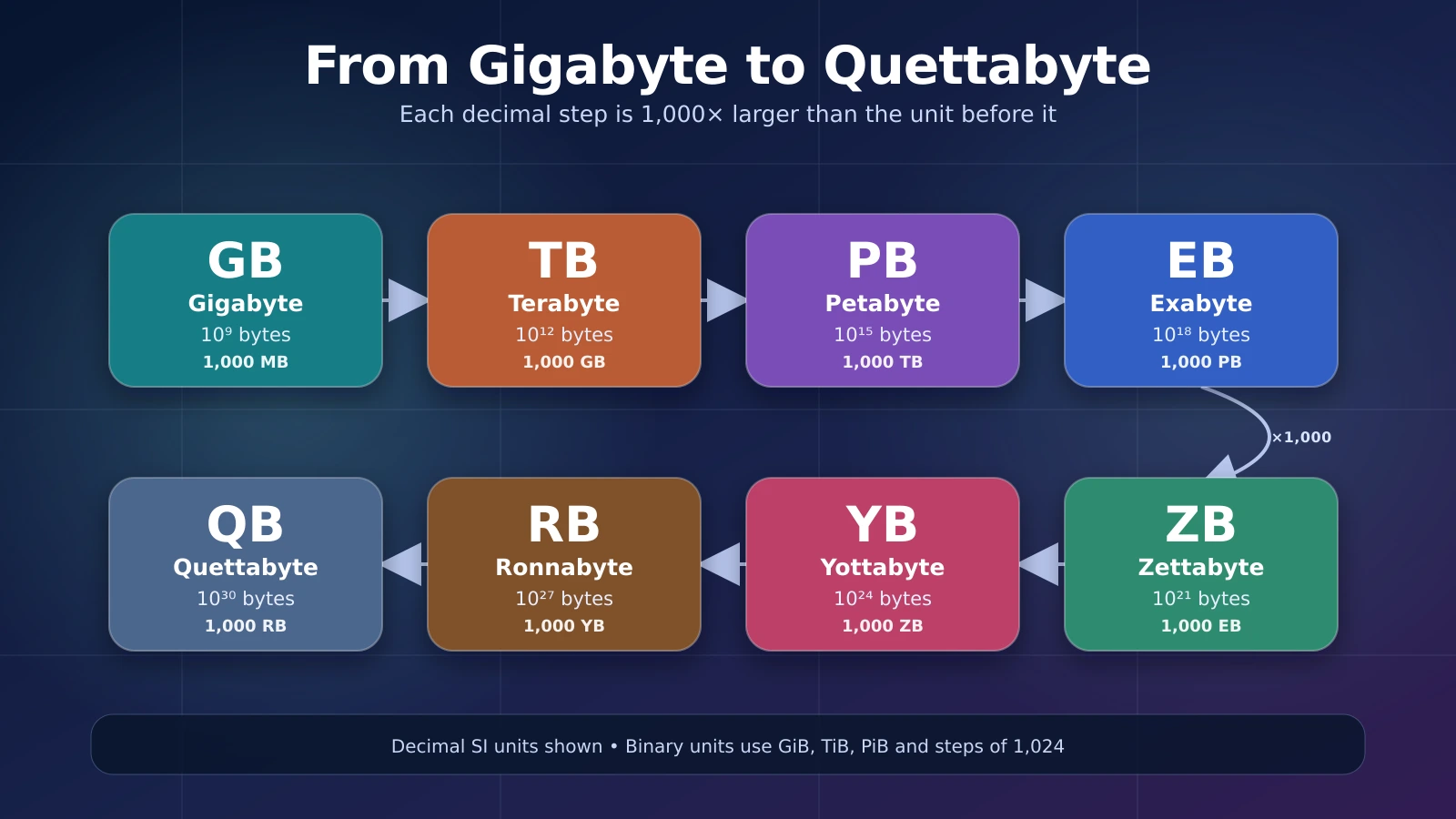
Quick answer: GB → TB → PB → EB → ZB → YB → RB → QB. Each decimal step is 1,000 times larger.
If you first need the everyday units, read KB vs MB vs GB: A Simple Guide to File Size.
This guide was checked against the BIPM and NIST prefix references on 28 August 2026. Standards and software displays can change, so use the unit definitions supplied by a device or service when an exact byte count matters.
Data Storage Units From GB to QB
The decimal order of large data units is:
| Unit | Symbol | Number of bytes | Relationship to the previous unit |
|---|---|---|---|
| Gigabyte | GB | 10⁹ | 1,000 MB |
| Terabyte | TB | 10¹² | 1,000 GB |
| Petabyte | PB | 10¹⁵ | 1,000 TB |
| Exabyte | EB | 10¹⁸ | 1,000 PB |
| Zettabyte | ZB | 10²¹ | 1,000 EB |
| Yottabyte | YB | 10²⁴ | 1,000 ZB |
| Ronnabyte | RB | 10²⁷ | 1,000 YB |
| Quettabyte | QB | 10³⁰ | 1,000 RB |
The International Bureau of Weights and Measures, usually called the BIPM, lists giga, tera, peta, exa, zetta, yotta, ronna and quetta as decimal SI prefixes. Ronna and quetta were added in 2022 to provide names for still larger quantities.
What Is a Gigabyte?
A gigabyte is one billion bytes in decimal measurement:
1 GB = 1,000,000,000 bytes
Gigabytes are common in everyday technology. They are used for phone storage, applications, games, videos, memory cards and monthly mobile-data allowances.
Examples of familiar capacities include:
- a 128 GB phone;
- a 256 GB memory card;
- a 500 GB computer drive; or
- a video file measured in several GB.
A gigabyte is already large compared with a kilobyte or megabyte, but it is the smallest unit covered in this guide.
What Comes After a Gigabyte?
The unit after a gigabyte is a terabyte.
1 TB = 1,000 GB = 1,000,000,000,000 bytes
Terabytes are now common for computer drives, external backups, network storage and large collections of photographs or videos. A 2 TB drive has twice the decimal capacity of a 1 TB drive.
The exact amount shown as available inside an operating system may be lower than the number printed on the drive. This can happen because the manufacturer uses decimal units while the software may calculate in binary units, and because formatting and system files also use some space.
What Comes After a Terabyte?
The unit immediately after a terabyte is a petabyte.
1 PB = 1,000 TB = 1,000,000 GB
A petabyte is one quadrillion bytes in decimal measurement. It is far beyond the storage normally needed by one person. Petabytes are more relevant to large data centres, cloud platforms, research systems, media archives and organisations managing enormous datasets.
The correct spelling is petabyte, not “pentabyte.” The prefix is peta, and its symbol is an uppercase P.
What Comes After a Petabyte?
The unit after a petabyte is an exabyte.
1 EB = 1,000 PB = 1,000,000 TB
An exabyte equals one quintillion bytes in decimal measurement. Exabytes are useful when discussing information across very large networks, groups of data centres, national infrastructure, scientific programmes or other systems operating at exceptional scale.
An individual file is extremely unlikely to be measured in exabytes. The unit is normally used for combined collections or large-scale data movement.
What Comes After an Exabyte?
The unit after an exabyte is a zettabyte.
1 ZB = 1,000 EB = 1,000,000 PB
A zettabyte contains one sextillion bytes in decimal measurement. This scale is mainly used when discussing global or near-global quantities of digital information rather than a normal storage device.
The correct spelling is zettabyte, with two letters “t.” Its symbol is ZB.
What Comes After a Zettabyte?
The unit after a zettabyte is a yottabyte.
1 YB = 1,000 ZB = 1,000,000 EB
A yottabyte is one septillion bytes in decimal measurement. It is a valid unit formed with the official SI prefix yotta, although it is rarely needed for the capacity of one real-world storage system.
Yottabytes are most useful as a way to describe or imagine extremely large future data scales.
What Comes After a Yottabyte?
The SI prefix after yotta is ronna, followed by quetta:
- 1 ronnabyte (RB) = 1,000 yottabytes = 10²⁷ bytes
- 1 quettabyte (QB) = 1,000 ronnabytes = 10³⁰ bytes
Ronna and quetta are official SI prefixes. The terms ronnabyte and quettabyte may therefore be formed when discussing data, but they are not common everyday storage labels. Their main purpose is to provide clear language when quantities grow beyond the yotta scale.
Quetta is currently the largest official positive SI prefix. That does not mean no larger number can exist; it means larger quantities would need scientific notation or another future naming convention.
How Much Larger Is Each Unit?
Every decimal step multiplies the capacity by 1,000:
| Starting amount | Equivalent larger-unit relationship |
|---|---|
| 1,000 GB | 1 TB |
| 1,000 TB | 1 PB |
| 1,000 PB | 1 EB |
| 1,000 EB | 1 ZB |
| 1,000 ZB | 1 YB |
| 1,000 YB | 1 RB |
| 1,000 RB | 1 QB |
The difference becomes enormous because the multiplication continues at every step. One petabyte is one million gigabytes, while one exabyte is one billion gigabytes.
A Simple Way to Visualise the Scale
Imagine that every photograph is exactly 5 MB. Real photographs vary, but using one fixed size makes the comparison easier.
| Capacity | Approximate number of 5 MB photographs |
|---|---|
| 1 GB | 200 |
| 1 TB | 200,000 |
| 1 PB | 200 million |
| 1 EB | 200 billion |
| 1 ZB | 200 trillion |
| 1 YB | 200 quadrillion |
These are mathematical illustrations, not promises about a device. Actual capacity depends on formatting, operating-system use, file size, metadata, compression and whether the system reports decimal or binary units.
Where Are These Large Units Used?
Different units are useful at different scales:
- GB: phones, applications, memory cards, individual videos and mobile-data plans;
- TB: computer drives, external backups, home servers and professional media collections;
- PB: large data centres, cloud systems, scientific datasets and institutional archives;
- EB: very large groups of systems, massive networks and aggregated data movement;
- ZB: global-scale data discussions and long-range technology planning;
- YB, RB and QB: extreme-scale calculations, future projections and scientific communication.
The unit does not describe what the data contains. A terabyte of photographs and a terabyte of database records contain the same quantity of bytes even though their purpose and structure are different.
Why Do Some Calculations Use 1,024 Instead of 1,000?
Decimal and binary units are different systems.
Official decimal prefixes increase by 1,000:
- 1 GB = 1,000 MB;
- 1 TB = 1,000 GB; and
- 1 PB = 1,000 TB.
Binary prefixes increase by 1,024:
- 1 GiB = 1,024 MiB;
- 1 TiB = 1,024 GiB; and
- 1 PiB = 1,024 TiB.
The binary names continue as EiB, ZiB and YiB. Software has sometimes displayed binary calculations using decimal-looking labels such as GB or TB, which is why two sources may appear to disagree.
When exact storage matters, check whether the value is written as GB or GiB, TB or TiB, and PB or PiB. Do not mix 1,000 and 1,024 inside the same calculation.
For a more detailed explanation of everyday file-size units, return to KB vs MB vs GB: A Simple Guide to File Size.
Bytes and Bits Are Not the Same
A capital B normally means byte, while a lowercase b normally means bit:
- GB means gigabytes;
- Gb means gigabits;
- TB means terabytes; and
- Tb means terabits.
One byte contains eight bits. Storage capacity is usually described in bytes, while internet and network speeds are commonly described in bits per second. A 1 Gbps connection is not the same as transferring 1 GB every second.
Why These Units Matter
Understanding large data units helps when:
- comparing hard drives and backup plans;
- estimating how long an archive may keep growing;
- reading reports about cloud computing and data centres;
- understanding scientific or engineering datasets;
- comparing network traffic with stored capacity; or
- checking whether two figures use the same measurement system.
The largest-looking number is not automatically the best choice. A storage plan should also be judged by reliability, redundancy, security, access speed, transfer cost and the amount of capacity actually required.
Frequently Asked Questions
What comes immediately after a terabyte?
A petabyte comes immediately after a terabyte. In decimal measurement, 1 PB equals 1,000 TB.
Which is bigger, a terabyte or a petabyte?
A petabyte is bigger. One decimal petabyte contains 1,000 terabytes, or one million gigabytes.
What comes after a petabyte?
An exabyte comes after a petabyte. The sequence continues PB → EB → ZB → YB.
What comes after a zettabyte?
A yottabyte comes after a zettabyte. One decimal yottabyte equals 1,000 zettabytes.
What comes after a yottabyte?
The official SI prefix after yotta is ronna, followed by quetta. Applied to bytes, these form ronnabyte and quettabyte.
Is a petabyte 1,000 or 1,024 terabytes?
A decimal petabyte is 1,000 terabytes. The binary relationship is 1 pebibyte (PiB) equals 1,024 tebibytes (TiB). Some software uses decimal labels for binary values, so check the documented unit when precision matters.
Is it petabyte or pentabyte?
Petabyte is the correct spelling. It comes from the SI prefix peta and uses the symbol PB.
What is the largest data-storage unit?
Quetta is currently the largest official positive SI prefix, representing 10³⁰. A quettabyte would therefore represent 10³⁰ bytes. Larger numbers are still possible and can be expressed using scientific notation.
Is a yottabyte real?
Yes. Yotta is an official SI prefix representing 10²⁴, so a yottabyte is a valid decimal data unit. It is rarely used for the capacity of a single physical storage system because the quantity is extraordinarily large.
Final Summary
What comes after a terabyte is easy to remember once the order is clear:
GB → TB → PB → EB → ZB → YB → RB → QB
In decimal measurement, every step is 1,000 times larger. Petabytes and exabytes are associated with large-scale systems, while zettabytes and beyond help describe global or future quantities of information.
Keep decimal and binary measurements separate. GB, TB and PB use powers of 1,000, while GiB, TiB and PiB use powers of 1,024.
Sources & References
- BIPM — SI prefixes
- NIST — Definitions of binary prefixes
- NIST — Metric SI prefixes
- IEC — Prefixes for binary multiples
Reviewed and updated
Editorial information
SOAKJAM articles are designed for clarity, useful context and transparent sourcing. Important facts should be checked against the linked primary sources.
Found an error, outdated detail or a useful source we should consider?