
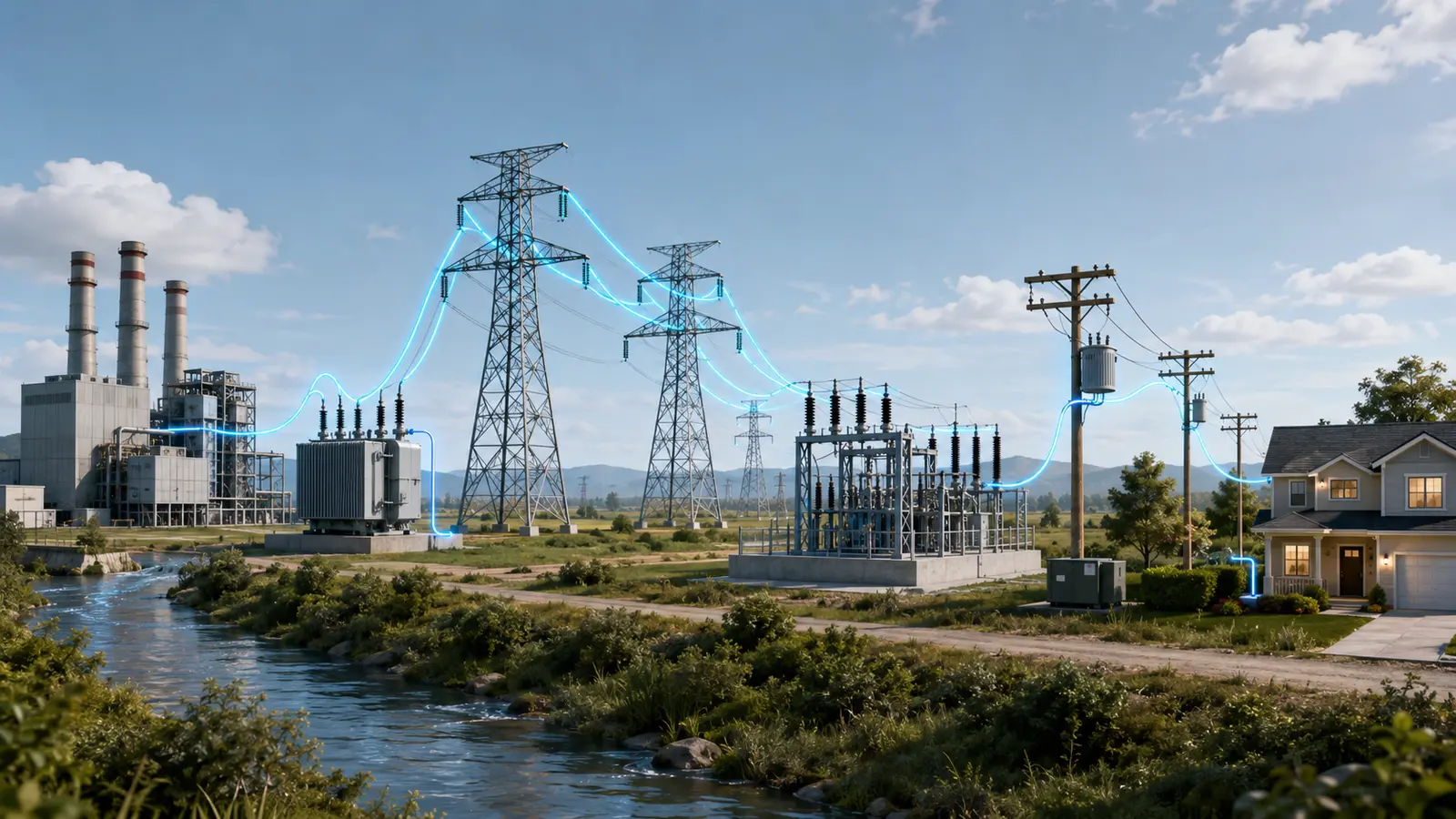
How does electricity reach your home when a switch makes a lamp glow almost instantly? The energy may begin at a power station, wind farm, hydroelectric plant, solar installation or another generator. It then passes through transformers, high-voltage transmission lines, substations, local distribution wires, a meter and a breaker panel before reaching household circuits.
The route sounds like a single chain, but a modern power grid is really an interconnected network. Many generators feed it, operators continually balance supply with demand, and protective devices isolate faults. The exact voltages, equipment and market arrangements vary by country, yet the physical journey follows the same broad pattern.
Quick answer: Generators produce electrical power, usually as alternating current. A step-up transformer raises the voltage for efficient long-distance transmission. Substations later reduce it for regional and local distribution. A neighborhood transformer lowers it again to a usable service voltage, after which electricity passes through the meter and main breaker to the circuits in a building. That is the short answer to how does electricity reach your home.
How does electricity reach your home in simple steps?
The journey can be divided into generation, transmission, distribution and final use. Electricity does not normally wait in the wires like water in a tank. Generators and storage systems must respond while people turn appliances on and off, and the network must keep voltage and frequency within permitted ranges.
| Stage | Main equipment | What happens |
|---|---|---|
| 1. Generation | Generator or inverter | Another form of energy is converted into electrical power |
| 2. Voltage increase | Step-up transformer | Voltage is raised so large amounts of power can travel with lower current |
| 3. Transmission | High-voltage lines and grid substations | Power moves across long distances and between regions |
| 4. Distribution | Distribution substations, feeders and local transformers | Voltage is reduced and power is divided among communities and streets |
| 5. Building service | Service cable, meter and main panel | Energy use is measured and protected circuits carry power to outlets and appliances |
The U.S. Energy Information Administration gives the same central outline in its guide to electricity delivery to consumers: power plants supply transmission and distribution lines, while transformers change voltage for different parts of the trip. Understanding those stages makes how does electricity reach your home much easier to visualize.
How does electricity reach your home from a power station?
Most large power stations use a rotating generator. A turbine turns a shaft inside the generator, and electromagnetic induction produces alternating voltage. Steam may drive the turbine at a nuclear, coal, gas, geothermal or concentrated-solar plant. Moving water drives hydroelectric turbines, while wind turns a turbine directly.
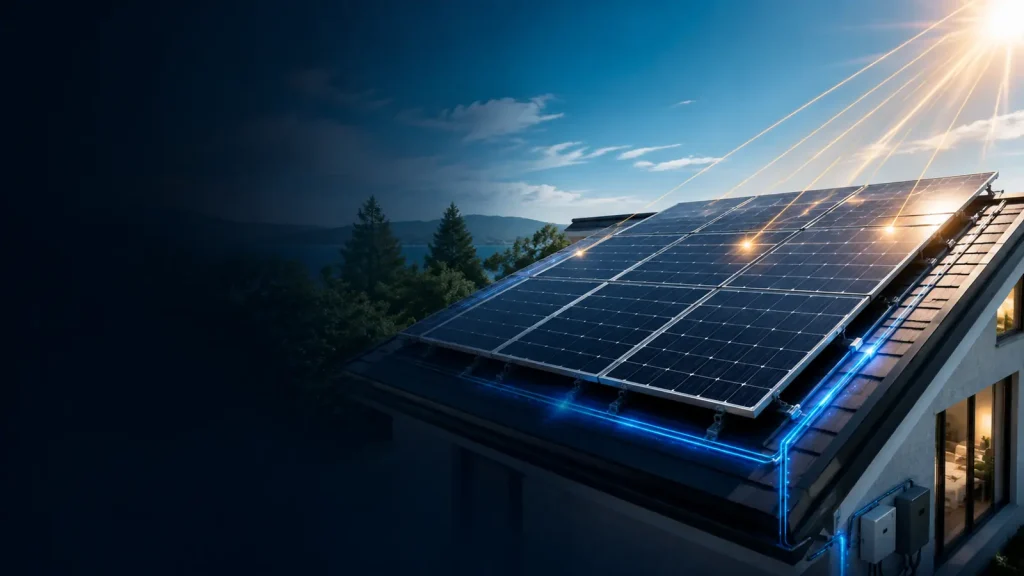
Solar photovoltaic panels work differently. They produce direct current without a rotating turbine, so power electronics convert their output into grid-compatible alternating current. Batteries also connect through power electronics. SOAKJAM’s guide to how solar panels work explains the cell and inverter stages in detail.
Once a generator is synchronized to an alternating-current grid, its voltage wave must match the system’s frequency, phase sequence and other connection requirements. It does not simply push power onto a line whenever its owner chooses. Grid rules, controls and protective equipment govern when and how each resource connects.
Why a step-up transformer raises the voltage
A generator’s output voltage is not normally the best voltage for carrying large amounts of power over hundreds of kilometres. Near the generating site, a step-up transformer raises the voltage before electricity enters major transmission lines.
For a given amount of real power, raising voltage allows the same power to be transferred with less current. Resistive heating in a conductor increases roughly with the square of current, so reducing current sharply reduces heating losses. Higher voltage therefore makes long-distance delivery more practical, although it requires larger clearances, stronger insulation and specialized switching equipment.
A transformer does not create extra energy. Ignoring its small losses, it trades voltage for current: voltage rises while available current falls in proportion. Transformers work with changing current and magnetic fields, which is one important reason large public grids developed around alternating current.
High-voltage transmission is the grid’s long-distance network
Transmission lines carry bulk power between generators, major substations and population centres. Many are overhead conductors supported by towers, while some routes use underground or undersea cables. A transmission system is usually meshed rather than a single point-to-point wire, allowing power to take multiple physical paths.
The Department of Energy’s electricity transmission primer describes lines and transformers as the main physical transmission facilities. Circuit breakers, disconnectors, instrument transformers, protective relays, communications and control systems are also essential. They measure conditions, interrupt faults and help operators keep equipment inside safe limits.
Power flow follows electrical laws across the connected network; an operator cannot label individual electrons and send them along one chosen tower line. Operators influence flows by changing generation, network configuration and controllable equipment. This interconnected behaviour is a fuller answer to how does electricity reach your home than imagining one dedicated cable from one plant.
Supply and demand must stay balanced
Electricity use changes every second. A city wakes up, air conditioners start, factories change production and thousands of small appliances cycle automatically. At the same time, wind and sunlight may change and a generator or transmission line may unexpectedly disconnect.
Grid operators forecast demand, schedule resources and make real-time adjustments. Conventional generators may increase or decrease output, hydropower and batteries can respond quickly, and demand-response programmes may temporarily reduce some loads. Operating reserves stand ready in case a large resource fails.
FERC’s introductory grid guide explains that electricity entering a grid must match what is being used, while its overview of ancillary services describes frequency regulation, reserves, voltage support and black-start capability. The exact nominal frequency is commonly 50 or 60 hertz depending on the country. A persistent supply-demand imbalance pushes frequency away from its target and can threaten reliable operation.
Substations connect and control different grid levels
A substation is more than a collection of transformers. It is a controlled connection point where lines meet, voltage may change, measurements are taken and protective equipment can separate a damaged section. Some substations connect two transmission voltage levels; others form the boundary between transmission and local distribution.
At a distribution substation, large transformers reduce transmission voltage to a medium-voltage level suitable for feeders serving communities. Busbars distribute that power among several outgoing circuits. Breakers and relays can open a feeder when they detect excessive current or another fault, limiting damage and helping keep unaffected circuits energized.
Utilities may also regulate voltage using transformer tap changers, capacitor banks and other equipment. The goal is not merely to make voltage lower, but to keep acceptable voltage available across a feeder as distance and customer demand change.
How does electricity reach your home through distribution?
Distribution feeders leave a substation and carry power through towns, villages and city districts. A feeder may run overhead on poles, underground in ducts, or through a mixture of both. Smaller branches called laterals take power into streets and groups of buildings.
Distribution is often arranged radially, meaning a customer normally receives power from one direction, although switches may provide an alternate route. Dense or critical areas may use more networked designs. Fuses, reclosers and sectionalizing switches isolate faults. A recloser can briefly open and then test the line again because some overhead faults, such as a momentary branch contact, disappear after power is interrupted.
The Department of Energy’s distribution-system baseline report traces the route from a high-voltage line to a distribution substation, feeder, lateral, local transformer and meter. Actual layouts differ, but these are the familiar final network stages.
The neighborhood transformer makes voltage usable
Before power enters an ordinary residence, a distribution transformer reduces medium voltage to the local utilization voltage. It may be the cylindrical unit mounted on a pole or a locked metal cabinet on a concrete pad. One transformer often serves several nearby homes.
Household standards are not universal. Many countries commonly supply roughly 220–240 volts at 50 hertz, while others use systems around 100–127 volts, often with additional arrangements for larger loads. Apartments and larger buildings may receive three-phase service, whereas many homes receive single-phase service. The utility and local electrical code determine the actual arrangement.
Never open, climb on or work near a utility transformer. Even its lower-voltage side can deliver dangerous fault current, and the primary side remains at distribution voltage. Only authorized workers should access it.
From the service cable to the meter and breaker panel
A service drop carries power from an overhead line to a building, while a service lateral performs the same job underground. The conductors reach the service equipment and electricity meter. The meter records energy passing into the premises, usually in kilowatt-hours, for billing and system records.
After the meter, the main disconnect and breaker panel divide the supply among circuits. Each breaker is sized to protect its circuit wiring from excessive current. Lights, sockets, water heaters, air conditioners and other loads may use separate circuits according to local rules. Earthing or grounding, bonding and residual-current or ground-fault protection provide additional safety functions, but their exact design varies.
A breaker does not reduce the voltage for an appliance. It is a protective switch. The appliance receives the circuit’s supply voltage and draws current according to its design and operating condition. Small electronic devices then often use internal power supplies to convert household AC into lower-voltage DC. At this final stage, the complete path explains how does electricity reach your home.
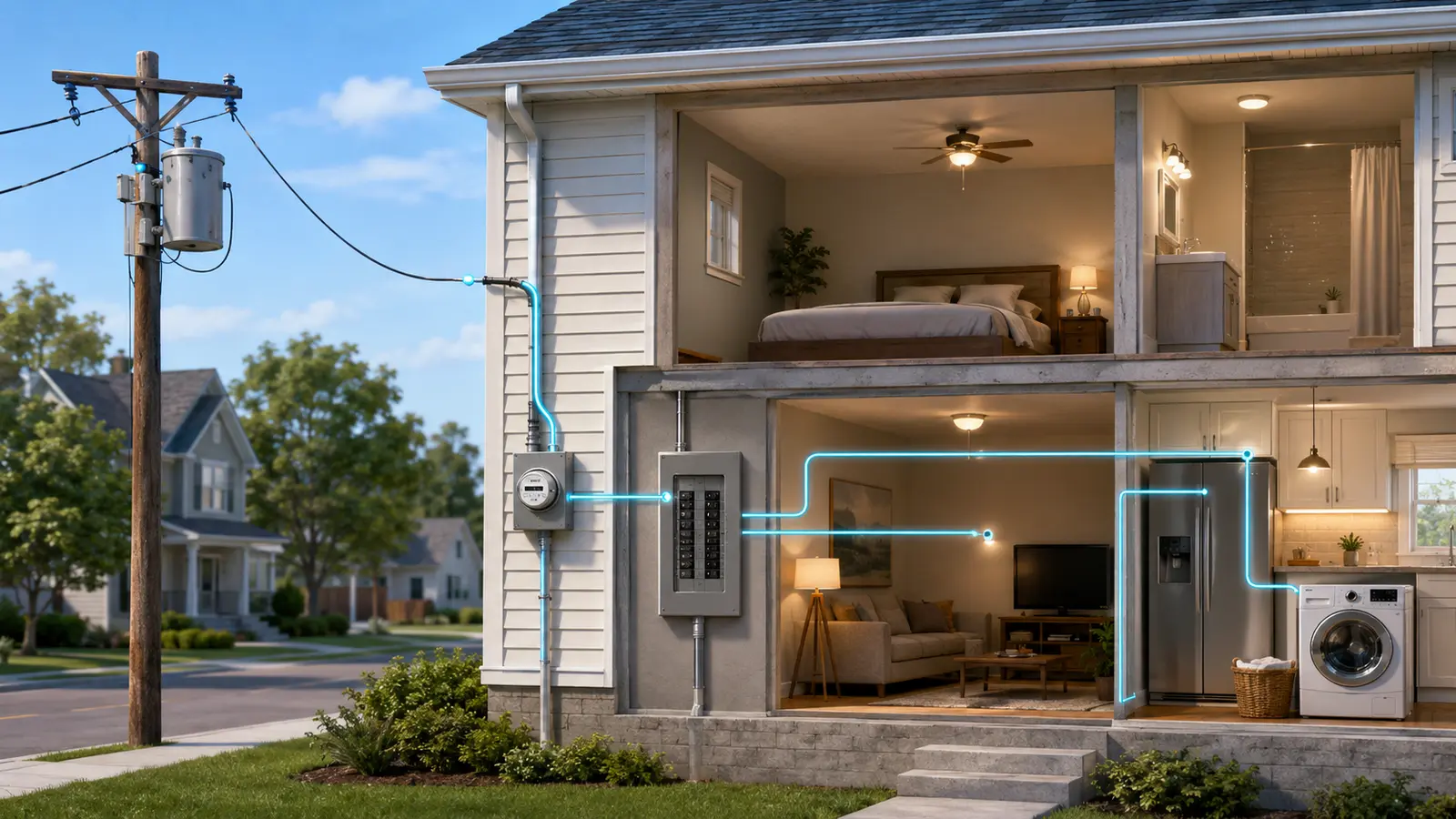
For body images, choose Full size with the normal wide article-content alignment. Avoid Full width if it escapes the white reading container.
What exactly does the electricity meter measure?
Power is the rate at which electrical energy is being transferred at one moment, measured in watts or kilowatts. Energy accumulates over time and is measured in watt-hours or kilowatt-hours. A 1-kilowatt appliance operating for two hours uses 2 kilowatt-hours, although real appliances may cycle or vary their input.
Traditional electromechanical meters used a rotating disc. Electronic meters calculate voltage, current and time digitally. Some smart meters communicate readings and events to a utility. The EIA’s guide to measuring electricity explains the difference between electricity capacity, power and energy use.
A smart meter is not necessarily connected to a household Wi-Fi router. Utilities may use dedicated radio networks, cellular service, power-line communication or other systems. SOAKJAM’s guide to how Wi-Fi works explains that separate local-network technology.
Does electricity come from one particular power plant?
Usually, no. On an interconnected AC grid, output from many generators enters a shared network and serves the combined demand. A customer may buy a tariff associated with a particular supplier or renewable programme, but the physical power at the socket reflects the conditions of the connected grid.
The electrons in household wiring also do not normally travel all the way from a distant power station when a lamp is switched on. In AC systems, charge carriers mainly oscillate locally. The electric and magnetic fields established through the circuit transfer energy, and the response propagates through the network much faster than the slow average drift of individual electrons.
This is why the lamp responds almost immediately even though the generating site may be far away. The grid and local wiring were already energized; closing the switch completes a path that allows energy transfer at the load.
Why some electrical energy is lost on the way
No real delivery system is perfectly efficient. Conductors heat because they have resistance, transformers have winding and magnetic losses, and substations and control equipment consume energy. Reactive current and network congestion can increase the current needed to move useful power.
High transmission voltage, adequately sized conductors, efficient transformers and suitable compensation reduce losses. Shorter delivery distances and local generation can help in some situations, but every resource must still be connected and operated safely. The EIA reported that U.S. transmission and distribution losses averaged about 5% from 2018 through 2022; its losses explanation is a national example, not a universal rate. Losses vary by country, network and operating condition.
What causes a power outage?
An outage can begin with damaged equipment, trees touching lines, lightning, wind, flooding, fire, animals, excavation, a vehicle collision, human error or an imbalance between available supply and demand. Protection systems may deliberately disconnect a line or generator to stop a fault from causing wider damage.
Utilities first identify the affected area and make it safe. Operators may remotely switch customers to another feeder. Field crews patrol, remove hazards, replace damaged poles or conductors and test equipment before re-energizing it. Restoration commonly prioritizes transmission facilities, substations and essential community services before smaller branches and individual service faults, but procedures vary.
A widespread blackout requires more than repairing one wire. Operators may need black-start resources that can begin without outside grid power, then rebuild stable electrical islands and reconnect them carefully. Bringing too much customer load back at once can overload the recovering system.
How does electricity reach your home during an outage?
It does not reach the building through the normal grid path until the fault is isolated and the relevant circuit is restored. A properly installed battery, generator or microgrid may supply selected loads independently. Such equipment needs approved transfer or isolation controls so it cannot energize utility lines and endanger workers.
How rooftop solar changes the traditional one-way journey
The traditional picture shows power moving from a central station toward customers. Rooftop solar, batteries, electric vehicles and other distributed energy resources make the distribution grid more active. A building may consume locally generated power, store it or export a surplus when regulations and equipment allow.
The Department of Energy’s solar systems integration guide notes that modern networks must accommodate two-way flow while maintaining reliability and security. Inverters must meet connection requirements and disconnect or support the grid according to their approved mode.
Ordinary grid-tied solar usually shuts down during an outage to avoid creating an unsafe electrical island. Continued backup requires compatible controls and an energy source capable of maintaining local voltage and frequency. Solar panels alone do not guarantee power when the wider grid fails.
Electrical safety at the final stage
- Stay well away from fallen or damaged power lines and report them to the utility or emergency services.
- Do not touch utility meters, sealed service equipment, pad-mounted transformers or overhead conductors.
- Use a qualified electrician for repeated breaker trips, burning smells, heat, sparks or damaged wiring.
- Never connect a portable generator directly to household wiring without approved transfer equipment.
- Operate fuel-burning generators outdoors and far from doors, windows and vents because carbon monoxide can be fatal.
Electricity is useful because it can transfer substantial energy quickly; that is also why incorrect work can cause shock, burns or fire. General explanations cannot replace local code, utility rules or trained electrical professionals.
Frequently asked questions
Can electricity be stored in the grid wires?
Not in the everyday sense of storing hours of household demand. The electromagnetic system contains a small amount of energy, but practical storage uses batteries, pumped hydropower, thermal storage and other technologies.
Why does voltage change several times?
High voltage reduces current and losses during bulk transmission. Lower voltages are more practical for distribution equipment and final use. Transformers make those stages possible.
What is the difference between transmission and distribution?
Transmission moves large amounts of power over long distances at high voltage. Distribution begins near demand centres, uses lower voltages and branches through local areas to individual customers.
Does turning on one appliance affect a power station?
One appliance is tiny compared with a regional grid, but millions of changing loads add together. Grid frequency and measurements reveal the combined change, and control systems adjust generation, storage or demand to restore balance.
The short version
So, how does electricity reach your home? A generator or inverter supplies electrical power. Transformers raise voltage for efficient transmission, high-voltage lines carry bulk power, and substations reduce and route it into local distribution feeders. A neighborhood transformer then provides the service voltage used by nearby buildings.
The service cable reaches the meter and main panel, where protected circuits carry energy to lights and appliances. Meanwhile, operators balance supply and demand, control voltage and frequency, and isolate faults. The instant result at a wall switch depends on an entire coordinated network working from generation to the final circuit.
Transparency
Sources & references
- U.S. Energy Information Administration — Delivery to Consumers
- U.S. Department of Energy — Electricity Transmission: A Primer
- U.S. Department of Energy — Electricity Distribution System Baseline Report
- Federal Energy Regulatory Commission — An Introductory Guide for Participation in PJM Processes
- Federal Energy Regulatory Commission — Ancillary Services
- U.S. Energy Information Administration — Measuring Electricity
- U.S. Energy Information Administration — Transmission and Distribution Losses
- U.S. Department of Energy — Solar Systems Integration Basics
- Ready.gov — Power Outages
Editorially reviewed
Editorial information
SOAKJAM articles are designed for clarity, useful context and transparent sourcing. Important facts should be checked against the linked primary sources.
Found an error, outdated detail or a useful source we should consider?