

Media and information literacy is the ability to access, understand, evaluate, create and share information responsibly. Online, it means more than spotting an obviously false headline. It means asking who made a claim, what evidence supports it, when it was published, what may be missing and whether independent sources agree.
No checklist can make a person immune to deception. A careful process can, however, slow down an emotional reaction and turn a vague feeling of doubt into specific questions that can be checked.
Quick answer: When an online claim matters, pause before sharing it. Identify the exact claim, trace it to the original source, inspect the evidence and date, compare independent reliable sources, and verify images or video in context. Strong confidence should come from converging evidence—not from polished design or repetition.
Media literacy at a glance
| Question | What to inspect |
|---|---|
| What is being claimed? | A fact, prediction, opinion, joke, advertisement or allegation |
| Who is the source? | Original author, institution, expertise, incentives and accountability |
| What is the evidence? | Documents, data, direct observations, methods and limitations |
| When and where? | Publication date, event date, location and missing context |
| Who else confirms it? | Independent sources with their own access to evidence |
| Why is it reaching me? | Recommendation, advertisement, forwarded message or coordinated campaign |
First identify the type of content
A news report, editorial, sponsored post, scientific paper, satire page and personal testimony make different promises. Confusion begins when one is presented as another. Look for labels, bylines, publication information and links to original material.
- News report: should distinguish verified facts from uncertainty and attribute information.
- Opinion: argues an interpretation and may select evidence to persuade.
- Advertisement: aims to influence a purchase or action and should be disclosed.
- Satire: uses invention or exaggeration for humor or criticism.
- User-generated post: may provide valuable firsthand evidence but often lacks editorial verification.
- Research: should explain methods, data and limitations, but one study is rarely the final word.
A professional appearance is not a content type and is not proof. Templates, logos, charts and authoritative language are easy to imitate.

A Practical Media Literacy Verification Workflow
1. Pause and name the claim
Emotion is a sharing accelerator. Urgency, anger, fear and delight can make a person react before reading. Pause and rewrite the message as one testable sentence. “This is shocking” is a reaction; “Agency X changed rule Y on this date” is a claim.
2. Leave the page and investigate the source
Do not judge a source only by what it says about itself. Open new tabs and see what reliable organizations say about it. This is often called lateral reading. Look for ownership, an editorial policy, relevant expertise, corrections and a record of accurate work.
Stanford’s Civic Online Reasoning resources teach readers to investigate a source, find better coverage and trace claims to their original context rather than remaining inside one page.
3. Find the original evidence
A post may cite an article that cites a press release that refers vaguely to a report. Follow the chain. Read the official decision, full study, dataset, speech or recording when it is available. A screenshot of a headline is not the article, and a cropped quotation is not the complete statement.
4. Check dates and context
Accurate material can become misleading when reused after circumstances change. Compare the date of publication with the date of the event. Check the location, units, sample, legal jurisdiction and whether the headline describes an absolute number or a percentage.
5. Seek independent confirmation
Multiple websites repeating the same wire story, press release or social post are not independent confirmation. Look for sources that obtained evidence separately. For local events, this might include an authority, on-the-ground reporting and a credible specialist.
6. Decide what remains uncertain
A responsible conclusion may be “not enough evidence yet.” Do not force every claim into true or false when key facts remain unknown. State the level of confidence and what new evidence would change it.
How to evaluate a source
Media literacy does not mean automatically trusting or rejecting a source; it means judging whether that source is suitable for the specific claim.
Authority depends on the claim. A meteorological agency is a strong source for an official weather warning; a local eyewitness may know what occurred on one street; a medical guideline should come from qualified health institutions and current evidence. Fame and follower count do not substitute for relevant expertise.
Useful signs include:
- A named author and clear organization.
- Links to primary evidence that readers can inspect.
- A description of methods and limitations.
- Visible dates and an update history.
- A corrections policy and willingness to correct errors.
- Separation between reporting, opinion and advertising.
- Specific language rather than unsupported certainty.
These are signals, not guarantees. A new specialist can be correct, and an established institution can make a mistake. The strength of the evidence remains central.
Evidence is stronger than citation decoration
A link does not automatically support the sentence beside it. Open the source and check whether it says what the post claims. Inspect the study population, comparison group, measurement, uncertainty and whether the result shows correlation or causation.
Be cautious when a dramatic percentage lacks a baseline. A risk that doubles from one case in a million to two cases in a million has changed substantially in relative terms but remains small in absolute terms. Both numbers are needed for perspective.
How to check an image
Visual media literacy is especially important because a genuine photograph can still be presented with a false date, place or description.
- Save the image or copy its address and use a reverse-image search.
- Look for the earliest credible appearance, not merely the most popular repost.
- Compare landmarks, signs, weather, clothing, shadows and language with the claimed location.
- Search key terms describing the scene plus the alleged place and date.
- Find a wider or higher-resolution version that may reveal cropped context.
- Check whether a reputable fact-checker or original photographer has addressed it.
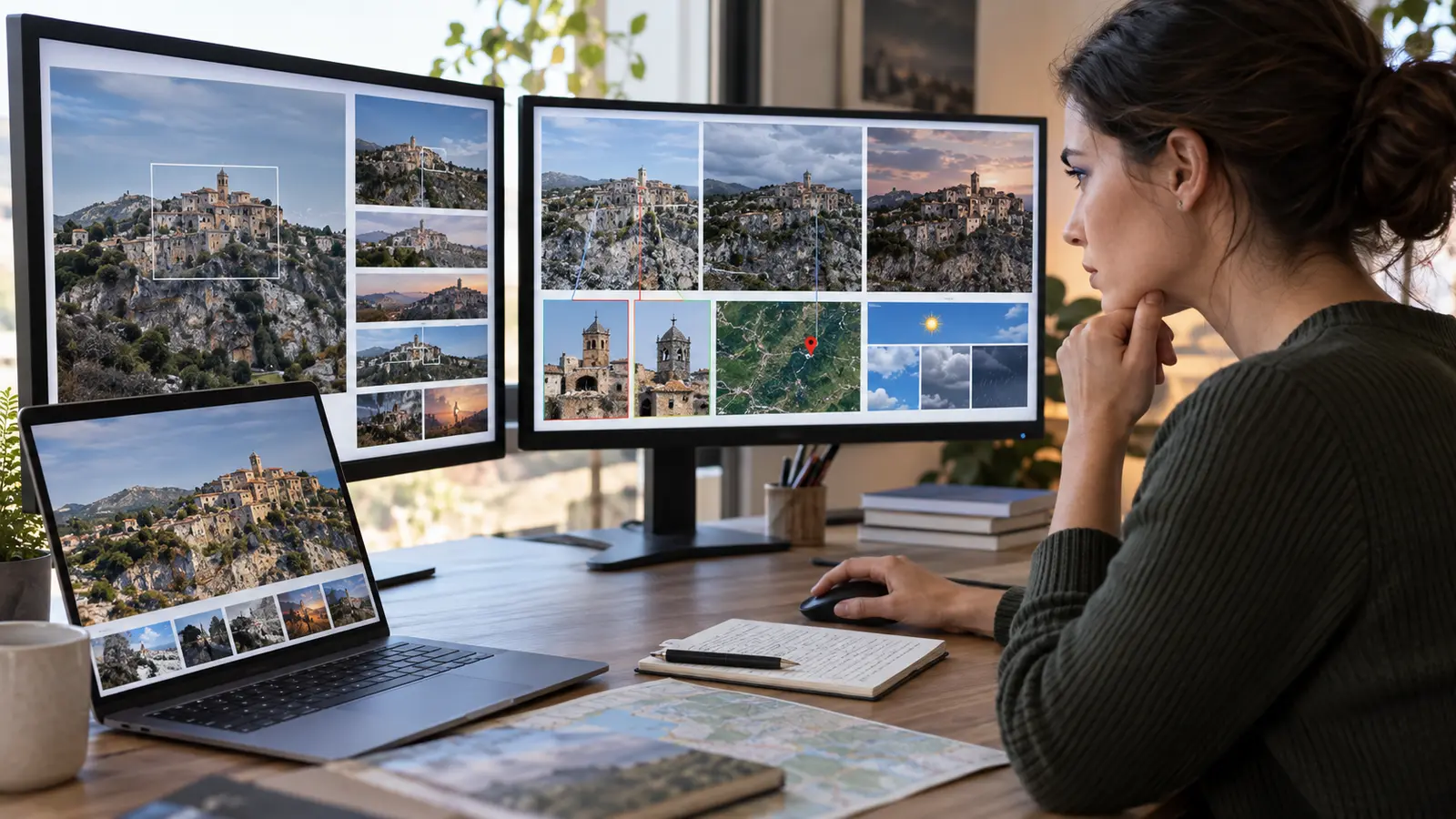
Google’s “About this image” tools can provide information about where an image has appeared and how other pages describe it. A reverse search may reveal that a genuine photograph from an older event has been attached to a new false caption.
How to check video and audio
Watch beyond the short clip. Search for the complete recording, transcript and original uploader. Notice abrupt cuts, missing questions, mismatched lip movement, unnatural reflections or audio that changes in room tone. Extracting several key frames and reverse-searching them can reveal an older source.
Technical clues alone are not enough. Compression, translation, frame interpolation and poor connections can create artifacts in authentic media. Contextual verification—who recorded it, where it first appeared and whether independent evidence matches—is usually stronger than guessing from pixels.
How Media Literacy Helps With AI-Generated Content
Generative tools can produce convincing text, pictures, voice and video. Detection tools may help, but their results can be uncertain and can change as models improve. Do not treat an automated score as a verdict.
Use the same evidence-first process: find provenance, inspect original files when possible, seek independent confirmation and ask whether the claimed event has supporting records. Content credentials and labels may add useful information, but missing metadata does not prove fabrication because platforms often strip it.
Misinformation, disinformation and malinformation
| Term | Meaning | Example pattern |
|---|---|---|
| Misinformation | False information shared without an intention to deceive | A person forwards an outdated warning believing it is current |
| Disinformation | False information deliberately created or spread to deceive | A fabricated document is presented as an official notice |
| Malinformation | Genuine information used misleadingly or to cause harm | Private details are published without relevant context |
CISA uses this MDM framework when discussing information activities. Intent can be difficult to prove from one post, so focus first on whether the content is accurate and harmful rather than casually accusing a person of deliberate deception.
Common manipulation techniques
- False urgency: “Share before it is deleted.”
- Impersonation: a lookalike account, URL, logo or document.
- Context collapse: an old or distant event presented as current and local.
- Cherry-picking: selecting one number or quotation while hiding the broader record.
- False dilemma: presenting only two choices when more exist.
- Popularity as proof: treating likes and repetition as evidence.
- Fabricated consensus: coordinated accounts creating the appearance of widespread agreement.
- Information flooding: producing so many competing claims that verification feels impossible.
Knowing these patterns helps identify questions to ask, but labels should not replace evidence. A dramatic style can accompany a true warning, while calm language can deliver a false claim.
Special care for health, money and emergencies
Media literacy becomes especially important when incorrect information could affect someone’s health, money or safety. Consequences determine how much verification is needed. Before acting on medical information, check current guidance from qualified health authorities and consult a professional for personal decisions. Before transferring money, use a known contact method to verify the request. During an emergency, prioritize official local alerts.
The World Health Organization describes an infodemic as too much information—including false or misleading information—during a disease outbreak. In high-pressure situations, simple, current guidance and clear corrections matter.
How fact-checking fits in
Fact-checkers can save time when they publish evidence, sources and a transparent method. Search the exact claim in a fact-check database or Google Fact Check Explorer. Then read the full explanation; do not rely only on a rating label.
A missing fact-check does not make a claim true. New, local or low-visibility rumors may not have been reviewed. Perform the source and evidence checks yourself.
Correcting something you shared
- Do not silently delete if people may already have acted on it.
- Post a clear correction in the same place and with similar visibility.
- Name the incorrect claim and provide the better evidence.
- Avoid repeating sensational false details more than necessary.
- Contact people directly if the error could cause immediate harm.
- Reflect on which signal you trusted too quickly.
Correction is part of information quality, not an admission that careful thinking failed. Reliable people and organizations make their update process visible.
A 60-second check before sharing
- Can I state the exact claim?
- Have I opened the original source?
- Is the date current and the location correct?
- Does the evidence support the headline?
- Can I find independent confirmation?
- Is an image or quotation missing context?
- Would I still share this if it did not trigger a strong emotion?
If the answer to several questions is no, wait. Speed benefits a rumor more than it benefits understanding.
Frequently asked questions
Is Wikipedia a reliable source?
It is useful for orientation and finding references, but quality varies by page. For an important claim, follow citations to strong original or authoritative sources.
Does a verified badge prove a post is true?
No. It may confirm identity or subscription status depending on the platform. The claim still needs evidence.
Can a peer-reviewed study be wrong?
Yes. Peer review is a quality-control process, not a guarantee. Look for replication, methods, limitations and the broader body of evidence.
Are anonymous sources always unreliable?
No. Journalists sometimes protect sources at genuine risk. Credible reporting explains why anonymity was granted and corroborates important claims.
Should I trust an AI summary?
Use it as a starting point, not evidence. Open and verify the cited primary sources because generated summaries can omit context or invent details.
Final summary
Media literacy is a repeatable way of thinking. Identify the claim, investigate the source beyond its own page, trace the evidence, check date and context, and compare independent reporting. Apply the same discipline when reading about generative AI or following a feed shaped by recommendation algorithms. For images and video, provenance and corroboration are more dependable than intuition alone.
The goal is not permanent suspicion. It is proportionate confidence: ordinary claims can receive a quick check, while health, money, safety and civic decisions deserve stronger evidence. Pause, verify and share with context.
Transparency
Sources & references
- UNESCO — Media and Information Literacy
- UNESCO — Media and Information Literate Citizens curriculum
- World Health Organization — Infodemic
- European Digital Media Observatory
- CISA — Misinformation, Disinformation and Malinformation
- Google — Fact Check Explorer
- Google Search Help — Learn more about an image
- Stanford History Education Group — Civic Online Reasoning
- International Federation of Library Associations — How to Spot Fake News
Editorially reviewed
Editorial information
SOAKJAM articles are designed for clarity, useful context and transparent sourcing. Important facts should be checked against the linked primary sources.
Found an error, outdated detail or a useful source we should consider?