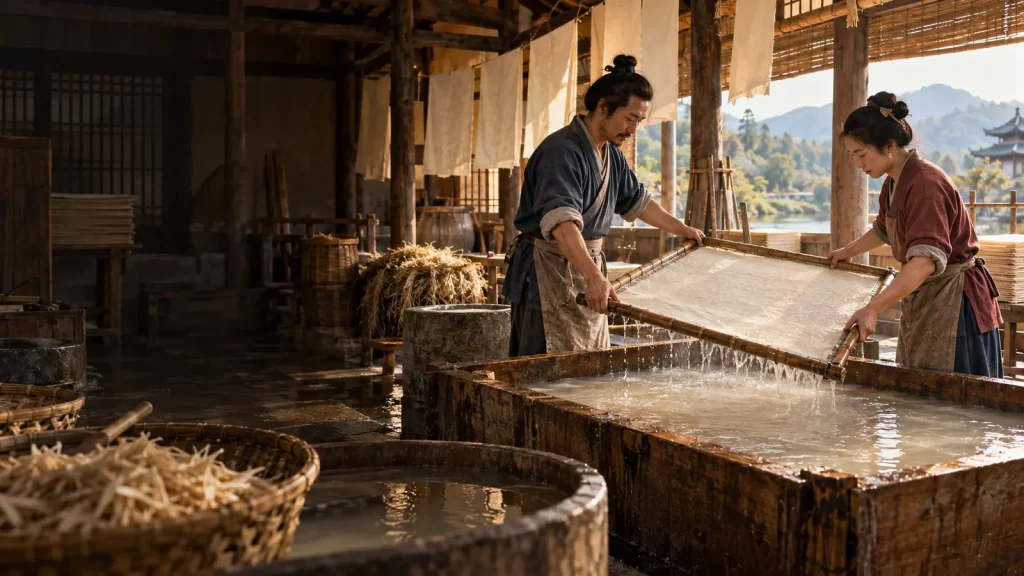

What was the Silk Road? It was not one paved highway between China and Europe. It was a changing network of land and sea routes that connected communities across Asia, Africa and Europe. Merchants, sailors, pilgrims, diplomats, craftspeople and nomadic groups moved goods between local markets, while ideas, technologies, artistic styles, languages and beliefs travelled with them.
Silk gave the network its famous modern name, but it was only one of many valuable products. Horses, textiles, spices, glass, ceramics, metals, paper, medicines, precious stones and food crops also crossed parts of the system. Few travelers completed the entire distance. Most goods passed through many hands, gaining new uses and meanings along the way.
Quick answer: The Silk Roads were overlapping trade and communication networks that developed over centuries. They linked inland caravan routes with rivers, ports and maritime routes, helping societies exchange merchandise, knowledge, religions, art and technology across Afro-Eurasia.
What was the Silk Road in simple terms?
In simple terms, what was the Silk Road? It was a network for long-distance exchange. Imagine many regional routes joining at market towns, mountain passes, oasis cities and ports. A trader might carry a load for one section, sell it to another merchant and return home. The goods could continue through several languages, currencies and political territories.
UNESCO describes the Silk Roads as gradually connected land and maritime networks through which communities exchanged silk and many other goods. Its overview of the Silk Roads emphasizes that people also transmitted knowledge, ideas, cultures, beliefs, science, arts, literature and technologies.
The plural term “Silk Roads” is often more accurate than the singular “Silk Road.” Routes shifted as empires rose and fell, borders changed, wars made particular corridors unsafe, climates affected travel and merchants found better markets. Connections ran east and west, north and south, over land and across seas.
Why was it a network rather than one road?
No authority designed or controlled the whole system. Roads already linked neighboring settlements long before they became parts of wider exchange. When stable governments protected routes, cities supplied travelers and distant markets wanted particular goods, regional connections could form much longer chains.
A caravan leaving northern China could choose different paths around the Taklamakan Desert. Routes through Central Asia branched toward the Iranian plateau, northern steppes, Indian subcontinent and eastern Mediterranean. Maritime traffic connected East Asian ports with Southeast Asia, India, the Persian Gulf, Red Sea and East African coast.
The British Museum describes the Silk Roads as overlapping networks linking communities across Asia, Africa and Europe rather than a simple line between “East” and “West.” Its Exploring the Silk Roads resource focuses on the movement of people, objects and ideas, especially during the first millennium CE.
What was the Silk Road before it had a name?
Exchange across Eurasia is older than the name Silk Road. Pastoral communities, farmers, miners and towns traded regionally for thousands of years. Archaeological evidence shows that materials and technologies moved between distant areas long before a continuous historical record described the routes.
Histories often highlight the late second century BCE, when the Han dynasty expanded westward and the envoy Zhang Qian returned with information about Central Asian societies and markets. These events strengthened connections between Han China and regions farther west, but they did not create every road from nothing.
The networks expanded and contracted at different times. They were particularly important during parts of the Han and Roman periods, the Kushan and Parthian eras, the Tang dynasty, the early Islamic centuries and the Mongol period. Activity continued in changing forms into later centuries, alongside increasingly important maritime trade.
The German geographer Ferdinand von Richthofen popularized the term “Silk Road” in the nineteenth century. The label grouped a much older and more complicated reality under one memorable name. It can be useful, provided it does not hide the network’s many routes, peoples and periods.
What was the Silk Road’s overland geography?
From northern China to the Tarim Basin
Major routes connected the Han and later Chinese capitals with the Hexi Corridor, a long passage between mountains and desert. Dunhuang stood near a strategic branching point. Travelers then followed oasis settlements around the northern or southern edges of the Taklamakan Desert, where water and supplies made movement possible.
Across Central Asian cities and grasslands
Routes converged around places such as Kashgar and continued through mountain valleys and fertile regions toward cities including Samarkand, Bukhara and Merv. Other paths crossed the Eurasian steppe. Central Asia was not an empty space between civilizations; it contained powerful states, farming communities, nomadic confederations and influential trading peoples.
Toward West Asia and the Mediterranean
From Central Asia, branches crossed the Iranian plateau and reached Mesopotamia, Anatolia, the Levant and Mediterranean ports. The Metropolitan Museum of Art’s study of trade between Rome and Asian empires describes strategically located trading posts and routes through Parthian territory toward Bactria and other regions.
These descriptions should not be read as one fixed itinerary. A route useful in one century could become less important in another. Political security, taxes, demand, river conditions and access to pasture or water continually reshaped the practical map.
The maritime Silk Roads
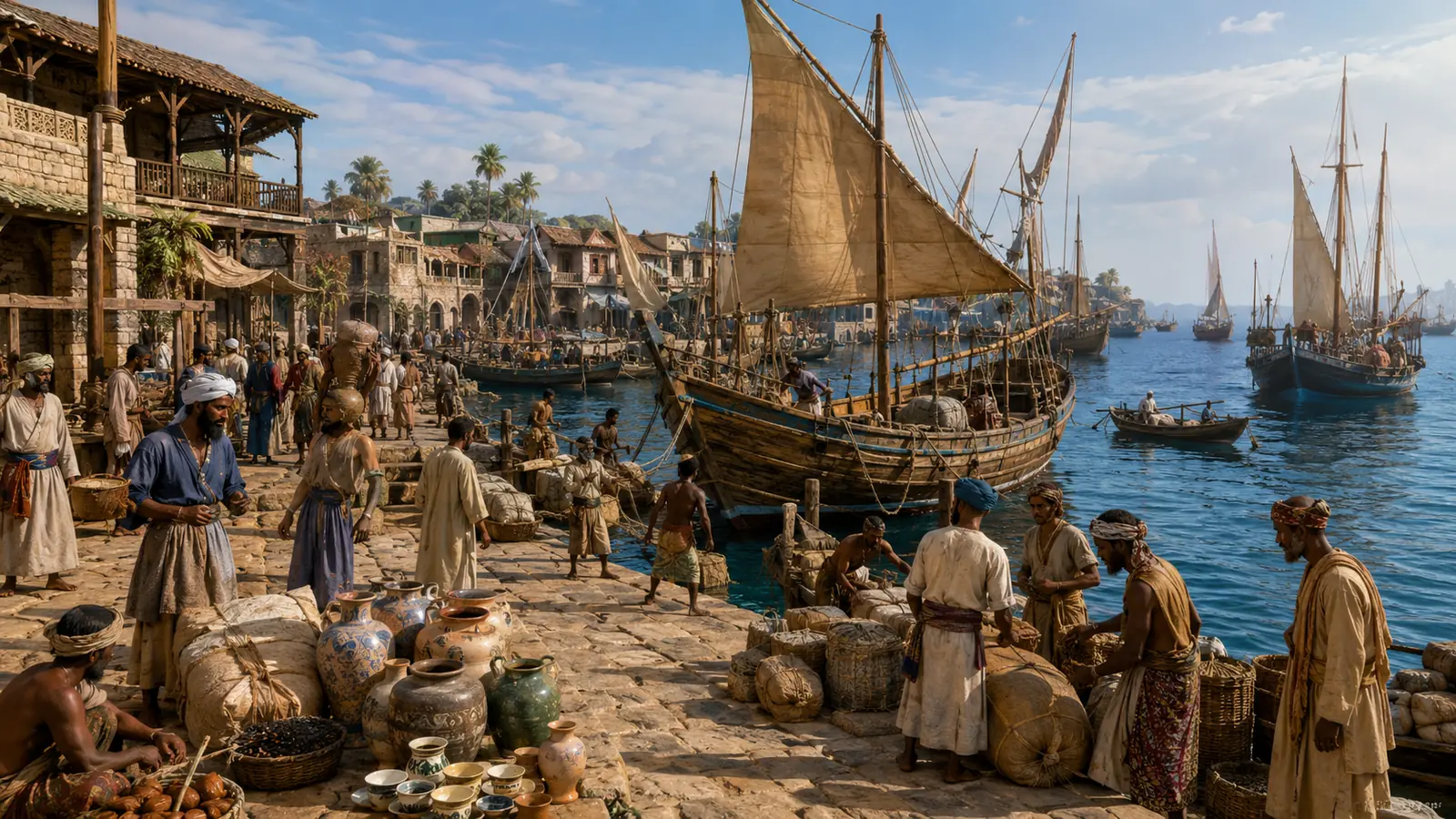
A complete answer to “what was the Silk Road?” must include the sea. Maritime routes carried large quantities of goods between ports and connected coastal societies to inland markets. Monsoon wind patterns helped sailors plan seasonal journeys across the Indian Ocean.
Ships linked Chinese and Southeast Asian ports with the Indian subcontinent, Sri Lanka, the Persian Gulf, Arabian Peninsula, Red Sea and East African coast. Cargo could then continue by river, caravan or Mediterranean shipping. Ports became multilingual centers where merchants arranged credit, storage, translation, repair and onward transport.
Maritime routes were not merely a late replacement for caravans. Land and sea systems coexisted and supported one another. UNESCO notes that maritime “spice routes” were an essential part of the broader network, while the Met’s account of the Tang dynasty describes seaborne connections from southern China through India and the Persian Gulf to East Africa.
How did trade actually work?
Popular stories sometimes imagine one merchant walking from China to Rome with a single cargo. Long-distance exchange more often worked as a relay. Producers sold to local traders; regional merchants carried goods to another city; wholesalers divided or combined cargo; and new owners moved it toward different markets.
Caravans managed risk
Travelers grouped together for security, guidance and shared resources. Camels were valuable in dry regions because they could carry heavy loads and tolerate difficult conditions. Horses, mules, donkeys, yaks, oxen, river craft and human porters served other landscapes.
Oasis cities connected routes
Oases provided water, food, markets and workshops. Cities collected taxes, offered storage and connected nomadic and settled communities. Their residents included interpreters, money changers, artisans, religious specialists and officials as well as merchants.
Caravanserais supported travelers
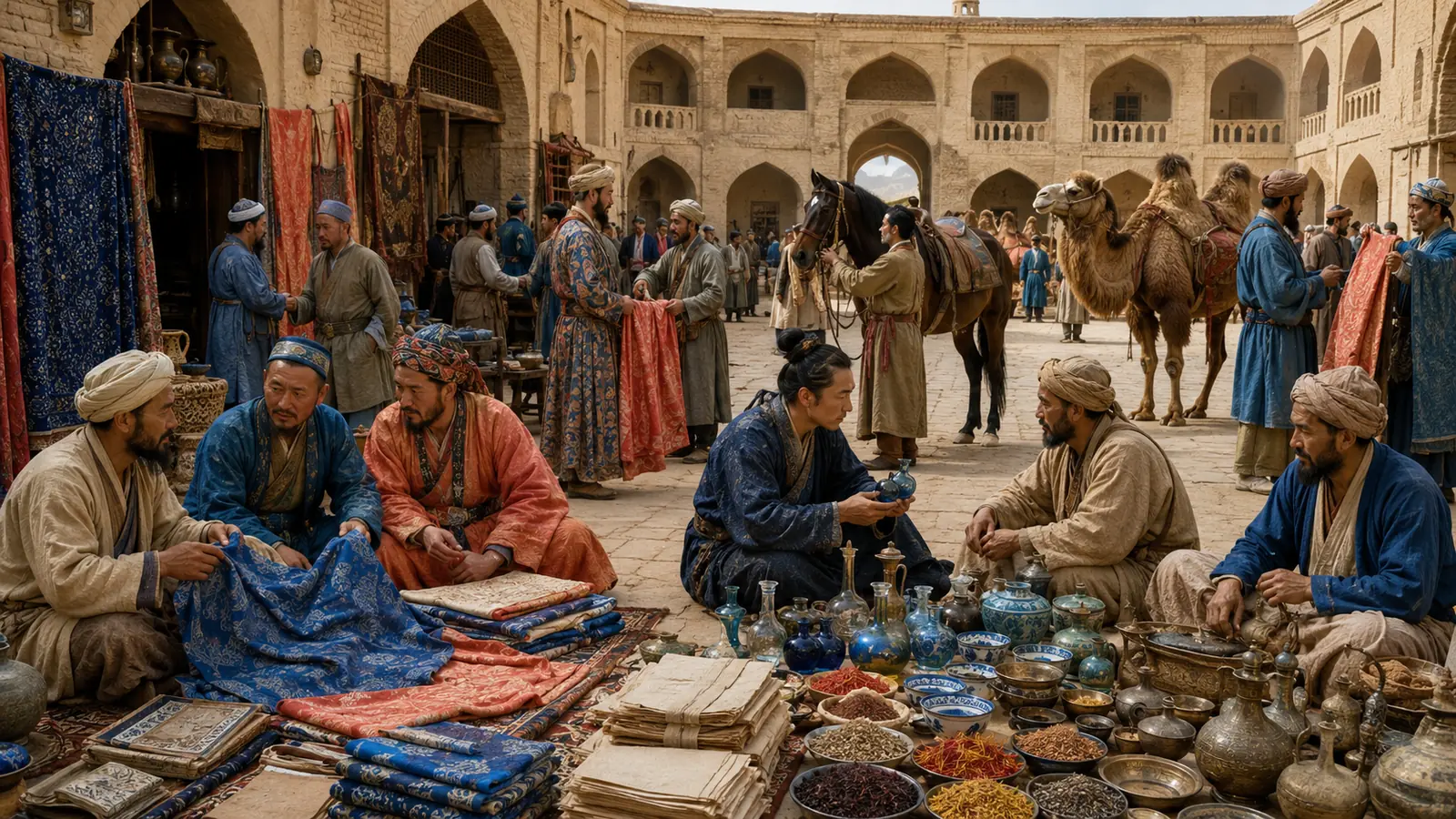
Roadside inns and enclosed courtyards offered shelter for people, animals and goods. The exact form varied by place and period. These facilities reduced some risks of long-distance travel, though merchants still faced weather, theft, disease, political conflict and changing tolls.
What was the Silk Road used to trade?
Silk was light, valuable and desired far from its production centers. It could serve as clothing, diplomatic gift, religious offering or store of wealth. Yet focusing only on silk hides the variety of everyday and luxury trade.
| Type of exchange | Examples | Why it mattered |
|---|---|---|
| Textiles | Silk, cotton, wool, felt and embroidered cloth | Clothing, furnishings, status, tribute and portable value |
| Animals and animal products | Horses, camels, livestock, furs, hides and musk | Transport, warfare, agriculture, clothing and luxury markets |
| Food and aromatics | Spices, fruits, nuts, sugar, tea and medicinal ingredients | Cuisine, preservation, medicine and ritual |
| Manufactured goods | Glassware, ceramics, metalwork, paper and crafted objects | Practical use, artistic influence and technical knowledge |
| Precious materials | Gold, silver, jade, gems and pearls | Currency, ornament, political display and religious use |
Goods changed as they moved. A ceramic style could inspire local potters who lacked the original materials. A foreign musical instrument might be redesigned for local performance. Imported cloth could be cut into new garments or reused to wrap sacred objects. Trade therefore produced adaptation, not simple copying.
Who travelled and traded?
The Silk Roads belonged to no single people. Chinese, Central Asian, Iranian, Indian, Arab, Turkic, Mongol, Tibetan, Armenian, Jewish, Greek, Roman, East African and many other communities participated at different times and places. Labels should not hide the mixed identities common in borderlands and trading cities.
Sogdian merchants from Central Asia became especially influential during the first millennium CE. They built commercial communities, worked as interpreters and diplomats, and helped move objects and cultural practices. The Smithsonian’s account of the Sogdians on the Silk Roads highlights their trade in silk, horses, gemstones, musk, furs, metalwork and textiles.
Merchants were only part of the story. Envoys carried political messages and gifts. Pilgrims sought sacred sites and texts. Scholars, physicians and craftspeople shared knowledge. Soldiers and officials protected or controlled roads. Migrants, captives and refugees also moved through these networks, sometimes without choosing to travel.
Religions, languages and ideas
Religious communities used the same routes as traders. Buddhism spread from South Asia through Central Asia into China and beyond, supported by monasteries, translators, patrons and pilgrims. Forms of Christianity, Manichaeism, Zoroastrian traditions and later Islam also travelled through connected regions.
Beliefs did not arrive unchanged. Texts had to be translated, unfamiliar concepts explained and images adapted to local artistic traditions. Cave temples, manuscripts, inscriptions and portable objects preserve evidence of these encounters. A city could contain several religious communities serving travelers from different backgrounds.
Languages were practical tools of trade and diplomacy. Multilingual merchants and translators connected people who did not share a mother tongue. Loanwords, scripts and writing practices moved with commercial and religious communities, leaving traces far beyond their places of origin.
Art, science and technology
The routes carried ways of making things as well as finished objects. Papermaking knowledge moved westward from China through Central Asia into the Islamic world and later Europe. Techniques in metalwork, glassmaking, ceramics, textiles and book production circulated through workshops and skilled migration.
Artistic exchange can be seen in clothing, decorative motifs, musical instruments, painting and sculpture. Local artists selected and transformed foreign elements rather than reproducing them mechanically. The Met’s study of a ninth-century Iraqi bowl emulating Chinese stoneware, for example, explains how potters created a local response to imported Chinese white wares.
Astronomical, mathematical and medical knowledge also crossed linguistic and political boundaries, although ideas rarely travelled in a straight line from one inventor to one recipient. Translation, commentary, experimentation and institutional support shaped what each society adopted.
Exchange also carried danger
Long-distance networks did not bring only prosperity and creativity. Armies used the same corridors. States competed for cities, passes and tax revenue. Traders could face robbery, enslavement, shipwreck, harsh weather and political violence.
Human and animal movement could also help infectious diseases travel between regions. Historians continue to study the routes and timing of particular outbreaks, so simple claims that one road “caused” a pandemic should be treated carefully. The broader lesson is that connectivity can spread risks as well as benefits.
Why did routes grow, shift and decline?
The Silk Roads did not have one rise and one sudden fall. Particular corridors prospered when governments provided security, cities maintained markets and demand justified the cost. They weakened when warfare, taxation, environmental change or political fragmentation made alternatives more attractive.
The Mongol Empire in the thirteenth and fourteenth centuries brought large parts of Eurasia under related rule and facilitated movement across some long-distance routes. Later political changes altered those conditions. At the same time, improved maritime networks could move bulk cargo more efficiently than overland caravans.
European expansion into oceanic trade from the fifteenth century changed global commercial patterns, but it did not erase older Asian, African and Middle Eastern networks. Ports, caravan routes and regional exchanges continued. It is more accurate to speak of transformation and rerouting than a single closing date.
Common myths about the Silk Road
- Myth: It was one road. It was a changing set of connected land and maritime routes.
- Myth: Only silk was traded. Animals, food, metals, ceramics, textiles, paper and many other goods moved.
- Myth: Traders regularly crossed the whole network. Most exchange happened through relays and regional markets.
- Myth: It connected only China and Rome. Communities across Central, South, Southeast and West Asia, Africa and Europe participated.
- Myth: Exchange was always peaceful. Cooperation existed alongside conquest, coercion, disease and competition.
- Myth: Marco Polo created or discovered it. The networks were ancient long before his thirteenth-century travels.
What was the Silk Road’s lasting legacy?
The networks demonstrate that past societies were not isolated. Objects found far from their materials’ sources, multilingual documents, shared artistic forms and translated texts reveal centuries of contact. Modern cultures across Afro-Eurasia contain foods, words, techniques, beliefs and designs shaped partly by these exchanges.
UNESCO’s Silk Roads Programme studies this shared heritage and promotes understanding of the plural identities produced by commercial, cultural and scientific interaction. The Chang’an–Tianshan Corridor, inscribed on the World Heritage List, preserves a connected series of settlements, trade centers, passes, fortifications, religious sites and other evidence across China, Kazakhstan and Kyrgyzstan.
The historical network should not be treated as a perfect model of modern globalization, but the comparison can be useful. Today information may cross continents in fractions of a second through infrastructure such as the submarine cables explained in SOAKJAM’s guide to the internet beneath the sea. The technologies differ, yet both systems depend on routes, hubs, maintenance, political cooperation and local connections.
Frequently asked questions
What was the Silk Road mainly used for?
It supported trade and communication between connected regions. Goods were central, but travelers also carried diplomatic messages, religious texts, artistic styles, technologies and practical knowledge.
How long was the Silk Road?
There is no single correct length because it was not one line. Different branches, maritime routes and regional connections changed across centuries. Any precise total depends on which routes a map includes.
Did anyone travel the entire Silk Road?
Some travelers made exceptionally long journeys, but they were unusual. Most merchants worked within a region, and goods moved through many owners and transport systems.
Why was silk so valuable?
Silk combined beauty, light weight, skilled production and limited availability in some markets. It served as luxury clothing, decoration, diplomatic gift, tribute and portable wealth.
Was the Silk Road only over land?
No. Maritime routes across East and Southeast Asian seas and the Indian Ocean were essential parts of long-distance exchange and connected with inland roads through port cities.
Does the Silk Road still exist?
The historical network no longer operates in its old political and technological form. Many routes, cities, ports, monuments and cultural traditions remain, and modern transport corridors sometimes follow or reference parts of its geography.
The short version
So, what was the Silk Road? It was a flexible network of overland and maritime routes across Afro-Eurasia, built from many local connections rather than one continuous road. Goods usually moved through relays, while travelers also spread religions, languages, technologies, art and knowledge.
Its history includes cooperation and creativity as well as conflict, exploitation and disease. Understanding that complexity makes the Silk Roads more meaningful: they show how deeply interconnected societies were centuries before modern transport and digital communication.
Sources and further reading
- UNESCO: About the Silk Roads
- UNESCO World Heritage Centre: Chang’an–Tianshan Corridor
- British Museum: Exploring the Silk Roads
- The Metropolitan Museum of Art: Trade Routes Between Europe and Asia
- Smithsonian: The Sogdians on the Silk Roads
Transparency
Sources & references
- UNESCO — About the Silk Roads
- UNESCO — Silk Roads Programme
- UNESCO World Heritage Centre — Chang’an–Tianshan Corridor
- British Museum — Exploring the Silk Roads
- The Metropolitan Museum of Art — Trade Routes Between Europe and Asia
- The Metropolitan Museum of Art — Trade Between Rome and Asian Empires
- The Metropolitan Museum of Art — Bowl Emulating Chinese Stoneware
- Smithsonian — The Silk Road: Connecting Peoples and Cultures
- Smithsonian — The Sogdians on the Silk Roads
Reviewed and updated
Editorial information
SOAKJAM articles are designed for clarity, useful context and transparent sourcing. Important facts should be checked against the linked primary sources.
Found an error, outdated detail or a useful source we should consider?