
Earth has always experienced natural climate changes, but the rapid warming observed since the industrial era has a clear modern cause. Understanding what causes global warming begins with a simple energy imbalance: human activities have increased gases that slow the escape of heat from the atmosphere, so the planet retains more energy than it releases.
That extra energy does not stay only in the air. Most enters the ocean, while some warms land, melts ice and changes the water cycle. The consequences therefore appear as more than a rising number on a thermometer. They reach homes, farms, health systems, coastlines, ecosystems and the cost of preparing for hazards.
Quick answer: The main answer to what causes global warming is the burning of coal, oil and gas, together with deforestation, agriculture and industrial processes. These activities add carbon dioxide, methane, nitrous oxide and other greenhouse gases to the atmosphere. The gases strengthen Earth’s natural greenhouse effect and reduce how quickly heat escapes to space.
Global warming at a glance
| Driver or process | Role in today’s climate | Important distinction |
|---|---|---|
| Carbon dioxide | Largest contributor to long-term human-caused warming | Accumulates and persists; every additional amount adds warming |
| Methane | Powerful warming gas with a shorter atmospheric lifetime than carbon dioxide | Rapid cuts can slow near-term warming |
| Nitrous oxide | Long-lived gas linked strongly to fertilizer and agriculture | Also affects stratospheric ozone |
| Aerosols | Some human-made particles cool the climate by reflecting sunlight or changing clouds | They mask part of greenhouse warming but harm health |
| Solar and volcanic changes | Influence natural variability | Do not explain the sustained modern warming trend |
| Feedbacks | Amplify or reduce an initial change | Water vapor and shrinking ice amplify warming; they did not start the present trend |
The natural greenhouse effect
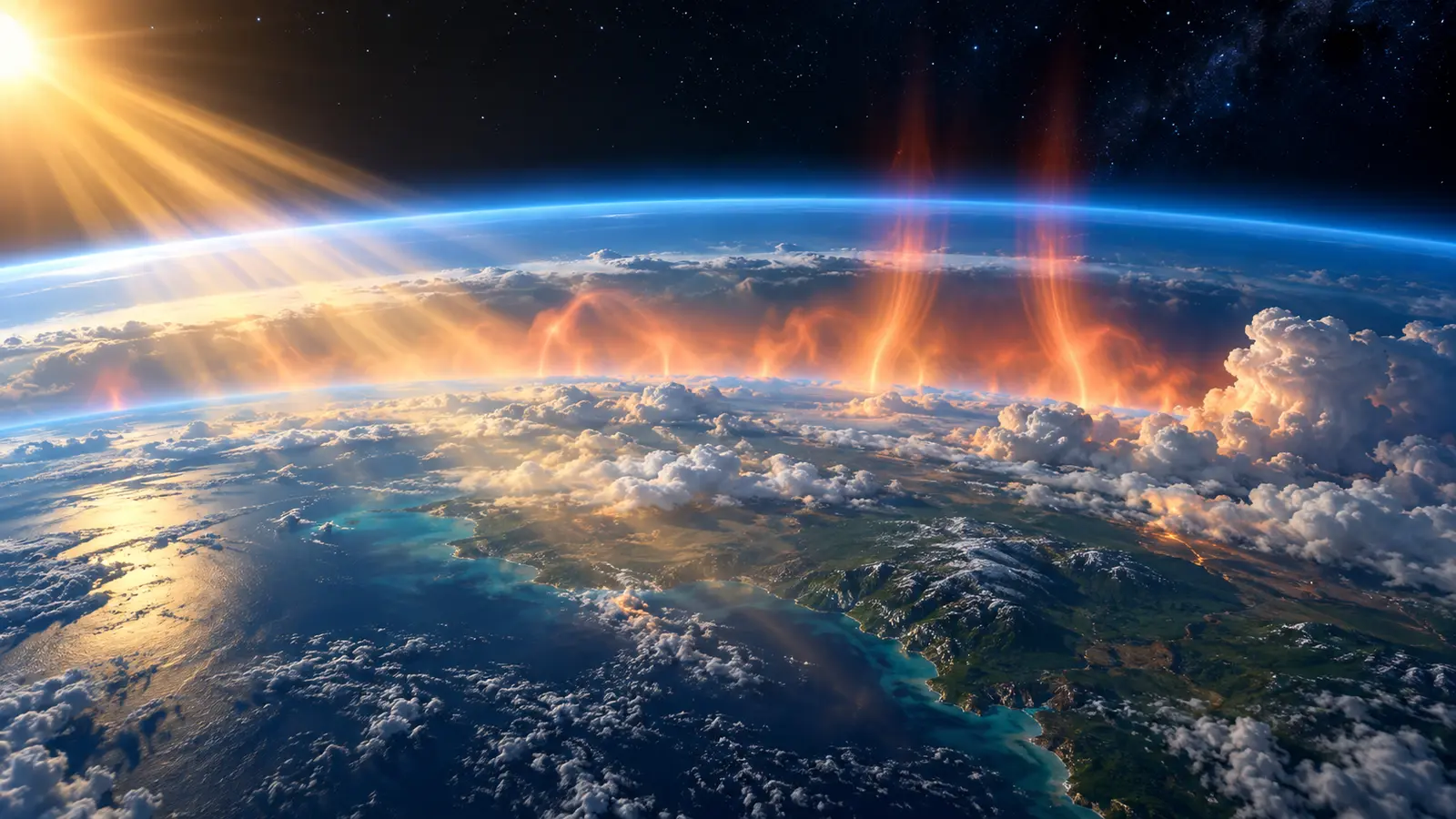
Sunlight reaches Earth mainly as shortwave energy. The surface absorbs part of it and releases energy upward as infrared heat. Certain atmospheric gases absorb and re-emit some of that infrared energy. This natural greenhouse effect keeps the planet warm enough for liquid water and life.
The problem is not that the greenhouse effect exists. It is that human activity has strengthened it unusually quickly. Adding more heat-trapping gases is like making it harder for the planet to lose energy. The surface and lower atmosphere warm until incoming and outgoing energy move toward a new balance.
NASA’s explanation of the causes of climate change notes that current warming cannot be explained by the Sun. Measurements show no long-term increase in incoming solar energy capable of producing the observed pattern. The lower atmosphere has warmed while the upper atmosphere has cooled—one of the fingerprints expected when greenhouse gases trap more heat below.
Carbon dioxide: the largest long-term driver
When coal, oil or natural gas burns, carbon that was stored underground combines with oxygen and enters the atmosphere as carbon dioxide. Cement manufacture releases additional carbon dioxide through chemical reactions. Cutting forests removes living carbon stores and can release carbon from vegetation and soil.
Oceans and land absorb a substantial share of human carbon dioxide emissions, but not all of them. The remainder raises the atmospheric concentration. Because a portion stays in the climate system for a very long time, carbon dioxide is not a problem that disappears immediately when one factory closes or one year’s emissions fall.
NOAA’s Global Monitoring Laboratory measures atmospheric carbon dioxide using observatories and sampling networks. Ice cores extend the record backward, allowing scientists to compare modern concentrations with air trapped long before direct instruments existed.
This evidence is central to what causes global warming: the added carbon carries the chemical signature expected from fossil fuels, atmospheric oxygen changes consistently with combustion, and the measured increase matches emissions when ocean and land uptake are considered.
Methane, nitrous oxide and industrial gases
Carbon dioxide is not alone. Methane comes from fossil-fuel production and transport, livestock digestion, rice cultivation, landfills and natural wetlands. It traps more heat per molecule than carbon dioxide over shorter comparison periods, but it also breaks down more quickly. Reducing avoidable leaks and other methane sources can therefore lower near-term warming pressure.
Nitrous oxide is strongly connected to nitrogen fertilizers, manure management, industry and combustion. It remains in the atmosphere for many decades. Fluorinated gases used in refrigeration and industry may be present in smaller quantities yet have very high warming effects per molecule.
Water vapor is the most abundant greenhouse gas, but in current climate change it mainly acts as a feedback. Warmer air can hold more water vapor, and the additional vapor strengthens warming. Human emissions of carbon dioxide and other long-lived gases provide the initial push; water vapor responds and amplifies it.
Why scientists are confident about the cause
Climate attribution does not rest on one thermometer or one computer model. Researchers combine independent lines of evidence:
- Surface stations, ocean measurements and satellites record widespread warming.
- Greenhouse-gas concentrations have increased sharply since industrialization.
- Carbon isotopes and declining atmospheric oxygen identify fossil-fuel combustion.
- Oceans have accumulated enormous amounts of heat.
- Glaciers and ice sheets are losing mass while sea level rises.
- Nights and winters often warm differently from days and summers in patterns consistent with greenhouse forcing.
- The lower atmosphere warms while the stratosphere cools.
- Models reproduce the observed long-term trend only when human influences are included.
The IPCC Sixth Assessment Synthesis Report evaluates thousands of studies from researchers around the world. Its conclusion is not that natural factors vanished, but that human influence has unequivocally warmed the atmosphere, ocean and land.
Natural factors still affect individual years
Volcanic eruptions can send reflective particles into the stratosphere and cool the surface temporarily. Small changes in solar output influence climate. Ocean patterns such as El Niño move heat between ocean and atmosphere and rearrange rainfall. These processes help explain why every year is not warmer than the one before.
They do not account for the multi-decade rise. An El Niño event can lift a year’s global surface temperature, and La Niña can temporarily suppress it, while the greenhouse-driven baseline continues upward. SOAKJAM’s companion guide to El Niño and La Niña explains that shorter natural cycle.
Answering what causes global warming therefore requires separating a long-term trend from temporary variation. Weather is the state of the atmosphere today; climate describes patterns and statistics over longer periods. A cold week in one country does not cancel global warming, just as one hot afternoon cannot prove its full cause.
Why warming is not even everywhere
Global temperature is an average. Land generally warms faster than ocean because water can mix heat downward and use energy for evaporation. The Arctic has warmed especially rapidly as snow and sea ice shrink, exposing darker surfaces that absorb more sunlight. Winds and ocean currents distribute energy unevenly.
Regional rainfall is even more complicated. A warmer atmosphere can hold more moisture, increasing the potential for heavy precipitation, yet changing circulation and evaporation can deepen drought elsewhere. Local geography, natural variability and infrastructure decide how a global shift becomes a personal experience.
Feedbacks: responses that change the size of warming
A feedback is not the same as an original forcing. Melting reflective ice reveals darker land or ocean, which absorbs more solar energy. Warming adds water vapor to the atmosphere. Thawing permafrost can release greenhouse gases. These positive feedbacks amplify an initial warming.
Some responses oppose warming. A warmer Earth emits more infrared energy to space, providing a stabilizing influence. Clouds can cool by reflecting sunlight and warm by trapping infrared energy; their net response depends on cloud type, height and location. Scientists include these processes and their uncertainties when estimating future change.
Where the extra heat goes
Air temperature receives most public attention, but the ocean absorbs the majority of the excess heat in the climate system. Warmer water expands, contributing to sea-level rise. Ocean heat can stress coral reefs, alter habitats and provide more energy and moisture for some storms.
Other energy melts glaciers, ice sheets and sea ice or warms land and the atmosphere. Looking at all these reservoirs prevents a misleading conclusion from a short pause in surface warming. The planetary energy imbalance can continue even when year-to-year air temperatures fluctuate.
The World Meteorological Organization’s State of the Global Climate 2025 summary describes record climate imbalance and continuing consequences across land, sea and ice. It also illustrates why one exceptional calendar year should be interpreted within the longer trend.
Global warming and climate change are related, not identical
Global warming refers mainly to the long-term increase in Earth’s average surface temperature. Climate change includes that warming and the wider changes it drives: rainfall shifts, sea-level rise, ice loss, ocean change and altered extremes.
The phrase “climate crisis” emphasizes severity and urgency, while “climate change” remains the scientific umbrella. The terminology does not change what causes global warming. Stronger greenhouse forcing is the physical mechanism, regardless of which public phrase is used.

What does 1.5°C mean?
Temperature targets are usually compared with an 1850–1900 pre-industrial baseline and assessed as a long-term global average. A single calendar year above 1.5°C does not by itself mean the Paris Agreement’s long-term temperature threshold has permanently been crossed. Natural variability can push an individual year higher or lower.
Every fraction of a degree still matters. Risks do not wait for a magical line and then switch on. Heat exposure, heavy rainfall, ecosystem loss and coastal impacts generally grow as warming increases. Limiting the peak reduces harm and the adaptation burden.
How warming changes risks for people
Climate change does not create every disaster by itself. A hazard becomes a disaster through exposure and vulnerability: where people live, the strength of buildings, access to warnings, health, income, governance and the condition of ecosystems.
Warming can make heat extremes more frequent and intense, increase atmospheric moisture available for heavy rainfall, dry vegetation in some fire-prone regions and raise the coastal baseline from which storm surge operates. The effect on a specific event needs formal attribution analysis rather than a slogan.
Stopping warming: why net zero matters
Carbon dioxide accumulates, so stabilizing temperature requires bringing net human carbon dioxide emissions to approximately zero. “Net” allows remaining emissions to be balanced by durable removals, but deep direct cuts are necessary because removal capacity is limited, costly and not always permanent.
Methane and other gases also need strong reductions. Replacing unabated fossil-fuel use, improving efficiency, electrifying suitable activities, reducing leaks, protecting ecosystems and changing industrial processes are parts of the transition. Carbon removal can complement these steps; it cannot make unlimited emissions harmless.
This is another practical way to understand what causes global warming: if carbon dioxide emissions continue above removals, atmospheric carbon dioxide continues accumulating and temperature pressure rises.
Mitigation and adaptation work together
Mitigation reduces the emissions that drive future change or increases durable removals. Adaptation reduces harm from conditions already present or expected. Clean electricity and methane controls are mitigation; flood-safe construction, heat action plans and drought-resilient water systems are adaptation.
They are complements, not substitutes. Adaptation becomes harder and more expensive as warming grows, while mitigation cannot remove every impact that communities already face. Some actions do both: restoring mangroves can store carbon while reducing wave damage, provided the ecology and local rights are respected.
What can an individual realistically do?
Personal choices matter, but they occur inside systems. A renter cannot choose a building’s insulation; a commuter cannot ride a train that does not exist. Governments, utilities, manufacturers and financial institutions shape the available options.
Useful individual actions often combine direct reductions with influence:
- Reduce avoidable energy waste and choose efficient equipment when replacing it.
- Use lower-emission transport where it is safe and practical.
- Waste less food and consider lower-emission meals.
- Repair, reuse and keep suitable products longer.
- Support credible workplace, community and public policies.
- Prepare households for heat, flooding or other local hazards.
A carbon calculator can help identify large categories, but it is an estimate, not a moral score. The companion article on how to reduce your carbon footprint separates high-impact decisions from attractive but minor gestures.
How scientists measure a changing global average
There is no single thermometer for the whole planet. Research groups combine thousands of land stations with measurements from ships, buoys and satellites. They correct for known changes such as a station moving, a ship changing its intake method or the mix of locations changing over time. Independent teams use different methods and still find the same broad warming pattern.
Urban heat islands are real local effects, but they do not explain what causes global warming. Climate datasets compare neighboring stations, account for urbanization and include remote land and ocean regions. Glaciers, spring timing, sea level, ocean heat and satellite observations provide evidence that does not depend on city thermometers.
Short records can be misleading because natural variation is noisy. A start year dominated by an unusually warm El Niño or a cool volcanic period can change the apparent short trend. Scientists therefore examine long periods, multiple indicators and the physical mechanisms behind them. This careful measurement is why the answer to what causes global warming is stronger than a simple line drawn through a few selected years.
Common misunderstandings
“The climate changed before, so this must be natural”
Past climates changed for identifiable reasons such as orbital cycles, solar variation, volcanoes and greenhouse gases. Natural change demonstrates that climate responds to forces; it does not show that today’s added greenhouse gases have no effect.
“Carbon dioxide is only a tiny part of the atmosphere”
A substance does not need to be abundant to have a strong effect. Ozone is also scarce yet crucial. The relevant questions are how the molecule interacts with infrared radiation, how much its concentration changed and how long it persists.
“More carbon dioxide is always good for plants”
Carbon dioxide can stimulate growth under some conditions, but plants also require water, nutrients and suitable temperatures. Heat, drought, pests, fire and nutrient changes can offset benefits. Crops and ecosystems respond as whole systems.
“Scientists predicted an ice age”
A minority of papers discussed cooling influences decades ago, while greenhouse warming research was already substantial. Scientific assessment evaluates the full literature. Observations since then have strengthened, not weakened, the evidence for human-caused warming.
Frequently asked questions
What is the biggest cause of current warming?
Human carbon dioxide emissions are the largest long-term contributor, especially from fossil-fuel combustion, with deforestation and cement also important. Methane, nitrous oxide and industrial gases add further warming.
Is the ozone hole the cause?
No. Ozone depletion and global warming are different environmental problems, although some chemicals affect both. International controls have successfully reduced many ozone-depleting substances.
Can volcanic emissions exceed human carbon dioxide emissions?
Globally, human activities emit far more carbon dioxide than volcanoes in ordinary years. Large eruptions more often cause temporary surface cooling through reflective particles.
Would warming stop immediately if emissions stopped?
Weather and ocean conditions would continue varying, and some impacts such as sea-level rise would persist. Global temperature would broadly stabilize after net carbon dioxide emissions reached zero rather than quickly returning to its earlier level.
Is uncertainty a reason to wait?
No. Uncertainty includes the possibility of worse outcomes as well as better ones. Risk management uses the best evidence available and updates decisions as knowledge improves.
Final summary
The evidence for what causes global warming comes from basic physics, atmospheric chemistry, direct measurements, paleoclimate records, ocean heat, ice loss and models tested against observations. Human-produced greenhouse gases explain the sustained modern trend; natural variability explains many temporary ups and downs around it.
Knowing what causes global warming also clarifies the response. Cut the gases that create the energy imbalance, protect and expand durable carbon stores, and prepare communities for changes that can no longer be avoided. The issue is global, but its effects and fair solutions are deeply human: safer homes, reliable energy, healthy air, secure food and protection for people with the fewest resources.
Transparency
Sources & references
- NASA Science — Causes of Climate Change
- NASA Science — Evidence
- IPCC — Climate Change 2023: Synthesis Report
- NOAA Climate.gov — Climate Change: Atmospheric Carbon Dioxide
- WMO — Earth’s Climate Swings Increasingly Out of Balance
- UNFCCC — The Paris Agreement
- United States EPA — Overview of Greenhouse Gases
Editorially reviewed
Editorial information
SOAKJAM articles are designed for clarity, useful context and transparent sourcing. Important facts should be checked against the linked primary sources.
Found an error, outdated detail or a useful source we should consider?