

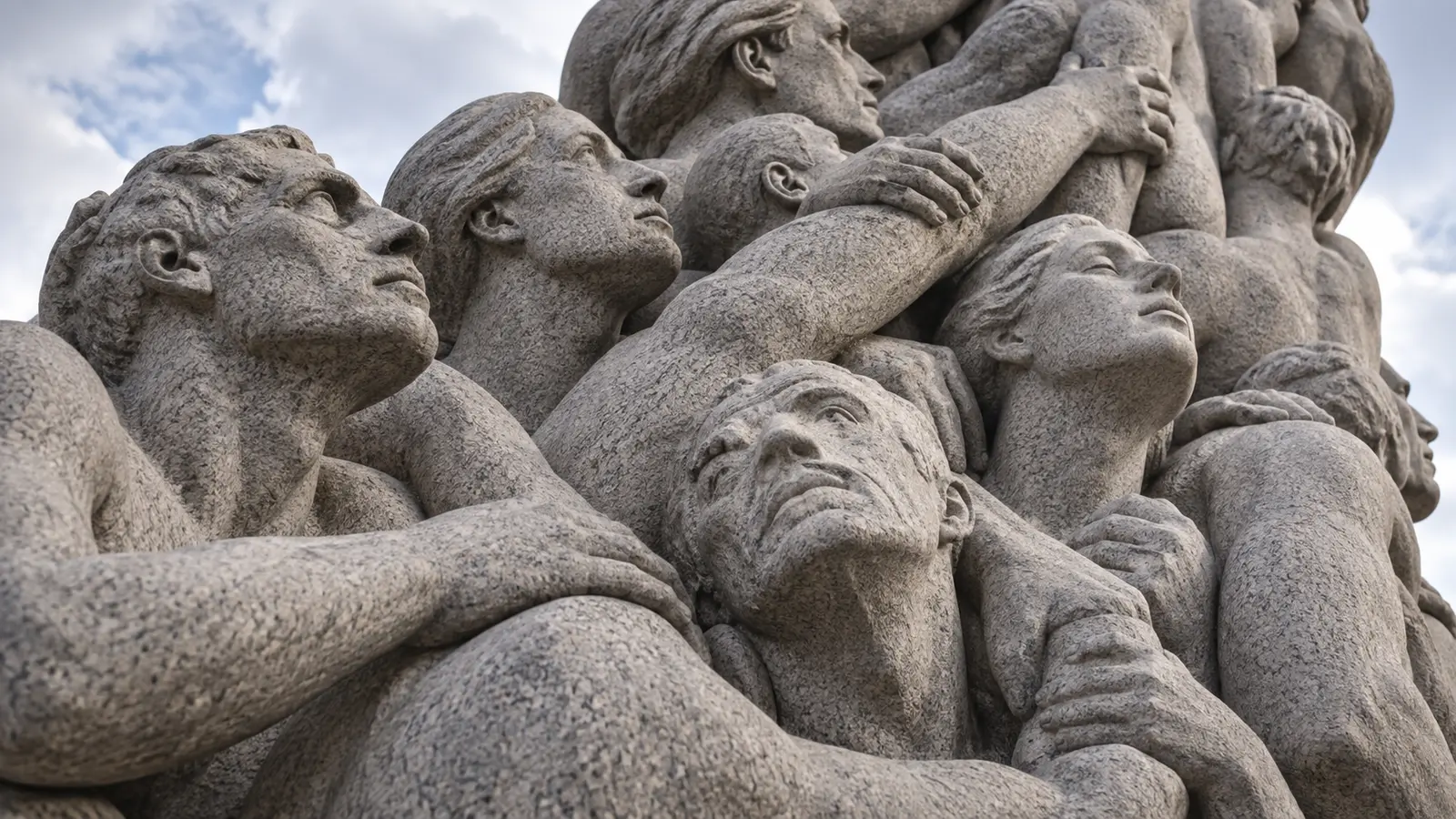
At first glance, a photograph of the Monolith in Vigeland Park can feel unsettling. It is crowded with human bodies—children, adults and older people—pressed together so tightly that one figure seems to flow into the next. Some appear to climb. Others seem to be held up, pulled down or carried by the crowd.
This is the Monolith in Vigeland Park, Oslo, one of Norway’s best-known public sculptures. Online captions sometimes describe it as a tower of tortured souls, a monument to hell or even an occult object. Those descriptions make a striking picture more dramatic, but they leave out the history that helps us understand what we are actually seeing.
Quick answer: The Monolith in Vigeland Park is a twentieth-century sculpture designed by Norwegian artist Gustav Vigeland. It is carved from a single block of granite, stands about 17 metres high and contains 121 intertwined human figures. Vigeland did not prescribe one final meaning. The work has been read as a vision of resurrection, humanity’s spiritual longing, the struggle for existence, or a dreamlike image of people bound together through life and death.
What exactly is the Monolith in Vigeland Park?
The Norwegian name is Monolitten. “Monolith” comes from Greek roots meaning “one stone,” an unusually literal title in this case: the figures were cut into one enormous piece of granite rather than assembled from separate blocks.
The column stands at the highest point of Vigeland Park, an extensive sculpture installation inside Frogner Park in Oslo. The park contains more than 200 works in granite, bronze and wrought iron. Although it carries Vigeland’s name, it is not simply a collection of statues placed on lawns. Its bridge, fountain, terraces, gates and long central axis were planned as parts of one artistic environment concerned with human relationships and the passage from birth to death.
| Detail | Established information |
|---|---|
| Artist and designer | Gustav Vigeland (1869–1943) |
| Location | Vigeland Park in Frogner Park, Oslo, Norway |
| Material | One block of Iddefjord granite |
| Height | Approximately 17 metres above ground |
| Human figures | 121 |
| Full-size model | Modelled in clay in 1924–1925, then cast in plaster |
| Stone carving | Began in 1929 and took about 13 years |
| Public unveiling | The protective structure was removed in 1944 |
Women and men of different ages wrap around the column. Near its summit, children form the crown. There is no royal figure, military hero or single person at the centre. The subject is humanity as a group.
Why are all the figures naked?
The nudity is one reason photographs attract attention, but it is not presented erotically. Clothing would identify a person with a particular period, occupation, social class or country. Removing it makes the figures harder to place in ordinary history. They become bodies at different stages of life rather than citizens wearing the fashion of 1920s Norway.
This choice is repeated across the park. Norway’s official tourism site notes that, apart from a statue of Vigeland himself, the park’s human figures are nude. It describes this as a way of removing fashion and social markers so the people appear timeless and universal.
The effect is important. From a distance, the bodies create the rhythm and outline of the column. Up close, each face, hand and bent back becomes an individual experience. The work continually shifts between the crowd and the person—between belonging to humanity and struggling to remain oneself inside it.
How the Monolith in Vigeland Park was carved from one stone
The making of the Monolith in Vigeland Park was not a moment of mysterious ancient engineering. It was a carefully documented modern project involving a sculptor, stone carvers, engineers, transport workers, scaffolding and years of physical labour.
Vigeland’s sketchbooks contain the idea of a tall column or obelisk by April 1919. A huge granite block was taken from the Iddefjord area in southeastern Norway in 1922. Sources do not give exactly the same original weight: the Vigeland Museum’s Monolith Hall describes a stone of about 260 tonnes, while Store norske leksikon gives approximately 280 tonnes. The sensible conclusion is not that one account must be fabricated, but that the enormous rough block was measured or rounded differently at different stages. The finished sculpture is commonly listed at about 180 tonnes.
Transporting it was an engineering project of its own. The stone travelled by barge to Oslo and then inland using a specially constructed rail arrangement. It was raised in the park in 1928. A tall wooden workshop was built around it, protecting both the stone and the people working high above the ground.
Meanwhile, Vigeland had created the complete design at full scale. He modelled it in clay over about ten months in 1924–1925. A plaster version was then produced in three large sections. This was not a small maquette enlarged by eye. It provided a life-size reference that could stand beside the granite.
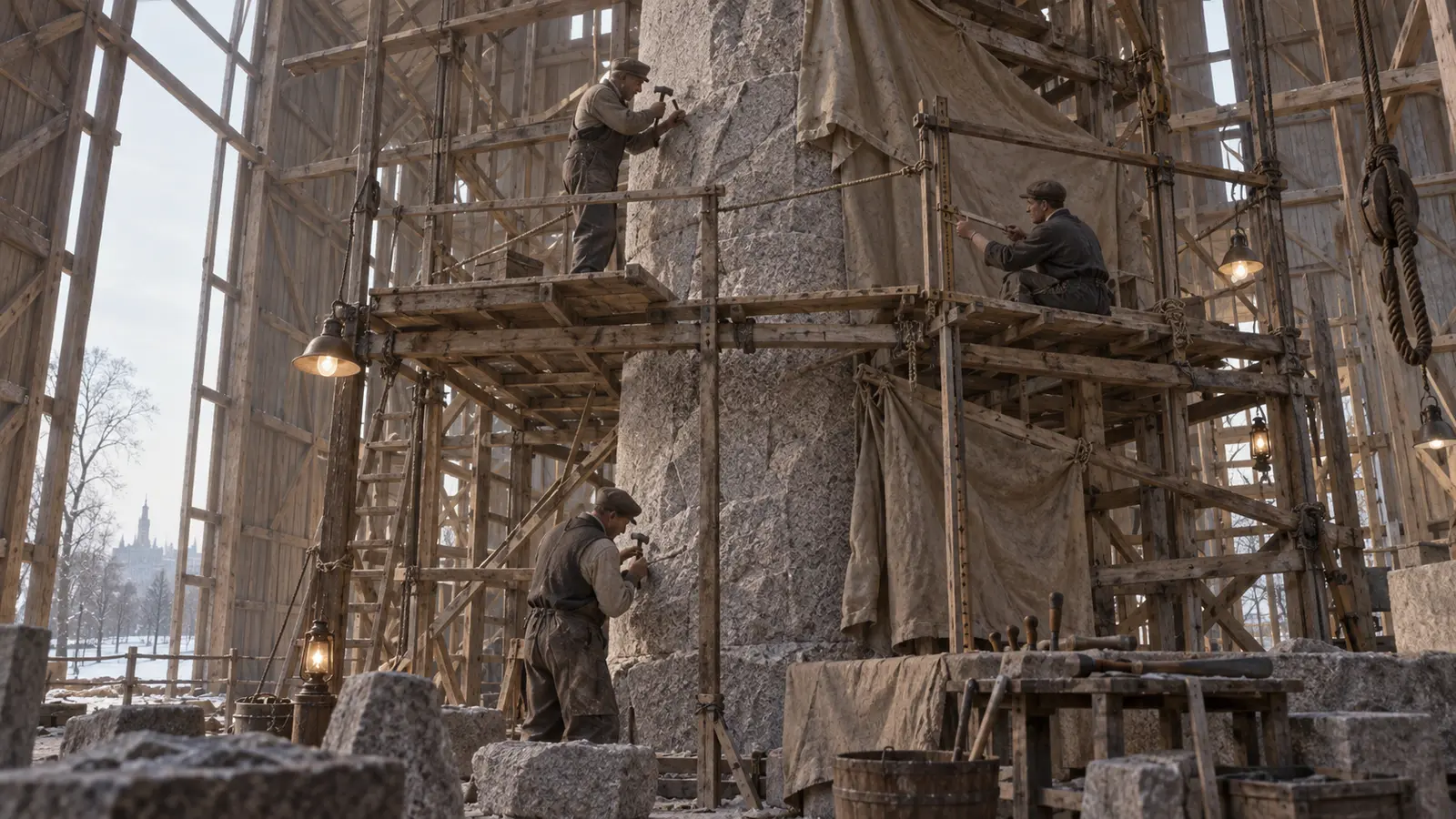
The Vigeland Museum’s Monolith Hall explains the extraordinary transfer process. Using an adjustable measuring device, the carvers mapped roughly one million points from the plaster model onto the stone. Hammer and chisel then turned those coordinates into bodies, gaps, faces and limbs. The technique was systematic, but no machine completed the sculpture. The final forms depended on trained human hands and continual judgement.
Vigeland designed it, but he did not carve it alone
It is common to read that Gustav Vigeland “carved the Monolith.” That is understandable shorthand, but it hides the people who spent years cutting the granite. The museum identifies Nils Jönsson, Karl Kjær and Ivar Broe as the principal stone carvers; current Norwegian tourism material also names Gustav Mod among the master stonemasons involved in the longer project.
Vigeland remained the artist: he developed the idea, modelled every figure, supervised the translation and determined the final form. The carvers performed the demanding work of transferring that model into granite. This distinction does not reduce his authorship. It gives a more honest picture of monumental sculpture, where an artist’s design often requires highly skilled collaborators to become stone or bronze.
Carving began in the summer of 1929. The official park chronology records the work as finished in the summer of 1942, after roughly 13 years. The wooden enclosure remained for a time, and the column was fully exposed in December 1944. Vigeland died in March 1943, so he saw the carving completed but did not live to see the finished monument open in the form visitors know today. The chronology can be checked in the museum’s history of Vigeland Park.
What does the Monolith in Vigeland Park mean?
This is where a well-researched answer must leave room for uncertainty. Vigeland did not publish a neat explanation assigning a meaning to every pose. The museum says he did not want to state “the meaning” of the work. He distinguished the more understandable stone groups around it, which depict life, from the column’s world of fantasy, which each viewer could interpret personally.
That does not mean we know nothing. Several interpretations are grounded in the artist’s work and museum research:
- Resurrection: The upward motion recalls Vigeland’s earlier relief Resurrection, which shows a mass of people moving from death toward life. The museum says Vigeland himself connected the developing Monolith idea with this work.
- Spiritual longing: The official account of the Monolith in Vigeland Park describes the figures’ movement as humanity’s longing and striving for something spiritual.
- The struggle for existence: Some bodies seem supported while others appear trapped or pushed aside. Norwegian reference works therefore include life’s struggle among the credible readings.
- Human interdependence: No figure reaches the top alone. Every body touches or depends upon other bodies, making the column an image of lives inseparably joined.
- A dream rather than a narrative: The figures float and merge in ways that ordinary gravity cannot explain. The work can be experienced as an emotional vision rather than a story with a beginning and ending.
Vigeland’s brief statement—“The column is my religion”—is memorable, but it should not be treated as the name of a secret doctrine. In context, it expresses the central place the work held in his imaginative life. The Vigeland Museum presents resurrection and spiritual striving as interpretations, not as a compulsory answer.
Why does the sculpture look frightening to some viewers?
A photograph can make the column look more sinister than the experience of walking around it. A close crop removes the broad stairway, sky, surrounding sculptures and ordinary park life. In grey stone, tightly packed naked bodies can resemble corpses. Because the movement has no obvious direction, a person who sees climbing may imagine escape, while someone who sees falling may imagine punishment.
Context, contrast and surrounding light can influence perception, as explained in SOAKJAM’s guide to why colors look different.
Those reactions are not foolish. Vigeland repeatedly explored anxiety, suffering, death and transformation. His 1890s relief Hell contains writhing figures and a central character he called Satan. Yet the National Museum of Norway explains that even this earlier work was understood not only as a biblical scene, but also as an image of inner anguish and the life of the soul. Vigeland later referred to both Hell and Resurrection while developing the column.
This artistic background explains why the Monolith in Vigeland Park can hold hope and distress at the same time. It does not justify turning one emotional response into a proven historical claim.
Is the Monolith satanic? Separating evidence from internet claims
There is no credible museum or historical source identifying the monument as a satanic shrine, a record of ritual sacrifice or a literal picture of souls escaping hell. It is also not an ancient artifact, a tomb or a column made from petrified people. It was designed and constructed in the twentieth century, and its development is documented through sketches, models, photographs, municipal decisions and workshop records.
| Online claim | What the evidence supports |
|---|---|
| “It is an ancient mysterious monument.” | Vigeland developed the idea in the early twentieth century, modelled it in 1924–1925 and supervised its carving. |
| “The figures are definitely souls in hell.” | Some viewers read suffering or struggle, but the artist refused one fixed explanation. Resurrection, fantasy and spiritual striving are also documented interpretations. |
| “Vigeland carved all 121 figures himself.” | He created the full-size model and supervised the work; professional stone carvers transferred it into granite over about 13 years. |
| “Monolith means an occult object.” | The title refers directly to the sculpture being carved from one stone. |
| “The nudity proves a ritual meaning.” | Nudity removes clothing, period and status, helping the figures function as universal human types. |
A responsible reading can still be critical. People may find the mass of bodies oppressive, spiritual, beautiful or disturbing. Art does not become meaningless simply because multiple interpretations are possible. The important boundary is between saying, “This looks like hell to me,” and saying, “Historical records prove that it was built as a monument to hell.” Only the first statement is supported as a personal interpretation.
The Monolith makes more sense inside the larger park
Seen alone, the Monolith in Vigeland Park can look like an isolated nightmare. Seen along the park’s central axis, it becomes part of a longer meditation on human life. Visitors first encounter figures on the Bridge, including parents, children, couples and the famous Angry Boy. The Fountain continues with images of life unfolding from childhood through ageing and death. At the western end, the Wheel of Life forms a circle of adults and children holding one another, a symbol the museum describes as eternity and the journey from cradle to grave.
The 36 granite figure groups around the Monolith’s circular steps are especially important. They show relationships more clearly than the crowded column: adults with children, couples, solitary people and ageing bodies. The museum describes these as universal human relationships, with individual figures giving way to groups. Moving from those readable encounters toward the dreamlike column is like moving from everyday life into memory, fear, faith or imagination.
This wider setting does not settle the meaning of the Monolith in Vigeland Park, but it corrects the impression that its only subject is torment. Across the installation, joy, tenderness, conflict, burden, separation, ageing and renewal exist together.
Details that are easy to miss
- The plaster original still exists. Visitors to the Vigeland Museum can see the full-size plaster model in three sections, along with models for 18 of the 36 groups surrounding the plateau.
- The top is crowned by children. This can support readings of renewal or continuation, although it should not be turned into a fixed code the artist never confirmed.
- The stone changed enormously. A rough block weighing roughly 260–280 tonnes became a finished sculpture commonly reported at around 180 tonnes.
- The park was a lifetime project. Its more than 200 sculptures were installed mainly from 1940 to 1949, but represent over four decades of planning and work.
- Oslo owns the collection. Under an agreement made with the city, Vigeland donated his work in exchange for a studio that would later become a museum. The museum’s collection now includes approximately 1,600 sculptures and 12,000 drawings.
The last point helps explain why the historical record is unusually rich. The artist’s home, studio, full-size models, drawings and park remain connected in one municipal collection rather than being scattered among private owners.
Can you visit it?
Yes. Vigeland Park is in the Frogner area of Oslo. According to the museum’s current visitor information, the outdoor park is free and always open. Museum schedules and admission prices can change, so travellers should check the official page rather than relying on an old social-media caption.
The museum is worthwhile because it reveals the construction process. Seeing the plaster model at human scale makes it easier to understand that the granite column was not improvised directly in stone. It was the last stage of a long sequence of sketches, modelling, casting, measuring and carving.
Frequently asked questions
How many people are carved into the Monolith?
There are 121 human figures. They include women and men across different ages, with children gathered near the top.
How tall is it?
Official museum and Norwegian reference sources describe the monument as approximately 17 metres high above ground.
How long did it take to make?
Vigeland spent around ten months creating the full-size clay model in 1924–1925. Transferring the design into granite began in 1929 and took the stone carvers about 13 years.
Why are the people climbing over one another?
Their exact movement is intentionally unresolved. They can appear to climb, float, support one another or fall. That ambiguity allows interpretations involving resurrection, ambition, dependence, struggle and spiritual longing.
Is the Monolith connected to hell?
Vigeland’s earlier art included works titled Hell, Judgement Day and Resurrection, and he referred back to some of them while developing the column. However, no authoritative source defines the Monolith in Vigeland Park simply as hell or as a satanic monument.
Is it really carved from one stone?
Yes. The full column was cut from a single large granite block. That is the reason for its name.
A monument that does not give an easy answer
The most honest way to understand the Monolith in Vigeland Park is to hold two ideas together. Its physical history is unusually concrete: one granite block, 121 figures, a full-size plaster model, nearly one million transferred points and about 13 years of carving. Its symbolic meaning is deliberately less certain.
That uncertainty is not a research failure. It is part of the work. The column can resemble a resurrection, a human mountain, a community holding itself together or a crowd struggling for the top. It can feel hopeful from one angle and frightening from another. What the evidence does not support is reducing it to a viral claim about satanism or tortured souls.
Vigeland left viewers with a monument whose stone can be measured precisely but whose human story cannot. That is why the image continues to stop people, puzzle them and make them ask the right first question: what am I looking at?
Transparency
Sources & references
- Vigeland Museum — The Monolith
- Vigeland Museum — Monolith Hall (Hall X)
- Vigeland Museum — Vigeland Park chronology
- Vigeland Museum — Vigeland Park overview
- Vigeland Museum — Gustav Vigeland chronology
- Vigeland Museum — About Gustav Vigeland
- Store norske leksikon — Monolitten
- Vigeland Museum — The collection
- Oslo City Encyclopedia — Monolitten
- National Museum of Norway — Hell by Gustav Vigeland
- Visit Norway — The mysteries of the Vigeland Sculpture Park
- Vigeland Museum — Visitor information
Editorially reviewed
Editorial information
SOAKJAM articles are designed for clarity, useful context and transparent sourcing. Important facts should be checked against the linked primary sources.
Found an error, outdated detail or a useful source we should consider?