

How did paper spread across the world? Paper feels ordinary because it is everywhere: inside books, parcels, receipts, artworks, official records and school notebooks. Its global reach can make the material seem inevitable. It was not. Papermaking began in ancient China, travelled through skilled workers and connected regions, changed as makers adopted local fibres, and reached different societies over many centuries.
How did paper spread across the world? Not through one journey or one heroic inventor carrying a secret westward. Sheets sometimes travelled before the knowledge to make them. Techniques moved through migration, trade, war, diplomacy and religious networks. Workshops then adapted the craft to rags, hemp, bark, mulberry, bamboo and eventually wood pulp.
Quick answer: Paper was developed in China by at least the second century BCE. Papermaking spread through East and Central Asia, entered the Islamic world by the eighth century, expanded through West Asia and North Africa, and reached parts of Europe through Islamic Iberia and the Mediterranean. Printing, industrial machinery and wood-pulp production later made paper a global mass material.
Paper’s global journey at a glance
| Period | Development |
|---|---|
| At least 2nd century BCE | Early paper is documented archaeologically in China |
| 105 CE | Court official Cai Lun reports improvements to papermaking to the Han emperor |
| 4th–7th centuries | Paper and papermaking become established across parts of East and Central Asia |
| 8th–9th centuries | Production grows in Central Asia and major cities of the Islamic world |
| 11th–13th centuries | Papermaking reaches Islamic Iberia, Italy and other parts of Europe |
| 15th century | European movable-type printing sharply increases demand for paper |
| 19th century | Continuous machines and wood pulp transform paper into an industrial commodity |
| Modern era | Paper production becomes global, supporting print, packaging, hygiene and art |
Dates mark broad phases, not a single line of advance. Evidence is uneven, workshops did not all use the same method, and paper often coexisted with older writing materials for generations.
What makes paper different from papyrus and parchment?
People recorded information long before paper. Mesopotamian scribes pressed signs into clay. Egyptian and Mediterranean writers used papyrus. Parchment and vellum were made from prepared animal skin. Wood, bamboo, palm leaves, silk, bark and textiles also carried writing in different regions.
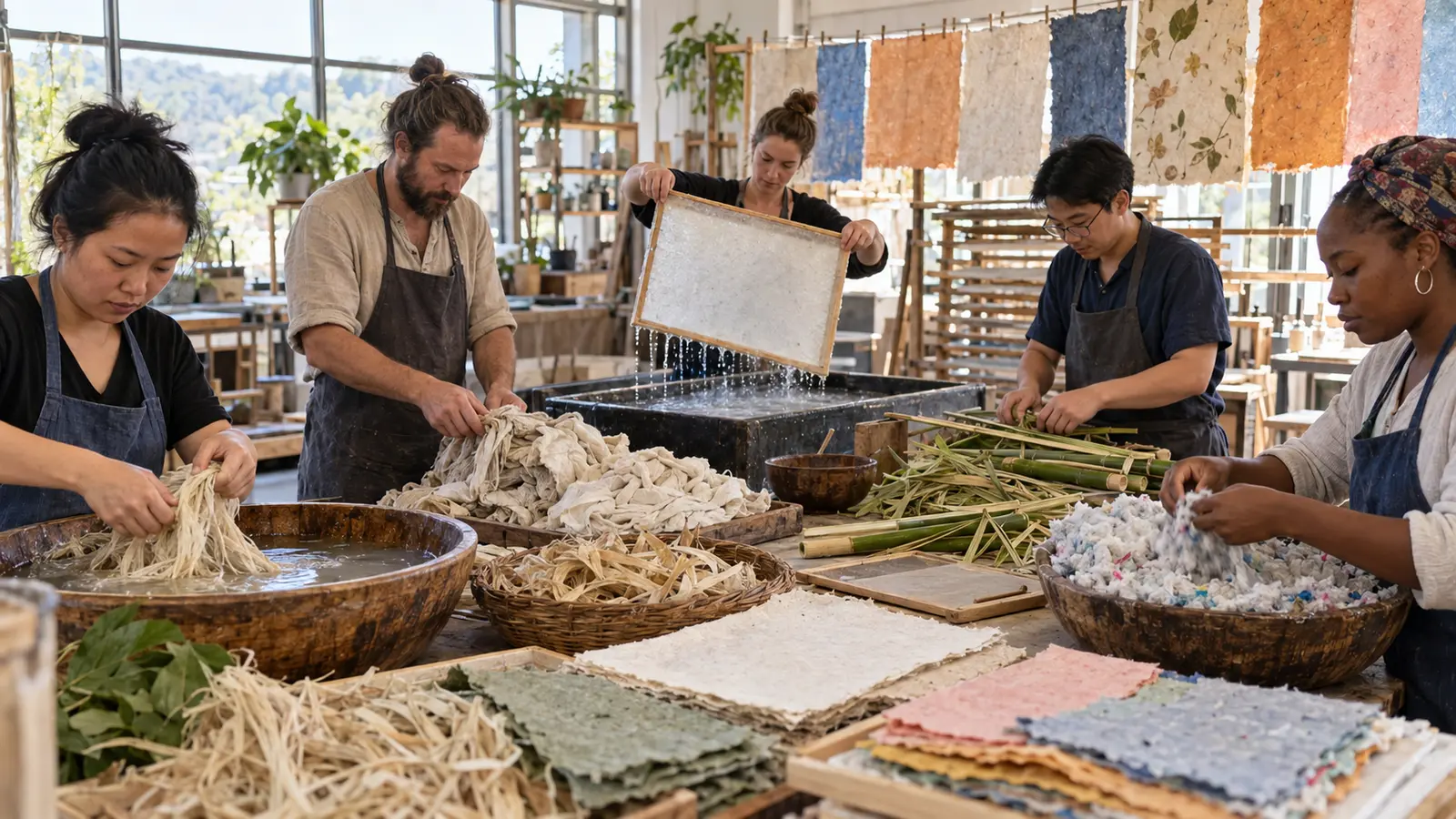
Paper is technically distinct. Makers break plant or textile material down into separated cellulose fibres, suspend those fibres in water, lift a thin layer on a screen or mould, drain it, press it and dry it. The fibres interlock into a sheet.
Papyrus is made by arranging and pressing strips of plant pith rather than dispersing fibres into a watery pulp. Parchment is processed skin. Bark papers such as Mesoamerican amate follow their own traditions and should not be reduced to imperfect versions of Eurasian paper.
These distinctions matter because the history of paper is not the history of writing itself. It is the history of one unusually adaptable sheet-making technology entering worlds that already had sophisticated ways to record, display and transmit knowledge.
Paper emerged through experimentation in ancient China
The oldest surviving evidence does not support a simple “invented in 105 CE” story. Archaeological finds show paper-like and writing paper materials in China from the second century BCE. The Metropolitan Museum of Art describes paper as first documented there in that period.
The year 105 remains important because later Chinese histories credit the Han court official Cai Lun with reporting an improved method to the emperor. Traditional accounts say his materials included tree bark, hemp waste, old cloth and fishing nets. He may have standardised, refined or promoted a craft that already existed rather than creating paper from nothing.
That more careful account is also more realistic. Technologies usually develop through many trials: makers discover which fibres separate well, how long to pound them, how to form an even sheet and what treatment helps ink stay near the surface. Cai Lun became the named figure in a longer, partly anonymous process.
Chinese papermakers used materials available in different places and periods, including hemp, ramie, paper mulberry, bamboo and recycled textiles. Their skills included preparing fibres, forming sheets, pressing, drying, sizing and finishing. Paper gradually became suitable for writing, painting, wrapping, ritual objects, clothing accessories and many other uses.
How did paper spread across the world?
Paper offered no automatic victory over every older material. Early sheets could be expensive, unfamiliar or poorly suited to a particular ink. Governments and religious communities trusted established materials, while parchment remained exceptionally durable.
Yet paper had several advantages that became powerful once supply networks grew:
- Plant fibres and discarded textiles could be found in many regions.
- A sheet was light compared with clay, wood or bamboo slips.
- It could be folded, bound, rolled, cut, painted, printed and recycled.
- Production could expand through organised workshops.
- Local makers could change the fibre recipe without abandoning the core process.
Adaptability was decisive. Papermaking was not a sealed formula requiring one Chinese plant. When the craft reached a place rich in linen and hemp rags, makers used those. When bamboo or mulberry was abundant, those fibres could dominate. The technology travelled because it could become local.
How did paper spread across the world through East Asia?
Paper and papermaking knowledge spread from China into neighbouring East Asian societies through diplomatic, religious and scholarly exchange. Korea developed distinguished papermaking traditions, often associated with strong sheets made from the inner bark of the paper mulberry. Korean kingdoms also became important channels through which Buddhist texts, artisans and technologies moved.
Japanese historical tradition records papermaking instruction arriving from the Korean kingdom of Goguryeo in the early seventh century. Japanese makers developed washi using fibres such as kōzo, mitsumata and gampi. The sheets served writing and printing but also architecture, lanterns, clothing, conservation and art.
Calling this movement a simple transfer from one nation to another misses the networks involved. Monks, envoys, migrants, craftspeople and texts moved between courts and religious institutions. Each workshop made choices about fibre, water, tools and finish. A shared principle produced visibly different papers.
Sheets reached Central Asia before every workshop knew the craft
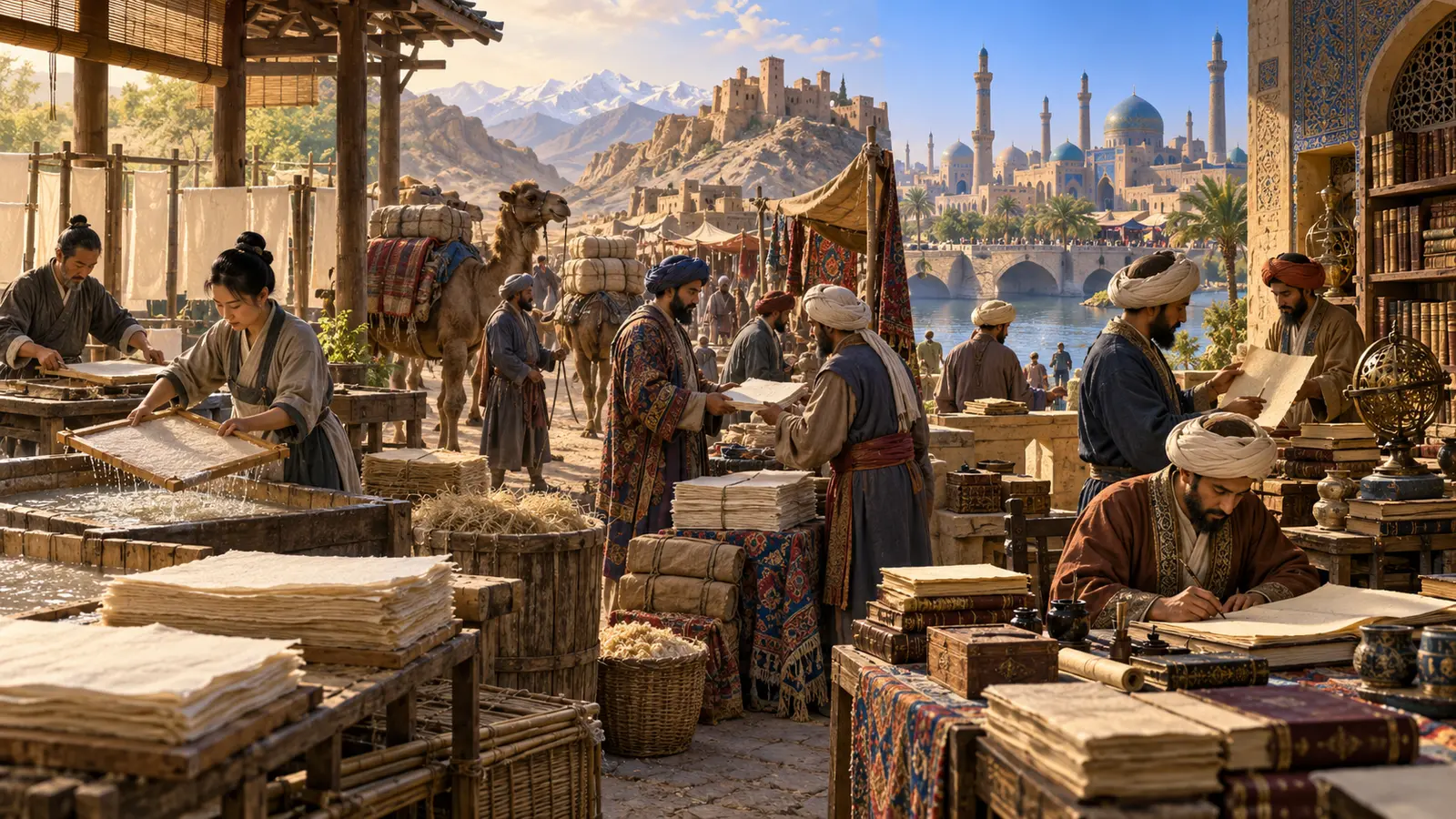
The Silk Roads were overlapping routes rather than one highway. Goods commonly changed hands many times, and ideas moved with merchants, pilgrims, soldiers, officials and displaced communities. Paper could therefore appear in a region before local people possessed the full production process.
Documents preserved in the dry environments of Central Asia show paper moving westward from China over centuries. It was useful for administration, correspondence, religious texts and commerce. Demand for the material created an incentive to learn how to make it closer to where it was being used.
This pattern—first imported sheets, then local production—is central to understanding how paper spread across the world. A finished object reveals what is possible. A workshop requires something more: knowledge of fibres, water, pulping, moulds, drying, sizing and quality control.
SOAKJAM’s guide to what the Silk Road really was explains why technologies usually moved through relays and regional hubs rather than through one traveller crossing a continent.
The Battle of Talas is not the whole explanation
A popular story says Chinese papermakers were captured after the Battle of Talas in 751 and revealed their secret at Samarkand. The episode is memorable, but historians treat the neat version with caution. Paper was already present in Central Asia, contacts with China predated the battle, and evidence for exactly who transmitted which techniques is incomplete.
War may have accelerated the movement of skilled people. It was not a magic gate that kept papermaking locked inside China until one day in 751. Trade, migration and regional production had been building the connection over a much longer period.
The better lesson is that technology spreads when people and institutions can reproduce it. A battle can relocate workers; a market can sustain a mill; a government can create demand; religious and scholarly communities can multiply uses. No single event explains the whole chain.
How did paper spread across the world through Islamic societies?
By the late eighth and early ninth centuries, paper was being made and used in major Abbasid centres. Baghdad’s scholarship, government, translation work and book culture grew while paper supply was expanding.
Papermakers in Islamic lands often used linen and hemp rags. They sorted, cleaned, softened and beat the fibres, formed sheets on moulds, then pressed, dried and sized them so pens could move across a smoother surface. Paper served accounts, letters, commercial records, maps, legal documents, poetry and books—not only luxury manuscripts.
The Islamic world was therefore not a bridge carrying an unchanged Chinese invention to Europe. Its makers adapted materials and finishes, while cities created large markets. Production and use spread through West Asia and North Africa into al-Andalus, linked to the wider Mediterranean by ports, courts, trade and centres of learning.
How did paper spread across the world through Europe?
Europeans encountered paper through trade, diplomacy and contact with the Islamic world and Byzantium. Production was established in parts of Islamic Spain before mills spread more widely through Christian Europe; Italian centres became especially influential in the later medieval period.
Adoption was gradual. Parchment carried legal and religious prestige, and some authorities doubted paper’s durability. Mills nevertheless refined water-powered stamping, sizing and wire watermarks that identified a maker or paper type and now help historians trace documents.
Demand accelerated when paper met printing. East Asia already had long traditions of block printing and movable type. In fifteenth-century Europe, metal movable-type presses made many copies economically, but required abundant sheets. Neither technology created the other; together they transformed the scale of books, pamphlets, forms and news.
Paper’s routes were global, but not culturally empty
European empires carried mills, printed administration and industrial products into societies that already had recording materials. In Mesoamerica, for example, Maya and other peoples made sheets from beaten bark, and Otomi papermaking continued in Mexico. Colonisation damaged many local knowledge systems even as imported paper and print expanded.
“Paper spread across the world” should therefore describe encounters, not an empty map filling with progress. Paper supported literacy, art and administration, but also taxation, missionary work, surveillance and imperial control. Asian papers entered European collections, European industrial sheets entered Asian markets, and artists combined imported materials with older practices. The history is a web of exchange, not a one-way arrow.
Industrial machines changed the scale and the fibre
Before industrialisation, papermaking was labour-intensive and often depended on scarce textile rags. Eighteenth- and nineteenth-century machines began forming a continuous web instead of one sheet at a time. In the Fourdrinier system, diluted pulp travels across moving wire, drains, passes through presses and dries on heated cylinders.
Mechanisation increased output, but fibre supply remained a problem. Nineteenth-century chemical and mechanical processes made wood an economical source of cellulose, feeding newspapers, schools, offices and packaging.
Scale brought costs. Acidic processes left many mass-market pages brittle and yellow, while mills consumed timber, water and energy and could pollute heavily. Recycled fibre, chemical recovery and certification can improve modern production, although performance still varies.
Paper changed institutions as much as books
Paper’s less glamorous uses mattered as much as literature. Governments kept tax, court and land records; merchants used contracts and accounts; religious communities circulated texts; scientists drew maps and calculations; families preserved letters and certificates. Tickets, labels, packaging and currency made the material part of daily administration.
Paper did not make information truthful or accessible by itself. The same cheap sheet could carry evidence, propaganda, a school lesson or a censorship order. It lowered barriers to copying and transport; people and institutions decided how to use that capacity. SOAKJAM’s article on what makes a story memorable explores how stories travel through oral, written and visual forms.
Did digital technology replace paper?
Digital communication reduced demand for some office documents, letters, maps and newspapers, but paper did not disappear. Packaging grew with global shipping and online retail. Tissue and hygiene products remain major uses. Artists, publishers, schools, governments and legal systems continue to choose paper where physical handling, annotation, access or permanence matters.
The digital world also depends on physical infrastructure and energy. Comparing “paper” with “digital” as if one were always material and the other weightless hides important costs on both sides. The responsible choice depends on source fibre, production, transport, device life, electricity, reuse and the purpose of the record.
Recycling extends fibre life, but cellulose fibres shorten and weaken after repeated processing, so many paper systems still require some fresh fibre. Contaminated or coated products may not be recyclable in a local facility. Clear purchasing and disposal information is more useful than a universal slogan.
Common myths about the spread of paper
- “Cai Lun invented paper alone in 105 CE.” He was important to its improvement and official recognition, but archaeological paper predates him.
- “Papyrus is an early kind of paper.” Papyrus uses pressed strips of pith; true paper re-forms dispersed fibres into a sheet.
- “The Battle of Talas instantly carried paper west.” The battle may have moved skilled people, but paper and regional contact already existed in Central Asia.
- “Europe received paper directly from China.” Islamic societies were crucial producers and innovators, and papermaking reached much of Europe through their connections.
- “Paper automatically created mass literacy.” Cheaper material helped, but literacy also depended on printing, schools, language, law, wealth and access.
Frequently asked questions
Where was paper invented?
The earliest documented true paper comes from ancient China, with archaeological examples from at least the second century BCE. The craft developed over time rather than appearing in one finished form.
Who was Cai Lun?
Cai Lun was a Han court official traditionally credited with presenting an improved papermaking method in 105 CE. He helped establish the craft’s historical reputation, but surviving paper predates him.
When did paper reach the Islamic world?
Paper use and production expanded there during the eighth and ninth centuries, with Central Asian centres and Abbasid cities such as Baghdad playing important roles.
When did Europe begin making paper?
Production appeared in parts of Islamic Iberia and then expanded in Christian Europe during the eleventh to thirteenth centuries. Exact “first mill” claims vary with definitions and evidence.
Why was paper important to printing?
It offered a lighter, more scalable and generally less expensive surface than parchment. Large print runs created demand for reliable, abundant sheets, while printing made paper more valuable.
Was paper made from trees from the beginning?
No. Early and medieval papers used fibres such as hemp, mulberry, bamboo and linen or hemp rags. Wood pulp became dominant only with nineteenth-century industrial production.
How did paper spread across the world? A technology remade locally
How did paper spread across the world? It moved because people moved: craftspeople, merchants, monks, officials, prisoners, migrants and printers. It spread because institutions wanted records and readers wanted texts. Most importantly, it spread because local makers could rebuild the process with fibres, tools and aesthetics suited to their own surroundings.
China supplied the earliest documented technology, but the finished global story belongs to many societies. Korean and Japanese makers developed distinctive papers; Central Asian networks carried sheets and skills; Islamic workshops transformed rag paper and book culture; European mills joined paper to mechanised print; Indigenous American bark-paper traditions followed their own paths; industrial mills changed fibre and scale.
The sheet on a desk is therefore not a neutral blank. It is the result of two thousand years of experimentation, exchange, labour and adaptation—light enough to travel, flexible enough to change and durable enough to carry voices far beyond the place where they began.
Sources and further reading
- The Metropolitan Museum of Art — Immaterial: Paper
- Yale University Press/A&AePortal — Paper Before Print: The History and Impact of Paper in the Islamic World
- The Metropolitan Museum of Art — Deity face pendant: ancient Maya use of amate bark
Transparency
Sources & references
Editorial review pending
Editorial information
SOAKJAM articles are designed for clarity, useful context and transparent sourcing. Important facts should be checked against the linked primary sources.
Found an error, outdated detail or a useful source we should consider?