

Satellite internet connects a user to the wider internet through radio links that travel to space. It can reach homes, ships, aircraft and remote communities where laying fiber or maintaining a mobile network is difficult. The basic idea is simple; the full network is not.
A working service needs satellites, user terminals, ground gateways, spectrum rights, traffic routing and constant control. Orbit determines how far the signal travels, how many satellites are needed and how often a connection must move from one spacecraft to another.
Quick answer: A satellite internet terminal sends data by radio to a satellite. The satellite relays it to a ground gateway connected to terrestrial networks, or sometimes to another satellite first. The return path works in reverse. Low Earth orbit systems reduce distance and delay but require large moving constellations; geostationary systems cover wide areas with fewer satellites but have longer signal paths.
Satellite internet at a glance
| Part | Role |
|---|---|
| User terminal | Tracks or electronically steers a radio beam to the network |
| Satellite | Receives, processes and relays signals |
| Gateway | Connects the space segment to fiber and internet infrastructure |
| Network control | Assigns capacity, beams, frequencies and handoffs |
| Inter-satellite links | Move traffic between satellites before it returns to Earth |
How data travels through the network
- A phone or computer sends a request through the local router.
- The outdoor terminal converts that traffic into a radio signal and sends it upward.
- The satellite receives the uplink and relays the data to a gateway, possibly through other satellites.
- The gateway passes the request into terrestrial internet networks.
- The response returns through a suitable gateway, satellite and downlink to the terminal.
Calling this a “direct connection to space” can hide the terrestrial part. Most services still depend on fiber-connected gateways, data centers and internet exchange points. Even a constellation with optical inter-satellite links eventually needs a route down to infrastructure that can reach the requested server.
The International Telecommunication Union explains that satellites can extend connectivity to remote communities. They complement rather than replace the undersea cables described in SOAKJAM’s guide to how the internet crosses oceans.
Why orbit changes the experience
Satellites do not all circle Earth at the same height. Three broad regions are commonly discussed.
| Orbit | Approximate character | Internet trade-off |
|---|---|---|
| Low Earth orbit (LEO) | Hundreds to roughly two thousand kilometres above Earth | Shorter delay, small moving coverage areas, many satellites and handoffs |
| Medium Earth orbit (MEO) | Between LEO and geostationary altitude | Intermediate delay and constellation size |
| Geostationary orbit (GEO) | About 35,786 kilometres above the equator | Very wide fixed coverage, longer round-trip path |
A geostationary satellite orbits once per sidereal day in the same direction as Earth’s rotation, so it appears fixed in the sky. A stationary dish can point toward it. LEO satellites move rapidly relative to the ground; the network must track them and hand traffic to the next satellite.
NASA’s orbital mechanics overview explains why altitude and orbital period are linked. SOAKJAM’s GPS guide covers a different satellite use in medium Earth orbit.
Why LEO can feel more responsive
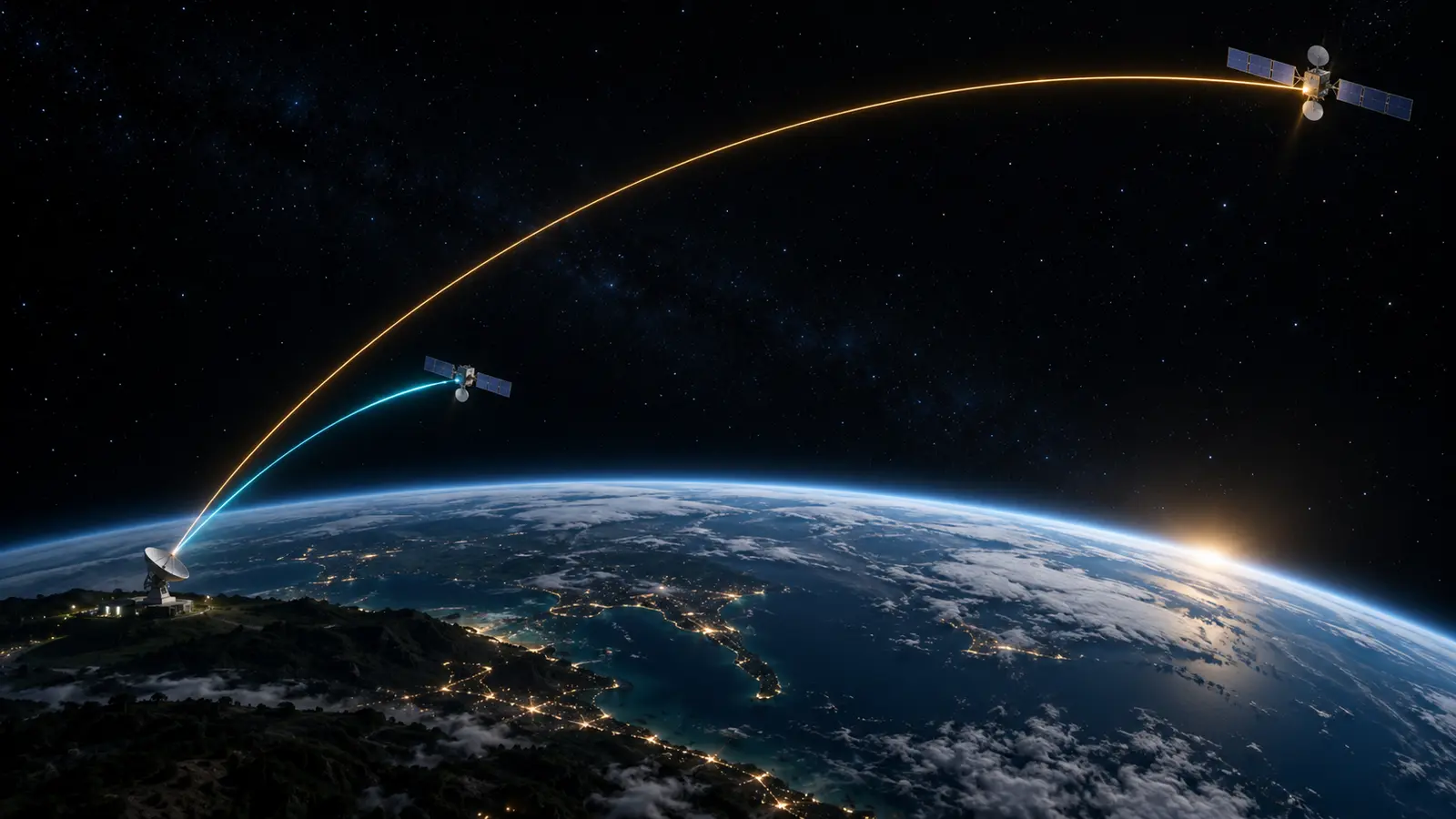
Radio waves travel at nearly the speed of light, but distance still adds delay. A signal to geostationary altitude and back to Earth travels more than 70,000 kilometres before including routing and processing. An interactive exchange may need multiple legs, so the delay is noticeable in calls, gaming and remote control.
A LEO satellite is much closer. The physical path is shorter, which allows lower latency when the rest of the network is well designed. This does not guarantee a particular ping. Gateway location, congestion, Wi-Fi, server distance, weather and routing all contribute.
Bandwidth and latency are different. A connection can download quickly yet pause before each response. SOAKJAM’s guide to ping and latency explains that distinction.
How a moving constellation maintains a link
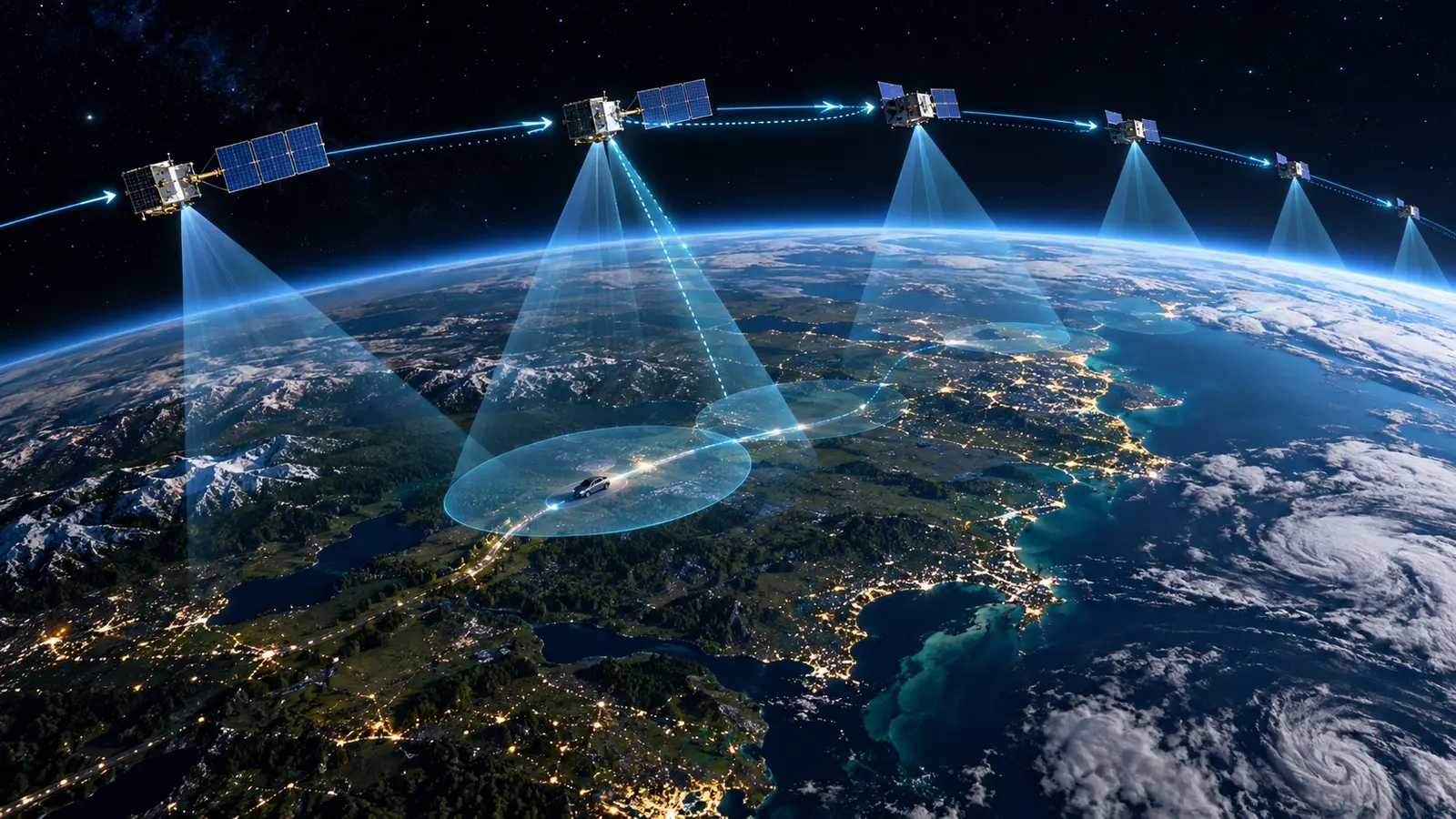
A LEO terminal may use a phased-array antenna. Instead of physically rotating a dish for every satellite, it changes the timing of signals across many small antenna elements. Their waves combine strongly in a chosen direction, steering the beam electronically.
Network software predicts satellite positions, assigns capacity and transfers the connection before the current satellite moves out of view. The process resembles a mobile phone handoff between cell towers, but the base stations are moving overhead at orbital speed.
Optical links can send data between satellites using lasers. They may reduce dependence on a nearby gateway and carry traffic across oceans or polar regions in space. Clouds do not obstruct a link between satellites, but the final radio or optical path to the ground still faces atmospheric conditions.
What can block or weaken the signal?
- Obstructions: Buildings, hills and trees can interrupt the line of sight.
- Heavy rain: Some high-frequency links suffer rain fade.
- Snow or ice: Accumulation can cover the terminal even when built-in heating helps.
- Interference: Other radio systems, poor installation or nearby equipment can reduce quality.
- Congestion: Many users in one beam share limited radio capacity.
- Power loss: The terminal and router need electricity, so service is not automatically available during an outage.
A clear view of the required sky region is essential. Mounting instructions differ by system and country; use an approved installer where electrical grounding, roof safety or local rules require one.
How capacity is shared
Each satellite and beam has finite spectrum and processing capacity. Operators reuse frequencies in separate areas and schedule transmissions among users. Performance may therefore change by location and time of day even when the terminal has an unobstructed view.
More satellites and gateways can add capacity, but demand can grow too. Advertised maximum speed is not a guarantee that every user receives that rate simultaneously. Compare typical performance, data policies and congestion management, not only a peak number.
Spectrum, coordination and safety
Satellites share radio spectrum with other space and terrestrial services. National regulators authorize user equipment and market access, while the ITU coordinates frequency assignments and orbital resources internationally to reduce harmful interference.
The ITU Radiocommunication space services and the U.S. Federal Communications Commission Space Bureau illustrate the regulatory work behind a commercial terminal. Users should buy equipment approved for their country rather than importing a terminal that may not be authorized or supported.
Space debris and astronomy
Large constellations create public questions beyond internet performance. Satellites must avoid collisions, dispose of spacecraft responsibly and limit long-lived debris. Operators share tracking information and perform maneuvers, but coordination becomes harder as orbital traffic grows.
Sunlight reflected from satellites can also affect astronomical observations, especially wide-field surveys. The International Astronomical Union maintains a Centre for the Protection of the Dark and Quiet Sky that works on mitigation with observatories, industry and regulators.
The European Space Agency’s Space Debris Office publishes tracking and environment information. A balanced account should recognize both the connectivity benefit and these shared-space responsibilities.
Who benefits most from satellite internet?
- Rural homes beyond cable, fiber and strong fixed-wireless coverage.
- Temporary sites such as construction, research or disaster-response operations.
- Ships, aircraft and vehicles that move outside terrestrial networks.
- Communities that need a backup path when ground infrastructure fails.
- Remote businesses that can justify equipment, power and subscription costs.
Dense cities usually have cheaper, higher-capacity terrestrial options. Satellite service can still provide resilience, but a roof terminal may face obstruction and building-permission problems.
How to evaluate a plan
- Check legal availability at the exact service address.
- Use the provider’s obstruction tool or installation survey.
- Compare equipment purchase, installation, monthly fee and cancellation terms.
- Read typical download, upload and latency ranges, not only “up to” speed.
- Check data allowances, priority policies and peak-time management.
- Confirm support for VPNs, public IP addresses, port forwarding or business use if needed.
- Plan backup power and a second connection if continuous access is essential.
Frequently asked questions
Does satellite internet work anywhere?
No. Coverage, licensing, capacity and the view of the sky vary. Some countries or addresses are not served.
Is satellite internet faster than fiber?
Usually fiber offers greater capacity, consistency and lower latency where available. Satellite’s strength is reach and rapid deployment.
Can weather stop the connection?
Severe rain, snow accumulation and atmospheric conditions can weaken some links. System design and frequency affect resilience.
Why does the dish need a clear sky?
The terminal must maintain radio line of sight. Trees or structures crossing the beam can interrupt data.
Can I move the terminal?
It depends on the plan, hardware and local authorization. Residential service may be tied to an address, while mobility plans use different terms.
Final summary
Satellite internet relays data between a user terminal, spacecraft and ground-connected networks. LEO constellations shorten the path and can improve responsiveness, but require many satellites, active tracking and frequent handoffs. Geostationary systems cover vast areas with stable pointing but longer delay.
For remote locations, that engineering can provide access no practical cable reaches. Evaluate it with clear eyes: check the sky view, typical performance, shared capacity, power, regulation and full cost. The best connection is the one that fits the location and the consequences of an outage.
Transparency
Sources & references
- ITU — Satellites bringing connectivity to remote communities
- ITU — Space services
- NASA — Basics of Space Flight, orbital mechanics
- FCC — Space Bureau
- ESA — Space Debris
- IAU — Centre for the Protection of the Dark and Quiet Sky
- NOAA — Satellite communications and radio propagation overview
- RFC Editor — RFC 2679 one-way delay metric
Editorially reviewed
Editorial information
SOAKJAM articles are designed for clarity, useful context and transparent sourcing. Important facts should be checked against the linked primary sources.
Found an error, outdated detail or a useful source we should consider?