
How do solar panels work? A photovoltaic panel absorbs sunlight and turns part of that light energy into direct-current electricity. An inverter then converts the direct current into alternating current that a home, school or business can use. A battery may store extra energy, but the panels themselves do not store electricity.
This simple idea depends on several coordinated parts: semiconductor solar cells, electrical conductors, protective glass, wiring, an inverter and safety equipment. Grid-connected systems also interact with a utility meter and the wider electricity network.
Quick answer: When light reaches a solar cell, absorbed energy frees mobile electrical charges inside a semiconductor. An internal electric field pushes positive and negative charges in different directions. Metal contacts collect the resulting direct current, and an inverter changes it into usable alternating current. That is the short answer to how do solar panels work.
How do solar panels work in simple terms?
Think of a solar-electric system as an energy path rather than one object. Sunlight reaches many small photovoltaic cells. Each cell produces a modest voltage and current. Manufacturers connect the cells to form a protected module, commonly called a solar panel. Multiple panels form an array.
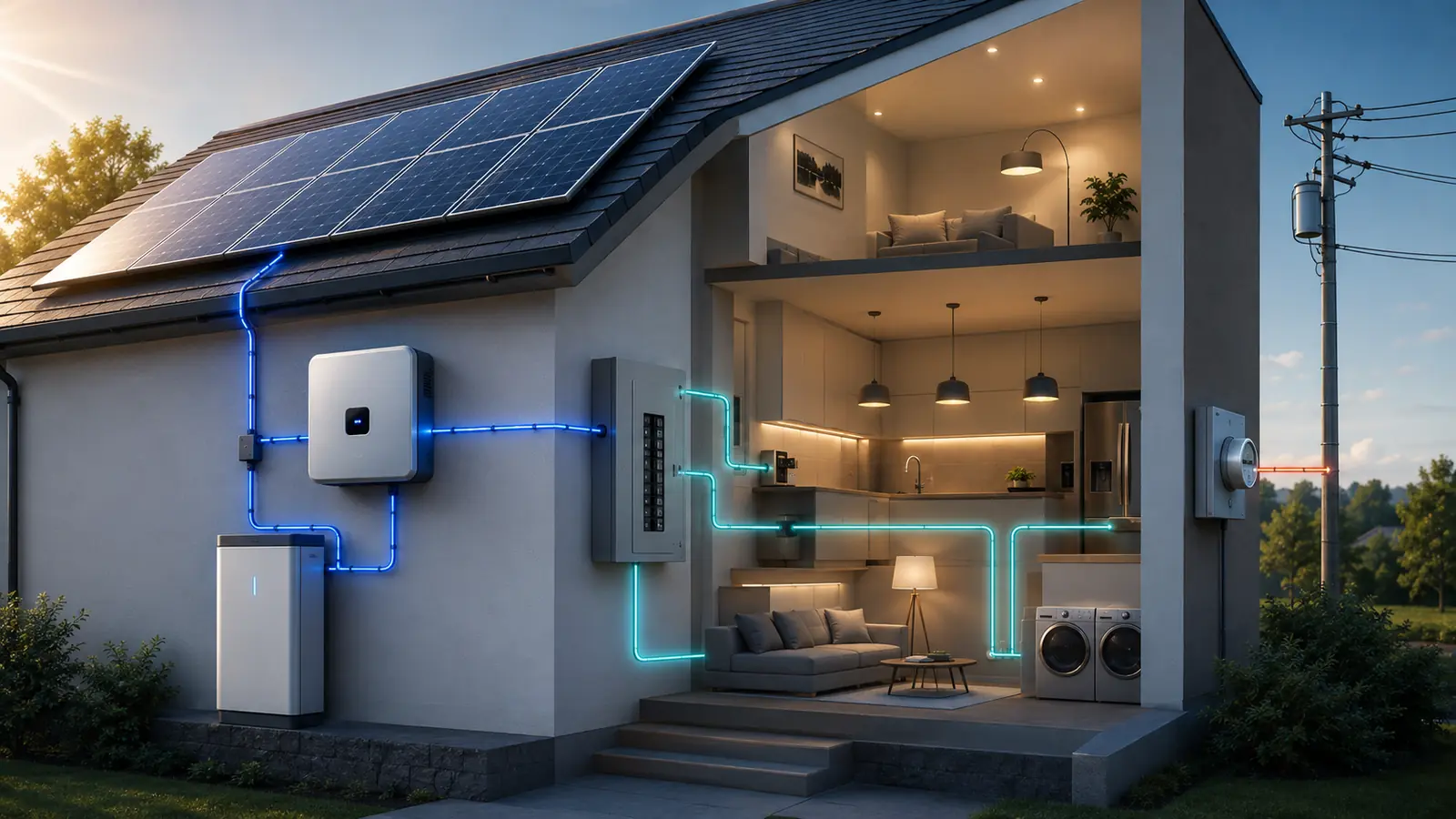
The array sends direct-current electricity through cables to an inverter. The inverter converts that power into the alternating-current form used by most building circuits. The building uses available solar power first in many common grid-connected designs. Depending on local rules and system settings, a surplus may charge a battery or flow through a meter to the grid.
The U.S. Department of Energy’s photovoltaic technology overview explains that cells are connected into larger modules and arrays, while mounting structures and power-conversion equipment complete the system. A panel is therefore the energy-producing surface, not the entire installation.
What is inside a solar panel?
A typical panel contains layers designed to generate electricity outdoors for decades. Common components include:
- Solar cells: semiconductor devices that convert light into electrical energy.
- Metal conductors: fine contacts and ribbons that collect current and connect cells.
- Encapsulant: a clear material that holds the cells in place and helps protect them from moisture and vibration.
- Front glass: a strong, transparent weather barrier.
- Back layer: another protective surface, or glass in some two-sided designs.
- Frame and junction box: structural support plus a protected place for electrical connections and bypass diodes.
Crystalline silicon is the most common cell material. Manufacturers prepare thin silicon layers so the completed cell contains a junction and built-in electric field. That field is central to producing useful current.
How do solar panels work inside a photovoltaic cell?
1. Light arrives as packets of energy
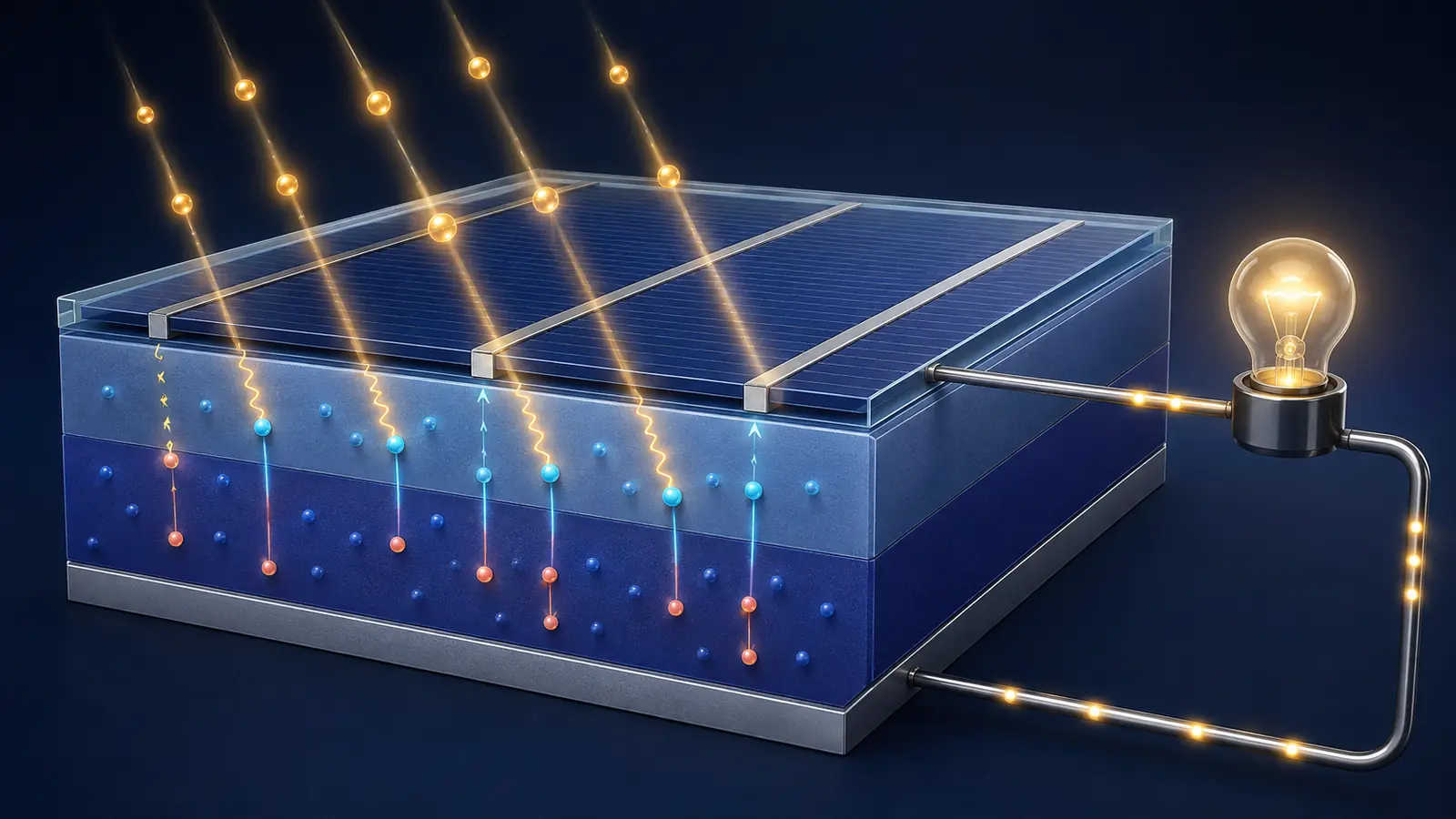
Sunlight contains particles of light called photons with a range of energies. Some light reflects from the cell, some passes through or becomes heat, and some is absorbed by the semiconductor. Only the absorbed portion with suitable energy can contribute to the electrical process.
2. Absorbed energy creates mobile charges
When a photon transfers enough energy, it can free an electron into a mobile energy state and leave behind a corresponding positive “hole.” These are charge carriers. Creating carriers is not sufficient by itself because they could recombine and release their energy before reaching the circuit.
3. An internal electric field separates the charges
The junction inside the cell establishes an electric field. It encourages electrons and holes to move in opposite directions, reducing immediate recombination and creating a voltage between the cell’s contacts. This built-in separation is why the cell can drive charges through an external circuit.
4. Conductors collect direct current
Metal contacts collect the charges. When a circuit is connected, electrons travel through the external path, where they can perform useful work, and return to complete the circuit. The direction of the cell’s output is fixed, so it is called direct current, or DC.
The Department of Energy’s guide to photovoltaic cell basics describes this sequence of light absorption, charge-carrier movement and current collection. It is the physical core of how do solar panels work, although real modules add many layers for protection and electrical connection.
From one cell to a complete solar array
A single silicon cell produces only a small voltage. Manufacturers connect many cells in series to raise voltage and arrange groups in parallel where the design requires more current. The finished panel receives a power rating measured in watts under defined laboratory conditions.
Installers connect panels into strings and arrays that suit the inverter’s permitted voltage and current range. The cables, connectors, disconnects, protective devices and mounting hardware must all be rated for the environment and system. Higher voltage is useful for moving power efficiently, but it also makes safe design and qualified installation essential.
Panels in a string influence one another. Shade or a weak cell can restrict current. Bypass diodes provide an alternate path around affected cell groups and reduce some losses, but they do not erase shade. Designers must study the roof, sun path and nearby objects.
From sunlight to electricity a building can use
Panels produce DC electricity
The output changes continually with sunlight and cell temperature. A device called a maximum power point tracker, normally built into an inverter or optimizer, adjusts electrical operating conditions to obtain useful power from the array as conditions change.
The inverter produces AC electricity
Most building appliances and public grids use alternating current. The inverter switches and controls the panel’s DC output to create an AC waveform with the required voltage and frequency. A grid-connected inverter also synchronizes its output with the grid and monitors safety conditions.
The electrical panel distributes power
After conversion, solar electricity enters the building’s distribution system. Appliances cannot tell whether an available unit of compatible AC electricity came from the roof or the grid. If the building needs more power than the array supplies, the grid can provide the difference in a standard grid-connected system.
A meter records energy exchange
When production exceeds immediate demand, electricity may flow outward if the installation and local utility rules permit export. Billing arrangements differ widely: some regions credit exported energy, some pay a different rate, and some restrict it. Solar hardware does not determine that policy.
A battery is optional and separate
A compatible battery system can store energy for later. It includes cells, controls, safety equipment and usually its own power electronics. The Department of Energy’s page on photovoltaic system design distinguishes the array from inverters, storage and other balance-of-system equipment.
Why the solar inverter matters
An inverter can track the array’s best operating point, detect abnormal grid conditions, report production and provide protective functions. Modern “smart” inverters may also support grid services when regulations allow.
The Department of Energy’s inverter and grid-services guide explains both basic conversion and the growing role of advanced inverters. Consumer monitoring may use a wired network, cellular connection or local wireless network; SOAKJAM’s explanation of how Wi-Fi works covers that separate communication layer.
| Architecture | How it is arranged | Practical consideration |
|---|---|---|
| String inverter | One central inverter serves one or more panel strings | Efficient and straightforward, but panels in a string can influence one another |
| Microinverters | A small inverter operates at each panel | Panel-level control helps complex roofs, while adding rooftop electronics |
| Power optimizers | Panel-level DC devices feed a central inverter | Combines panel-level control with centralized DC-to-AC conversion |
No architecture is automatically best. Roof shape, shade, access, cost, local code and installer support all matter. A complete answer to how do solar panels work must include this power-conversion stage.
Do solar panels store electricity?
No. This is one of the most common misunderstandings. Solar panels generate electricity while light is available; they do not save it for later. Without a battery, unused power must be consumed at that moment, exported where permitted or curtailed.
A battery adds time shifting. It can charge when production is high and discharge later, such as after sunset. A backup-capable system also needs controls that safely separate selected circuits from the grid during an outage. Simply adding any battery does not guarantee whole-building backup.
Most ordinary grid-following solar inverters shut down when the utility grid fails, even in bright sunshine. This anti-islanding behavior protects workers and equipment from an unexpected local source energizing a disconnected line. Continued operation requires equipment specifically designed and approved for backup or grid-forming operation.
How do solar panels work on cloudy days?
Clouds reduce the strong direct beam from the sun, but they do not always block all light. Diffuse light scattered through the atmosphere can still reach the panel, so an array commonly continues producing at a lower level. Output may rise and fall quickly as clouds move.
The Department of Energy’s overview of solar radiation explains that season, time of day, weather, location and surrounding landscape all affect the amount of energy available. A bright but cloudy day and a dark storm are not equivalent.
At night there are no useful photons from the sun, so conventional panels stop producing. The building then uses energy from the grid, a battery or another source. Moonlight is reflected sunlight, but its intensity is far too low for meaningful ordinary solar generation.
What affects solar-panel output?
- Available sunlight: stronger solar irradiance usually allows more output, within equipment limits.
- Orientation and tilt: the angle between incoming light and the panel affects how much energy reaches a given surface area.
- Shade: trees, buildings, antennas and even small obstructions can affect a cell group or string.
- Temperature: silicon panels generally produce less voltage and power when their cells become hotter, even on a sunny day.
- Dirt, dust or snow: anything that blocks light reduces the energy reaching cells.
- Electrical mismatch: panels with different conditions or characteristics may not all operate at their individual ideal points.
- Equipment losses: resistance, inverter conversion, transformers and standby consumption use part of the available energy.
- Aging: weather and material changes gradually reduce output over many years.
Solar cells often work more efficiently when cool. A cold, clear day can produce excellent results, while a very hot panel may make less power than its sunlight level alone suggests. The Department of Energy’s guide to photovoltaic performance and efficiency describes temperature, reflection, wavelength and internal electrical losses.
Rated watts are not guaranteed live output
A panel’s nameplate wattage is measured under standardized test conditions. Real roofs rarely match those exact light intensity, cell temperature and spectral conditions all day. The rating lets people compare products consistently; it is not a promise that the number will appear every sunny moment.
Energy and power are also different. Power, measured in watts or kilowatts, is the rate of production at one instant. Energy, measured in watt-hours or kilowatt-hours, accumulates over time. A 5-kilowatt array operating at different outputs throughout the day might produce a certain number of kilowatt-hours by evening.
Annual energy estimates use local weather history, array direction, shade, system losses and equipment details. Actual results vary from year to year. A credible proposal should state its assumptions rather than multiplying the panel rating by every daylight hour.
Main types of photovoltaic panels
Crystalline silicon
Most modern rooftop panels use silicon wafers. Monocrystalline products use cells cut from single-crystal material, while polycrystalline products use material containing multiple crystals. Appearance, efficiency and manufacturing have evolved, so the label alone does not determine long-term quality.
Thin-film photovoltaics
Thin photovoltaic layers can be deposited on a supporting surface. Products such as cadmium-telluride modules offer different manufacturing, temperature and efficiency characteristics.
Bifacial panels
Bifacial modules collect light from both surfaces. Rear output depends on mounting, spacing and ground reflectivity, so the label does not guarantee a fixed gain.
Emerging tandem and perovskite designs
Researchers combine materials that absorb different parts of the spectrum. Perovskites and tandem cells show laboratory progress, while durability and scalable manufacturing remain active challenges.
Spacecraft also depend on solar arrays, often using specialized high-efficiency cells designed for radiation and extreme environments. Navigation satellites are one example; SOAKJAM’s guide to how GPS works explains their separate timing and positioning role.
Solar photovoltaic is different from solar thermal
Photovoltaic panels produce electricity directly from light. Solar-thermal equipment captures heat instead. A domestic solar water heater warms water or another fluid, while concentrating solar-thermal plants use mirrors to focus sunlight and make high-temperature heat that can drive a generator.
Both use solar energy, but their components and output are different. A shiny roof collector is not necessarily photovoltaic, and a large field of mirrors is not a conventional PV array.
How long do solar panels last?
Panels do not normally stop at one exact birthday. Their output tends to decline gradually as exposure, thermal cycles, moisture, mechanical stress and material changes accumulate. Product and performance warranties set manufacturer-specific terms, but warranty length is not identical to physical lifetime.
A 2025 Department of Energy summary reported average operational lifespans of roughly 25 to 35 years for modules in a national survey, while noting that some systems can remain in service longer. Its solar end-of-life overview also discusses repair, reuse and recycling.
Glass and aluminum make up much of a typical module and are technically recyclable, along with other recoverable materials. Yet technical possibility does not ensure convenient or economical recycling everywhere. Collection systems, regulations, transport and processing markets vary by region. Responsible purchasing should consider an installer’s removal and end-of-life plan.
Maintenance and safety
Solar arrays have no fuel deliveries and few moving parts, but they are not maintenance-free. Owners should monitor production for unexplained changes and follow manufacturer guidance. A qualified person can inspect visible damage, loose mounting, cable protection, inverter warnings and vegetation or shade changes.
Cleaning needs depend on rain, dust and roof angle. Do not climb onto a roof merely because output varies. Falls, hot surfaces, broken glass and live DC conductors are serious hazards. Compare similar weather first, then use a trained technician.
Panels can produce voltage whenever illuminated, even if the building’s main switch is off. Installation, isolation, repair and fire-safety planning must follow local electrical and building rules. Manufacturer instructions and licensed professionals take priority over general online advice.
Frequently asked questions
How do solar panels work at night?
They do not produce meaningful electricity without sunlight. A connected building uses the grid, stored battery energy or another supply after dark.
Do solar panels need direct sunlight?
Direct sunlight gives strong output, but panels can use diffuse daylight. Production is usually lower under clouds and depends on their thickness and the available sky light.
Do solar panels work when it is hot?
Yes, but hot cells generally produce less power than equally illuminated cool cells. Sunlight and temperature affect the system in different ways.
How do solar panels work during a power cut?
A standard grid-following system normally shuts down for safety. Backup operation requires compatible isolation controls, inverter capabilities and usually storage or another stable energy source.
Does every solar system need a battery?
No. Many grid-connected systems operate without storage. A battery can shift energy to later hours or support backup, but adds cost, conversion losses, controls and maintenance considerations.
Can one shaded panel reduce the whole array?
It can reduce part of a traditional series string. Bypass diodes, multiple tracker inputs, optimizers or microinverters can limit the effect, but good shade-aware design remains important.
What is the difference between DC and AC?
Direct current flows with a consistent polarity, while alternating current reverses direction repeatedly. Solar cells make DC; an inverter creates AC compatible with common building circuits and the grid.
The short version
So, how do solar panels work? Photons transfer energy inside semiconductor cells, an internal field separates electrical charges and contacts collect direct current. Connected cells form panels and arrays. An inverter converts their changing DC output into useful AC electricity.
Clouds, shade, angle, heat, dirt and equipment losses affect real production. Batteries are separate, optional storage devices, and ordinary grid-tied panels do not automatically provide power during an outage. Understanding the whole path—from sunlight to cell, inverter, building, grid and optional battery—makes solar claims much easier to evaluate.
Transparency
Sources & references
- U.S. Department of Energy — Solar Photovoltaic Technology Basics
- U.S. Department of Energy — Solar Photovoltaic Cell Basics
- U.S. Department of Energy — Solar Photovoltaic Performance and Efficiency Basics
- U.S. Department of Energy — How Does Solar Work?
- U.S. Department of Energy — Solar Integration: Inverters and Grid Services Basics
- U.S. Department of Energy — Solar Photovoltaic System Design Basics
- U.S. Department of Energy — Solar Radiation Basics
- U.S. Department of Energy — End-of-Life Management for Solar Photovoltaics
Editorially reviewed
Editorial information
SOAKJAM articles are designed for clarity, useful context and transparent sourcing. Important facts should be checked against the linked primary sources.
Found an error, outdated detail or a useful source we should consider?