

What do laundry care symbols mean? The five main symbol families tell you how a textile can be washed, bleached, dried, ironed and professionally cleaned without irreversible damage.
The pictures are compact because clothing travels across languages and markets. Once you recognise the family shapes—a washtub, triangle, square, iron and circle—the smaller marks become easier: a cross means do not use that treatment, dots indicate heat severity and bars below a symbol call for a gentler process.
Quick answer: Read care symbols from left to right. The washtub covers washing, the triangle bleaching, the square drying, the iron pressing and the circle professional textile care. Numbers inside a wash tub set a maximum temperature in degrees Celsius. One or two bars underneath reduce mechanical action. Dots show heat level. A crossed symbol prohibits that treatment.
What do laundry care symbols mean? The short answer
| Basic shape | Care stage | What to inspect inside or around it |
|---|---|---|
| Washtub | Washing | Temperature, hand, cross and bars underneath |
| Triangle | Bleaching | Empty, diagonal lines or cross |
| Square | Drying | Circle and dots for tumble drying; lines for natural drying |
| Iron | Ironing | Dots for heat, cross for no ironing and any steam restriction |
| Circle | Professional textile care | Letters and bars intended for a trained cleaner |
Under ISO 3758, the symbols communicate the most severe treatment that should not cause irreversible damage. They are limits, not promises that every stain will disappear or that every milder method is suitable for hygiene needs.
Care labels are a sequence, not a random code
The international GINETEX system places the categories in a set order: washing, bleaching, drying, ironing and professional textile care. A label may add words, fibre content, country information or a second language, but the family order provides a map.
Start with the base shape, then read its modifiers. Do not count dots before deciding whether they sit inside a dryer or an iron. One dot means a lower heat level in both contexts, but it applies to a different machine and process.
Also distinguish the label’s instructions from the fibre name. Two garments both labelled “cotton” can have different care limits because of dye, finish, lining, print, construction or blended components. The manufacturer is labelling the complete article, not an imaginary sample of pure fibre.
What do laundry care symbols mean for washing?
The washtub tells you whether household washing is permitted and how severe that process may be.
- A number inside the tub gives the maximum washing temperature in degrees Celsius. A label marked 30 allows washing up to 30°C; it does not require exactly that temperature for every load.
- A hand in the tub means hand washing under the applicable care standard. Use a suitable detergent, support the wet garment and avoid rough rubbing or wringing.
- One bar underneath calls for a mild process with reduced mechanical action.
- Two bars underneath call for a very mild process, often relevant to delicate or machine-washable wool items.
- A cross over the tub means do not wash in water. It does not automatically mean that no cleaning is possible; check the professional-care symbol.
Machine programme names vary. “Delicates,” “easy care” and “wool” are not guaranteed to perform identically across appliances. Match the bar requirement with your machine manual, reduce the load when the programme requires it and avoid forcing a bulky item into a small drum.
Temperature is only one source of stress. Drum movement, spin speed, load size, detergent, soaking time and abrupt temperature change can shrink, felt, stretch or transfer colour. A 30°C normal wash and a 30°C very mild wash are not the same instruction.

Bars, dots and crosses are the grammar
Three modifiers repeat across the care system:
Cross: do not use the treatment represented by the base symbol. A crossed iron means no ironing; a crossed triangle means no bleaching. It does not prohibit every other care stage.
Dots: heat severity. More dots allow a higher temperature within that process. Dots in a square-and-circle apply to tumble drying; dots inside an iron apply to ironing. Exact equipment temperatures and symbol editions can vary, so follow the current label and appliance guidance.
Bars underneath: gentler treatment. One bar means mild; two mean very mild. Bars do not mean “wash twice,” and they are not a drying rack.
A common mistake is to read one mark in isolation. The base shape supplies the noun; the modifier supplies the limit.
What do laundry care symbols mean for bleach?
The triangle covers bleaching, not ordinary detergent. Under the GINETEX system:
- an empty triangle permits chlorine or oxygen bleach;
- a triangle with two diagonal lines permits oxygen or non-chlorine bleach but not chlorine bleach; and
- a crossed triangle means do not bleach.
“White garment” does not automatically mean chlorine bleach is safe. Elastane, wool, silk, finishes, stitching and prints can be damaged even when the main fabric looks pale. Some stain removers and “colour-safe” products contain oxygen bleach, so check ingredients as well as the large word on the front.
Never mix chlorine bleach with ammonia, acids or other cleaning products. Dangerous gases can form. Use one product according to its verified label, ventilate the area and keep chemicals away from children.
What do laundry care symbols mean for drying?
The square is the drying family. The detail inside separates tumble drying from natural drying.
A circle inside a square refers to tumble drying. Dots inside the circle show the allowed heat severity. A crossed square-and-circle means do not tumble dry. It does not necessarily mean the garment must remain wet; look for a natural-drying instruction or use a cautious method consistent with the label.
A square without a circle can contain lines that describe natural drying. Depending on the mark, the garment may need to hang, drip dry or lie flat. A shaded-corner modifier means dry away from direct sunlight. The exact set in use can differ by market and label standard, so use an official chart when the arrangement is unfamiliar.
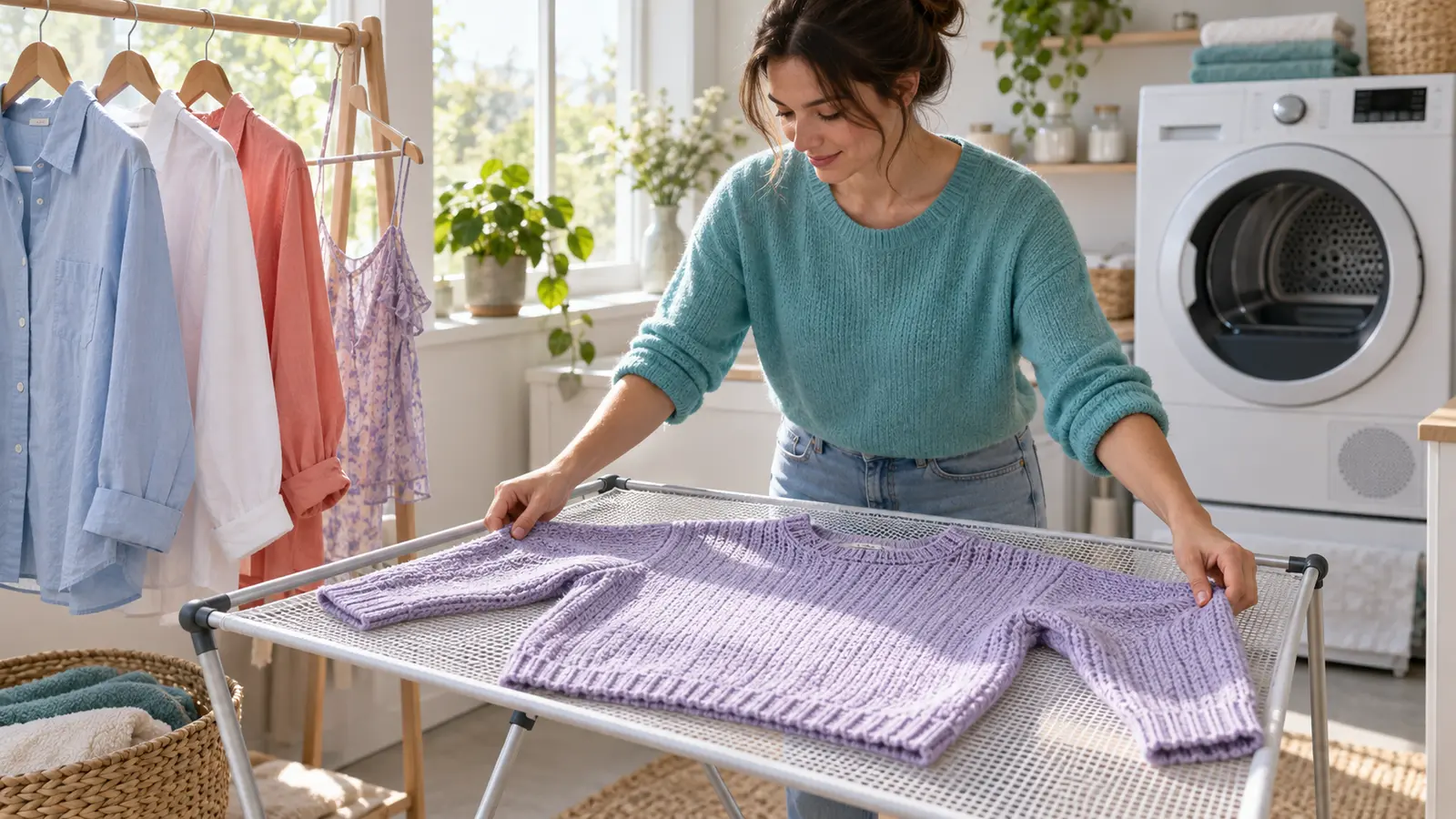
Shape matters while wet. A heavy knitted sweater can stretch on a hanger, which is why flat drying is common. A delicate garment may distort under strong spin or tumble action even at low heat. Smooth seams and return the item to its intended dimensions before drying when its instructions permit.
Tumble-dryer heat is only part of the effect. Time and mechanical action matter too. Remove suitable garments when dry rather than running an unnecessary extra cycle.
What do laundry care symbols mean for ironing?
The iron shape covers heat applied with a household iron. Dots indicate the permitted heat level; a crossed iron means do not iron. Some labels also distinguish whether steam is allowed.
Begin below the maximum and test an inconspicuous area. Dark fabrics can develop shine under pressure, prints can melt and synthetic fibres can deform quickly. Turn the garment inside out or use a clean pressing cloth when appropriate.
“Iron” and “steam” are not interchangeable. A garment may tolerate a low soleplate temperature but not steam, while another can be reshaped gently with moisture. Follow the complete symbol rather than assuming steam is always the mild option.
Do not iron directly over heat-sensitive decoration, reflective tape, coated fabric or care labels unless the maker explicitly permits it.
The circle is for professional textile care
A plain circle belongs to professional cleaning. Letters inside the circle tell a trained cleaner which solvent systems or wet-cleaning processes are allowed. Bars underneath call for milder handling. A crossed circle means do not use the professional treatment represented by that system.
The letters are not a home recipe. Do not buy a chemical and imitate a dry-cleaning process in a kitchen or bathroom. Professional cleaners control solvent, moisture, agitation, temperature and recovery with specialised equipment.
Show the full garment and label to the cleaner, especially when it has stains, glued construction, leather trim, beads or several fabrics. Point out the stain and what caused it if known; rubbing it first may set the mark or remove dye.
Maximum safe treatment does not mean required treatment
If a tub says 40°C, the label sets a ceiling under its standard; it does not order you to wash at 40°C every time. A lower-temperature programme may reduce energy and colour loss when it still meets the hygiene and cleaning need.
There are exceptions. Illness, workplace contamination, reusable hygiene products and healthcare textiles may require validated procedures that go beyond an ordinary clothing habit. If a care limit conflicts with a necessary disinfection process, the item may not be suitable for that use.
Similarly, “tumble dry permitted” does not make tumbling compulsory. Air drying can be gentler and use less energy if the garment’s natural-drying needs, weather and indoor moisture are managed safely.
SOAKJAM’s guide to reducing your carbon footprint honestly explains why useful environmental choices consider frequency, equipment, product life and local energy rather than relying on one slogan.
Why labels can look different between countries
ISO 3758:2023 defines an international care-labelling system, and GINETEX owns protected care-symbol trademarks used in many countries. The United States also regulates care instructions through the Federal Trade Commission’s Care Labeling Rule and permits specified symbols.
Not every market uses an identical chart, temperature convention or legal requirement. Older garments may follow an earlier standard. Imported clothing can combine symbols with written instructions. A machine manual may describe programmes using regional names.
Use the words on the same label when they clarify a symbol, and consult an official chart for the country or standard involved. Do not rely on a social-media graphic that omits the edition, region or natural-drying marks.
How to read a real care label
Read the row as a complete care plan. For example, a label might communicate:
- wash at or below the printed temperature using a mild process;
- use only non-chlorine bleach if needed;
- do not tumble dry, but dry flat in shade;
- iron at a low heat; and
- do not dry clean.
Do not turn that example into a template for a different garment. A crossed tumble symbol paired with no visible natural-drying symbol requires a cautious choice informed by fibre, construction and official guidance.
If the label is cut out, photograph it before removal next time. For an unlabeled item, use fibre content, colourfastness and construction to choose a conservative test—but recognise that a home guess cannot recover finishes and components you cannot see.
When a label has faded, check whether the maker still publishes care information for the exact product code. A similar-looking garment is not enough: a later version may use another lining, coating or dye. Keep purchase records for expensive outerwear, formal clothing and technical garments because a cleaner may need the original material details.
If no verified instruction survives, avoid treating “gentle” as “risk free.” Water can affect interfacing and glue; spot cleaning can leave rings; steam can distort a bonded layer. Test only a hidden area, stop if colour transfers or texture changes, and use a reputable textile-care professional when replacement would be costly.
A practical laundry routine
- Read before buying. A beautiful item that requires unavailable professional care may not suit daily use.
- Check every label before the first wash. New dyes and finishes can behave differently from familiar clothes.
- Sort by instruction as well as colour. Separate very mild cycles, lint producers, heavy items and anything that can bleed.
- Empty pockets and close fasteners. Secure hooks, turn decorated garments inside out and use a mesh bag where appropriate.
- Choose the least severe effective process. Stay within temperature, action and drying limits.
- Measure detergent for load and water conditions. More is not automatically cleaner and can leave residue.
- Reshape and dry correctly. Support knits, keep shade-required items out of direct sun and allow airflow.
- Recheck before heat. A stain can set in a dryer or under an iron; treat it safely before applying heat.
Common care-label mistakes
- Treating 30°C as a cycle name: it is a maximum temperature; bars define mechanical severity.
- Reading the square as “dryer” in every case: a circle inside the square means tumble drying; other lines describe natural drying.
- Assuming a triangle means dry cleaning: the triangle is bleach; the circle is professional care.
- Thinking one dot means one minute: dots indicate heat level, not time.
- Ignoring small components: lining, trim, glue and print can determine the safest limit.
- Using a lower setting but a harsher action: cool water does not make a normal cycle equivalent to a very mild one.
- Cutting the label before saving it: photograph both care and fibre information if the label is uncomfortable.
Frequently asked questions
Does a wash temperature mean exactly that temperature?
No. In the international system, the number is the maximum permitted temperature. Choose a lower setting only when it will still clean the item appropriately.
What do two lines under a wash symbol mean?
They call for a very mild process with substantially reduced mechanical treatment. Use a compatible programme and loading method described by the appliance maker.
Is “no tumble dry” the same as “dry flat”?
No. The first prohibits tumble drying. Flat drying is a separate natural-drying instruction. Do not infer the second solely from the first.
Can I use oxygen bleach on a crossed triangle?
No. A crossed triangle means do not bleach. Two diagonal lines inside an uncrossed triangle are the mark that permits oxygen or non-chlorine bleach.
What do letters inside a circle mean?
They specify professional cleaning processes and solvents. They are instructions for the cleaner, not directions for home chemical use.
What if the written instruction disagrees with a symbol?
Pause before washing. Check the manufacturer’s official support or retailer and keep a photo of the label. Do not choose the harsher interpretation while the conflict is unresolved.
What do laundry care symbols mean? Five shapes, one care plan
What do laundry care symbols mean? They set a sequence of treatment limits: wash, bleach, dry, iron and professional care. The main shape identifies the stage; numbers, dots, bars, lines and crosses refine what is safe.
The label works best when read as a whole. Washing gently cannot undo damage from forbidden tumble drying, and low heat cannot make an unsuitable bleach safe. Fibre, dye, trim and construction all meet in one row of instructions.
Learn the five family shapes, pause at every cross and follow the gentleness modifiers. That small habit protects colour, fit, texture and the useful life of the clothes you already own.
Sources and further reading
- International Organization for Standardization — ISO 3758:2023, Textiles — Care labelling code using symbols
- GINETEX — Care Labelling Symbols
- GINETEX — Care Symbols
- GINETEX — Our mission and objectives
- US Federal Trade Commission — Clothes Captioning: Complying with the Care Labeling Rule
- US Federal Trade Commission — Care Labeling Rule, 16 CFR Part 423
Editorially reviewed
Editorial information
SOAKJAM articles are designed for clarity, useful context and transparent sourcing. Important facts should be checked against the linked primary sources.
Found an error, outdated detail or a useful source we should consider?